


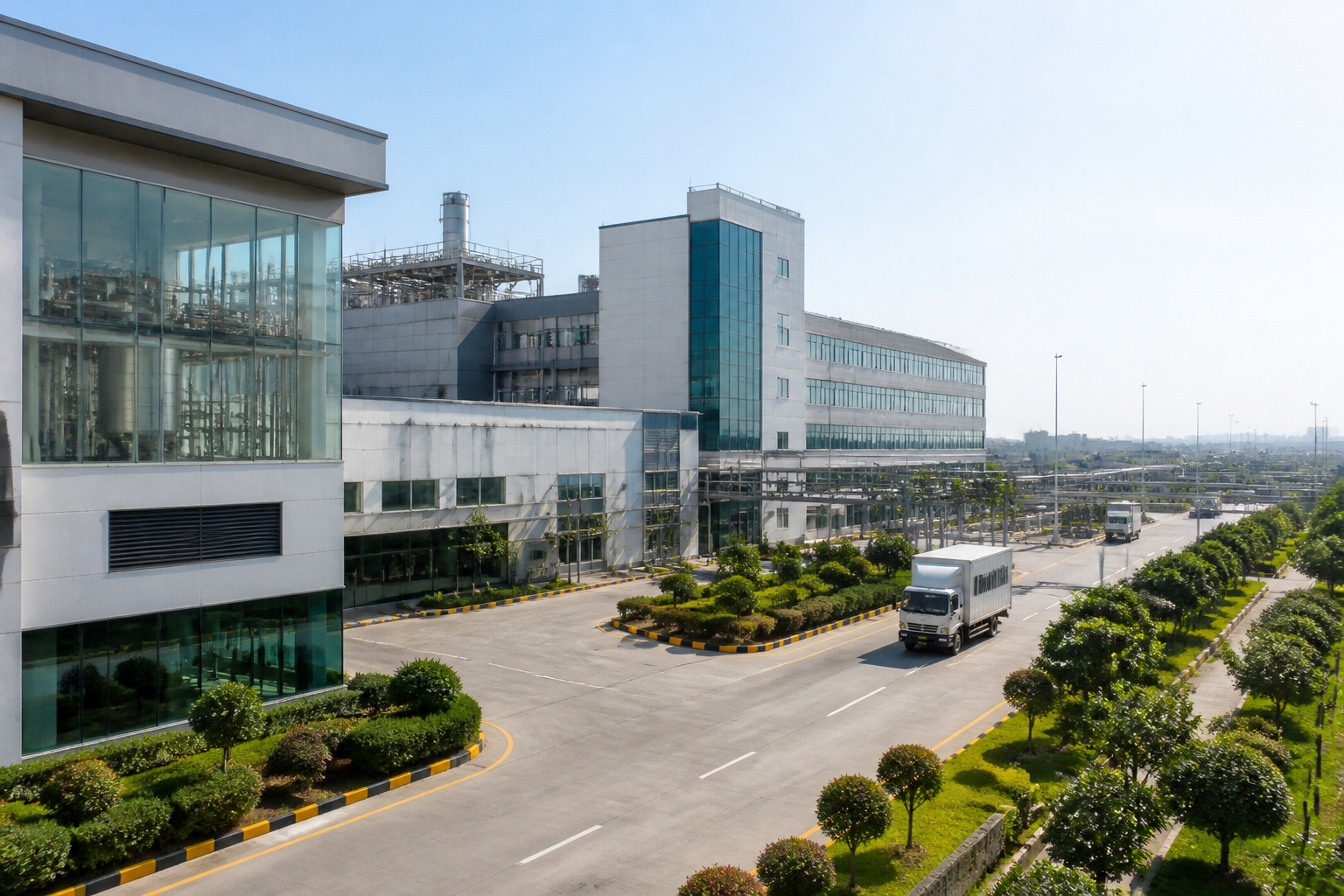
Granules India’s plan to invest about ₹2,000 crore over the next three to four years is more than a corporate expansion announcement. It signals a shift in the business model of one of Hyderabad’s established pharmaceutical companies—from high-volume generic medicines towards complex generics, oncology products, peptide contract development and manufacturing, and technology-enabled production. For the city’s industrial economy, the proposed investment points to the continuing importance of specialised manufacturing capacity, research infrastructure and global market access.
The company’s capital expenditure will be directed towards complex generics, oncology, peptide CDMO, United States operations, manufacturing capacity, research and development infrastructure, digitalisation, artificial intelligence-led manufacturing excellence and quality systems, according to chief financial officer Mukesh Surana. The plan was discussed at an investor webinar, the transcript of which was submitted to the stock exchanges, and reported by Times of India – Hyderabad.
The timing is important for understanding the announcement. Granules said it returned to growth in FY26 after nearly three years of flat performance. Chairman and managing director Krishna Prasad Chigurupati described the company as entering a new growth cycle, while also making clear that its existing vertically integrated business would remain the cash-generating base for the next phase of expansion.
That combination—protecting the established base while adding higher-value businesses—is central to the strategy. Granules is not presenting the investment as a replacement of its current manufacturing system. Instead, it plans to use the cash-generating strength of its existing operations to finance a more selective product pipeline and additional capabilities.
The shift can be seen in the changing contribution of complex generics. Executive director Priyanka Chigurupati said complex generics increased from 1% of revenue in FY20 to 33% in FY26. They accounted for about 45–50% of finished dosage revenue in FY26. The numbers indicate that the company’s product mix has already begun to move away from a predominantly volume-led model, although the supplied material does not provide the corresponding revenue values or a breakdown of profitability by business line.
That distinction matters. A change in revenue mix does not by itself establish how much additional employment, investment or profit each segment will generate. It does, however, show where the company believes its future growth is likely to come from. Complex generics generally require more specialised development and manufacturing capabilities than standard products, and Granules’ stated strategy is built around that difference.
The company has also identified a pipeline of first-to-file opportunities in the United States. It has filed two sole first-to-file abbreviated new drug applications for generic Lumryz and generic Dyanavel. Granules said the products have a combined US market size of more than $350 million and could offer 180-day exclusivity. It also has an oncology first-to-file candidate and four to five additional first-to-file opportunities expected to commercialise between FY30 and FY34.
These plans place regulatory and technical capability at the centre of the investment story. The value of a first-to-file product depends not only on filing an application but also on development, regulatory clearance, manufacturing readiness and commercial execution. The company’s stated capital expenditure on research infrastructure, quality systems and manufacturing capacity therefore appears designed to support the entire chain rather than only expand physical output.
The strategy also shows how closely Hyderabad’s pharmaceutical industry is connected to international markets. The United States contributes about 75% of Granules’ revenue and will remain its anchor market. This concentration gives the company scale in a major market, but it also makes the business strongly dependent on US demand, regulatory conditions and the company’s ability to maintain supply and compliance there. The plan to enter specialty and institutional channels from FY29 is presented as one way of expanding beyond the company’s existing market approach.
Granules is also seeking greater geographic diversification. It plans to launch a business-to-consumer division in Canada next year and build a stronger presence in Latin America and other international markets by FY30. The company’s stated direction is therefore twofold: increase the value and complexity of products, while also widening the channels and geographies through which they are sold.
The controlled-substances business forms another part of this expansion. Granules said it had become the third-largest US manufacturer by value, up from eighth in July 2025. It plans to build on its attention-deficit/hyperactivity-disorder franchise and expand into pain management, supported by its US manufacturing base and Drug Enforcement Administration quota track record.
This part of the plan highlights the institutional infrastructure behind pharmaceutical production. Manufacturing controlled substances is not simply a matter of adding factory space. The company’s reference to its US manufacturing base and DEA quota record indicates the importance of regulatory permissions, production controls and established compliance systems. The supplied report does not provide details of the proposed capacity additions or the investment split across these businesses, so the operational scale of the expansion remains to be established.
The peptide CDMO platform, built around Senn Chemicals, is the most clearly defined new growth platform in the company’s announcement. Granules expects the business to become profitable in FY27, reach an annual revenue run rate of $50 million in three years and exceed $100 million within five years. CDMO operations can make a company part of another pharmaceutical firm’s development and manufacturing chain, rather than limiting it to the sale of its own finished products.
For Hyderabad, the significance lies in the kind of industrial ecosystem this model requires. The investment is directed not only towards conventional production capacity but also towards research and development, quality systems, digitalisation, artificial intelligence-led manufacturing and specialised product development. Those priorities point to a more technology-intensive form of pharmaceutical manufacturing, in which the factory is linked to data systems, regulatory processes and global client requirements.
The company’s four identified growth engines—controlled substances, complex generics and early-market opportunities, oncology, and peptide CDMO—also suggest a deliberate attempt to reduce dependence on a single product category. Yet diversification does not remove execution risk. Each segment has different technical, regulatory and commercial requirements, and the company has not, in the supplied material, disclosed a detailed annual investment schedule or segment-wise capital allocation.
The proposed capex therefore needs to be read as a multi-year industrial programme rather than an immediate capacity announcement. Its impact will depend on when the investments are deployed, how quickly the new facilities or systems become operational, and whether the identified products and platforms meet their stated commercial milestones. The company’s own timeline places several first-to-file commercialisations between FY30 and FY34, while its peptide CDMO targets extend over three and five years.
This long horizon also changes the way the announcement should be understood within Hyderabad’s urban economy. Large pharmaceutical companies create demand for industrial land, specialised facilities, research infrastructure, logistics and skilled labour, but the supplied report does not quantify the number of jobs or the physical footprint of the proposed expansion. It would therefore be premature to translate the ₹2,000 crore figure directly into a forecast of local employment or construction activity.
What the announcement does establish is the company’s stated intention to deepen its manufacturing and research base. It also confirms that Hyderabad-linked pharmaceutical growth is increasingly being described through higher-value capabilities: complex products, oncology, peptides, digital systems and global market access. The transition is not presented as a departure from manufacturing, but as an attempt to make manufacturing more specialised and commercially differentiated.
The institutional question for the next phase is whether the proposed investment converts strategy into operating capacity. The relevant milestones include the deployment of the organic capex, progress in complex generics and oncology, the commercial performance of the first-to-file pipeline, profitability of the peptide CDMO platform, and the planned expansion into specialty, institutional, Canadian and Latin American channels.
Granules’ announcement confirms a substantial investment ambition and a clear change in product strategy. It does not yet establish the final allocation of funds, the exact locations or timelines of individual facilities, or the resulting employment and urban-infrastructure requirements. Those details will determine whether the plan becomes a broader industrial expansion for Hyderabad or remains primarily a corporate portfolio transition.
