


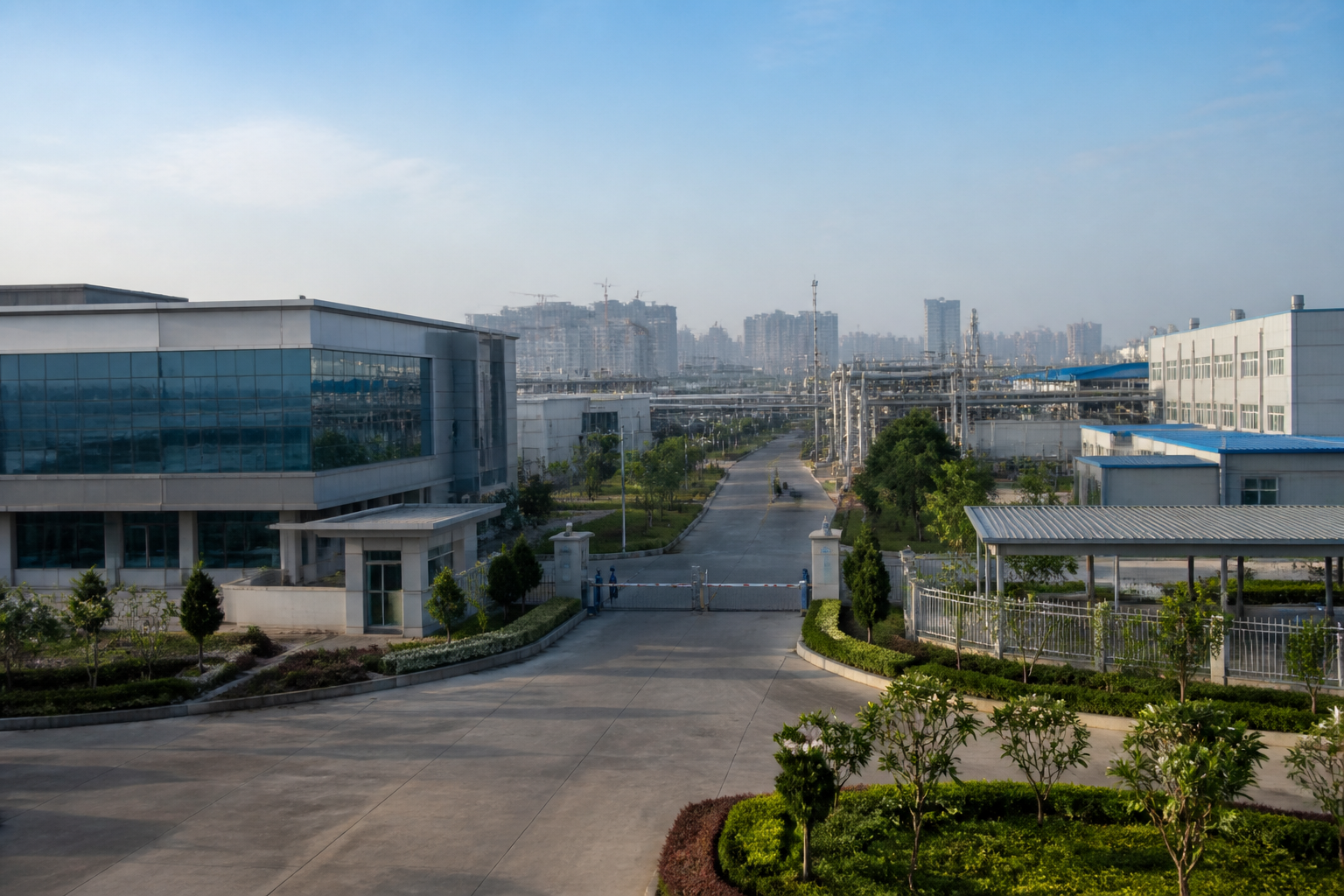
Granules India’s plan to invest about ₹2,000 crore over the next three to four years offers a window into how Hyderabad’s pharmaceutical economy is trying to move beyond scale-driven generic manufacturing. The company says the capital will support complex generics, oncology, peptide contract development and manufacturing, US operations, manufacturing capacity, research and development infrastructure, digitalisation, artificial intelligence-led manufacturing excellence and quality systems.
The announcement is significant not because it represents another large corporate capital-expenditure number, but because it describes a change in the physical and institutional requirements of pharmaceutical growth. A conventional volume-led manufacturing model depends heavily on production capacity and cost efficiency. The model Granules India has outlined requires more specialised facilities, stronger quality systems, deeper research capabilities, regulatory readiness and digitally managed operations.
That distinction matters for a city such as Hyderabad, where pharmaceuticals form a major part of the industrial economy. However, the report supplied by Times of India – Hyderabad does not identify the location of individual projects under the investment plan. It also does not state how much of the ₹2,000 crore will be spent in Hyderabad, how many jobs may be created, or whether new plants, laboratories or warehouses will be built in the city. The urban significance of the announcement therefore lies in the direction of industrial development, rather than in a confirmed new facility or immediate civic impact.
Granules India chairperson and managing director Krishna Prasad Chigurupati said the company had returned to growth in FY26 after nearly three years of flat performance and was entering a new growth cycle. The company’s established vertically integrated business, he said, would remain the cash-generating base for expansion, while future growth would come from controlled substances, complex generics and early-market opportunities, oncology, and peptide CDMO.
This portfolio signals a move towards activities that require more specialised infrastructure than standardised production alone. Complex generics can involve difficult-to-manufacture formulations and more demanding development processes. Oncology manufacturing requires stringent quality controls and a specialised production environment. Peptide contract development and manufacturing adds another layer of technical capability because the company would be serving development and manufacturing requirements for other pharmaceutical businesses.
The report does not provide a detailed project-by-project breakdown of the investment. It does, however, identify the areas where Granules India expects to deploy organic capital expenditure: product development, manufacturing capacity, US operations, R&D infrastructure, digital systems, artificial intelligence-led manufacturing excellence and quality systems. Taken together, these priorities show that the proposed expansion is not limited to adding factory space. It also involves building the systems needed to develop, validate and commercialise more complex products.
For Hyderabad’s industrial ecosystem, this creates a more demanding infrastructure question. Pharmaceutical growth depends on land and buildings, but also on reliable utilities, controlled production environments, specialist technical workers, testing capabilities, logistics and regulatory compliance. The source material does not quantify the company’s requirements for power, water, waste treatment, transport or industrial land. It would therefore be premature to claim that the investment will automatically produce a new urban development corridor or resolve any local infrastructure constraint.
The clearest evidence of Granules India’s strategic shift comes from the changing composition of its revenue. Executive director Priyanka Chigurupati said complex generics had increased from 1% of revenue in FY20 to 33% in FY26. She added that the segment accounted for about 45% to 50% of finished-dosage revenue in FY26. These figures indicate that higher-value products have moved from a marginal component of the business to a substantial part of its finished-dosage activity.
The numbers also show why the company is directing capital towards differentiated products rather than relying only on expansion of established lines. A rise from 1% of revenue in FY20 to 33% in FY26 represents a significant change in business mix over six financial years. The report does not provide the company’s total revenue, absolute revenue from complex generics or the capital invested in achieving this shift. It nevertheless establishes that Granules India’s growth strategy is already being reflected in its reported product composition.
The company is also sharpening its first-to-file pipeline in the United States. It has filed two sole first-to-file abbreviated new drug applications, or ANDAs, for generic Lumryz and generic Dyanavel. Granules India said the two products together address a US market of more than $350 million and could offer 180-day exclusivity. The company also has an oncology first-to-file candidate and four to five further first-to-file opportunities expected to commercialise between FY30 and FY34, according to Priyanka Chigurupati.
These filings connect the investment plan to a market-access strategy. Pharmaceutical manufacturing infrastructure is valuable only when products can move through development, regulatory approval and commercial distribution. The emphasis on first-to-file products suggests that Granules India is seeking opportunities where development capability, timing and regulatory execution may matter as much as production scale.
At the same time, the figures should not be treated as guaranteed future revenue. The reported US market size is an estimate of the relevant market for the products, not a projection of Granules India’s sales. The potential 180-day exclusivity is also described as a possibility. Similarly, the expected commercialisation window of FY30 to FY34 is a company-stated expectation, not evidence that all identified products will reach the market within that period.
This distinction is important for assessing the urban and industrial implications of the investment. A pharmaceutical company can announce a large capital programme while the eventual pace and location of construction, hiring and production remain dependent on project approvals, product development, regulatory outcomes and commercial decisions. The supplied report does not provide details of land acquisition, environmental permissions, construction schedules, financing milestones or commissioning dates.
The policy landscape is also only partly visible in the announcement. Granules India’s plans touch several regulatory and administrative systems, including drug approvals, manufacturing quality standards, environmental compliance, industrial infrastructure and export operations. Yet the source does not identify any specific government incentive, state approval, industrial-park allocation or public funding connected to the ₹2,000 crore plan. The investment should therefore be understood as a corporate strategy announcement, not as an announced government-backed urban development project.
For Hyderabad, the larger question is whether pharmaceutical investment can deepen the city’s industrial capabilities without being measured only through headline capital expenditure. The company’s stated priorities point towards a more knowledge-intensive production model involving R&D infrastructure, digitalisation, artificial intelligence-led manufacturing and quality systems. Such a model can increase the importance of specialised labour, technical education, testing capacity and dependable industrial services, although the supplied material does not quantify the company’s staffing or infrastructure needs.
The announcement also highlights the difference between manufacturing expansion and urban expansion. A new plant may have a clear physical footprint, while investments in software, quality systems, product development or US operations may have a less visible relationship with the city. Without a location-wise capital allocation, it is not possible to determine how much of the proposed investment will translate into buildings, utilities, logistics demand or land-use change in Hyderabad.
What the evidence confirms is that Granules India is positioning itself for a higher-value phase of pharmaceutical growth. The company plans to invest about ₹2,000 crore over three to four years, has identified four future growth engines, and reports that complex generics rose to 33% of revenue in FY26 from 1% in FY20. It has also identified first-to-file opportunities in the US, including two sole filings with a combined market size of more than $350 million.
What remains uncertain is equally important: the city-wise allocation of the investment, the location and scale of new facilities, the associated employment impact, the infrastructure demands and the conversion of pipeline opportunities into approved commercial products. The next meaningful indicators will be Granules India’s project-level capex disclosures, facility announcements, regulatory milestones and evidence of how much of the planned expansion is physically anchored in Hyderabad.

