


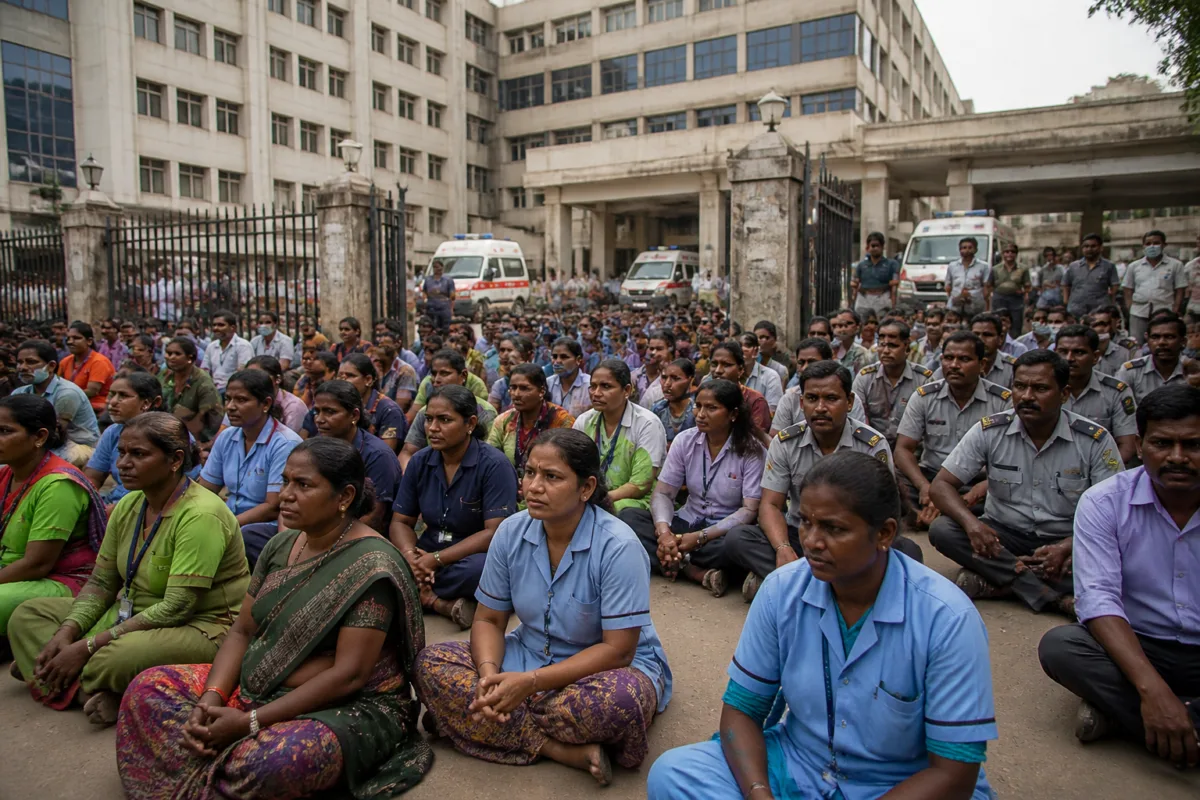
Contract healthcare workers across Telangana entered the second day of protests on Friday, demanding higher wages and statutory labour benefits while warning of a larger strike at teaching hospitals if the State government does not address their long-pending grievances.
Sanitation, patient care and security workers staged demonstrations at government hospitals across the districts. In Hyderabad, protests were reported at Gandhi Hospital, Osmania General Hospital, Niloufer Hospital, Fever Hospital, King Koti Hospital, Koti Maternity Hospital, Malakpet Area Hospital, Nampally Hospital and Sarojini Devi Eye Hospital.
The workers are seeking an increase in their minimum monthly wages to Rs 26,000. M Narasimha, a senior leader of the Telangana Medical Contract Employees and Workers Union, said contract workers had been appealing for the increase for the past two years but had not received a resolution from the State government.
“Contract employees have been working on meagre salaries for the past several years without even receiving new uniforms,” Narasimha said. He alleged that field-level healthcare workers were being denied statutory minimum wages, paid leave and bonuses.
The protest involves workers whose roles support the daily functioning of public hospitals. Sanitation staff help maintain hygiene in facilities, patient care workers assist with non-clinical support and security personnel manage access and safety around hospitals. Their demands therefore concern both employment conditions and the continuity of essential hospital operations.
The union warned that workers could launch a massive protest strike across all teaching hospitals if their demands remain unresolved. The report did not specify a date for the proposed strike or indicate whether the State government or health department had opened formal talks with the union.
The demonstrations were organised at major medical institutions and saw participation from union leaders and hospital contract workers. The protests also bring attention to the role of outsourced and contract labour in public healthcare delivery, where essential services are often performed by workers who are not part of the regular government establishment.
Further developments will depend on whether the State government responds to the workers’ wage and labour-benefit demands and whether the union proceeds with its proposed strike at teaching hospitals.

