


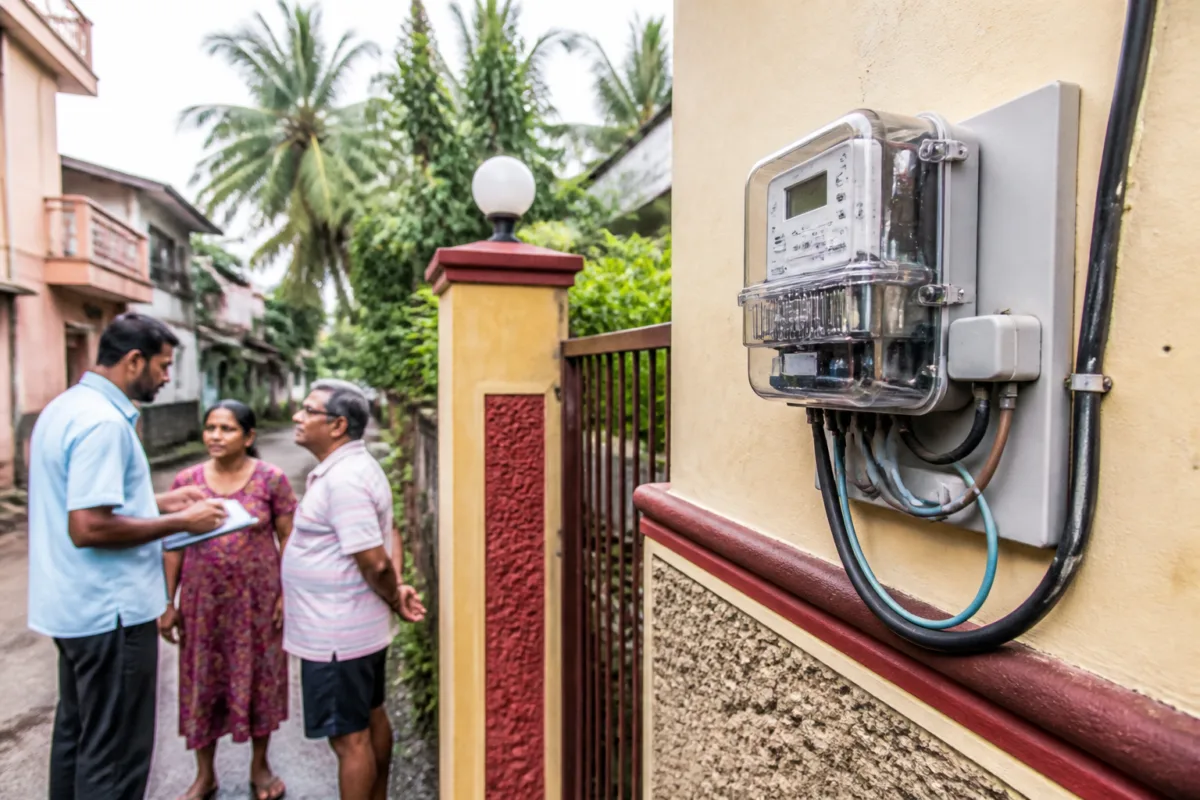
The Goa smart meter dispute has moved beyond a question of replacing electricity meters. It now centres on whether consumers received adequate information, whether the electricity department can shift postpaid users to prepaid connections without consent, and how public agencies should handle data, safety and cybersecurity concerns.
The latest challenge has come from the Smart Meter Naka Group, which said the Goa human rights commission’s inquiry report raises more questions than answers. The group was responding to a report in which the commission examined allegations of forced smart meter installation and found no human rights violation in the replacement of meters. The commission took up the matter suo motu after a newspaper report and proceeded against the chief electrical engineer.
That finding is important, but it does not settle every question surrounding the project. The group’s criticism rests partly on the distinction between a human-rights inquiry and a comprehensive review of smart meter policy. According to the group, the commission’s recommendations on issuing printed notices and improving consumer awareness indicate that communication and procedural safeguards were not sufficiently clear, even though the commission did not find a human rights violation.
This distinction matters because the replacement of an electricity meter is not only a technical operation. It can alter how consumers receive information, how consumption data is recorded and processed, and how electricity payments are made. When the group argues that consumers were not informed about personal data sharing, it is raising a governance question: what information is collected, who can access it, for what purpose and under what safeguards? The supplied report does not provide the department’s detailed response to each of these allegations, so those questions remain open.
The dispute also highlights the difference between awareness and consent. The group alleged that postpaid connections were switched to prepaid without consumer consent, citing arguments made by amicus curiae Abhijit Goswami. A prepaid system changes the immediate relationship between a household and the electricity provider. Instead of receiving a bill after consumption, the consumer must maintain an available balance to continue supply. The report does not establish the number of consumers affected or the precise terms under which any such switch took place, but it shows why the legal basis and communication process have become central to the controversy.
The group said the electricity department relied on Section 47(5) of the Electricity Act, 2003, and demanded clarification on how that provision supports compulsory prepayment. The report does not reproduce the department’s legal interpretation or establish whether the provision has been tested in court in relation to the specific Goa rollout. That makes the question of statutory authority a live issue rather than a settled conclusion.
Safety evidence is another unresolved part of the debate. Citing an RTI reply, the Smart Meter Naka Group said the department admitted that it did not have safety data on radiation and health effects. The group has therefore demanded that all safety reports be made public before any rollout. The report does not state that smart meters have been shown to cause harm. Instead, it records a demand for disclosure of evidence that the group says should precede wider implementation. The distinction is crucial: an absence of publicly available information is not proof of danger, but it can weaken public confidence in a technology being introduced through a public utility.
The same logic applies to cybersecurity. Smart meters generate and transmit consumption information, making questions about data handling and system protection part of the project’s public-interest dimension. The supplied report records the group’s concerns about cybersecurity risks but does not identify a breach, attack or specific vulnerability. What it does establish is that the project is being contested not simply on installation, but on the institutional systems that must accompany digital utility infrastructure.
The human-rights commission’s role is also at the centre of the disagreement. The group said the inquiry was limited to human rights and not intended to function as a full smart meter policy review. It criticised the commission’s recommendation that the department proceed with installations as exceeding the commission’s legal capacity. This is an institutional question about the boundaries of oversight. A commission may examine whether rights were violated, while a department remains responsible for establishing technical standards, consumer procedures, data governance and the legal basis for billing changes. The report does not provide the full inquiry order, so the exact scope and wording of the commission’s recommendation cannot be assessed from the supplied material alone.
The controversy therefore involves several layers of public administration. The electricity department is responsible for implementing the meter replacement programme and responding to consumer concerns. The chief electrical engineer became the respondent in the human-rights proceedings. The commission examined the allegations within its own remit. An amicus curiae assisted the inquiry, while the activist group is pressing for disclosure and considering further legal action. Each institution has a different role, but the dispute shows how unclear communication can cause those roles to overlap in the public debate.
For consumers, the practical issue is not only whether a new device is installed on a wall. It is whether they are given usable information before the change, whether payment conditions are clearly explained, whether there is a transparent process for raising objections, and whether safety and data-protection material is publicly accessible. The commission’s recommendations on printed notices and consumer awareness, as described in the report, point to the importance of these basic administrative safeguards.
The case also illustrates why infrastructure modernisation cannot be separated from service quality. The Smart Meter Naka Group said the government should first address power cuts and service deficiencies, while also questioning the project’s legal and technical foundations. The report does not provide data on outages or service performance, so it cannot establish whether those deficiencies are widespread or how they compare across Goa. But the demand reflects a broader public expectation: digital infrastructure should not be presented as a substitute for reliable core service.
The available evidence confirms that the Goa smart meter programme faces a trust deficit among at least one organised consumer group. It also confirms that the inquiry found no human rights violation in meter replacement, while recommending steps related to notices and awareness. What remains unsettled in the supplied material is the legal basis for compulsory prepayment, the department’s detailed position on data sharing, the availability of safety evidence, and the precise scope of the commission’s authority to recommend continued installation.
The next stage will depend on whether the government and electricity department publish the relevant safety, data-handling and legal information, and how they respond to the group’s stated intention to explore legal remedies and seek scrapping of the project. Until those details are available, the smart meter dispute remains as much a test of public-utility transparency as of the technology itself.

