


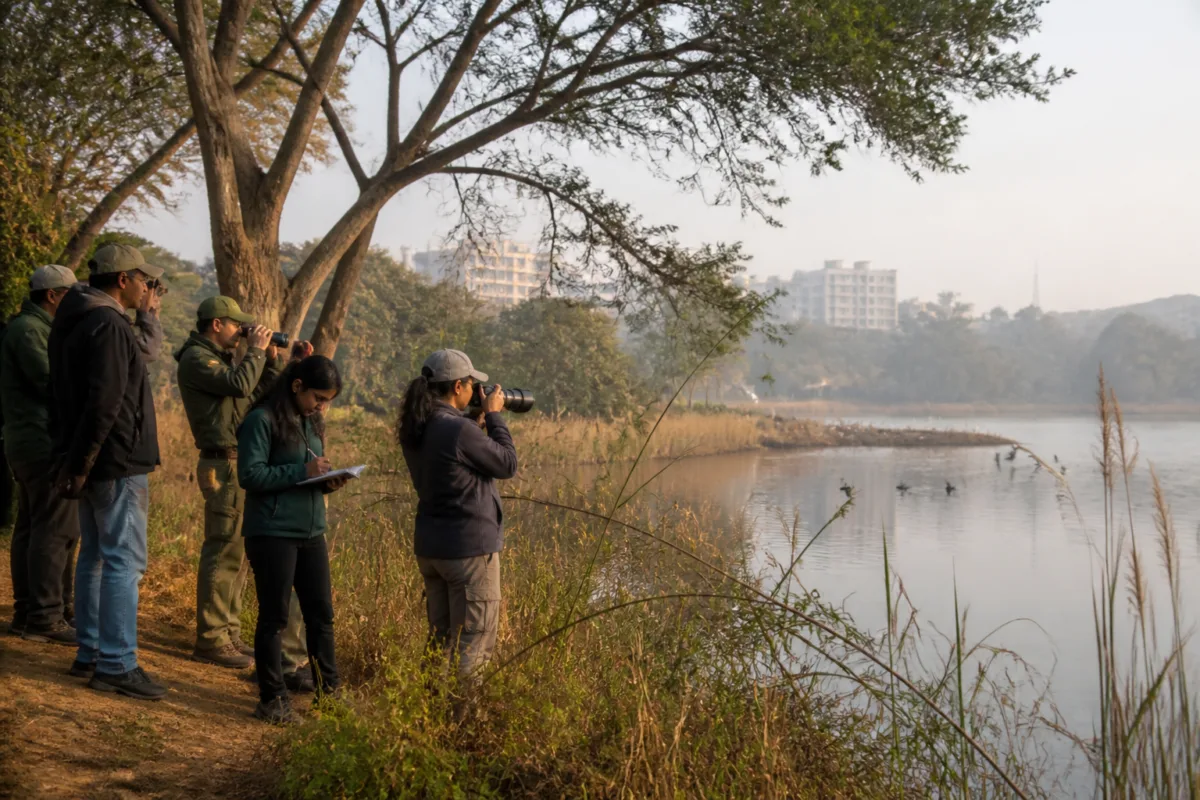
A new monthly bird census at Chandigarh’s Sukhna Wildlife Sanctuary is intended to turn ecological observation into a recurring input for decisions about habitat protection and development around the city’s protected landscape. The Chandigarh forest and wildlife department will conduct the study with support from the Wildlife Institute of India (WII), tracking bird diversity, habitat use and possible changes linked to human activity.
The announcement is significant because it places regular ecological measurement alongside the pressures of urban growth. Rather than relying only on an occasional wildlife count, the proposed survey is designed to build a continuing record of where birds are found, which areas they use and whether those patterns change over time. Officials said the resulting data could provide a scientific foundation for future land-use and development decisions surrounding the sanctuary.
That connection between a wildlife census and land-use decisions is the central urban issue. Sukhna Wildlife Sanctuary is not being treated only as an isolated conservation site. Its condition is also being examined in relation to activity around it, including the possibility that changes in noise, movement or habitat conditions may alter how birds use the sanctuary and nearby water bodies. The survey therefore creates a mechanism through which ecological observations can enter the administrative process before development decisions are made.
The source report does not establish that any specific project has caused a decline in bird populations or that a particular development proposal is under review. It records an official concern that urban growth and human activity might affect migratory patterns and could push birds towards quieter water bodies nearby. Monthly monitoring is intended to determine whether such shifts are actually occurring, particularly ahead of the winter migration season.
This distinction between concern and evidence matters. Urban expansion is often discussed in broad terms, but its effects on a protected landscape can be difficult to assess without repeated, location-specific information. A single count may indicate which species are present at one point in time. A monthly series can potentially show whether a species is using the same area, whether activity is concentrated near certain water bodies, or whether vulnerable zones are experiencing changes in bird presence. The proposed survey is meant to identify those patterns rather than assume them.
The project also offers a clearer division of institutional responsibilities. The Chandigarh forest and wildlife department will lead the local effort, while WII experts will provide training in scientific monitoring techniques. The collaboration brings together the department’s administrative role and field presence with WII’s technical expertise in survey methods. The source does not specify the final reporting format, publication schedule or decision-making protocol for the data, but it makes clear that the survey is intended to support conservation strategy.
The methods described are important because they can make observations more consistent across months and among different survey teams. WII training will cover line-transect and point-count methods, bird identification through plumage, flight patterns and calls, and the use of optical equipment and digital applications to record observations and coordinates. These techniques are intended to give field observations a common structure, allowing officials and volunteers to record not only what they see but also where and how it was observed.
The involvement of local residents adds a civic dimension to the programme. Residents will be invited to participate as volunteers and work alongside departmental teams during the counts. Their participation could expand the number of people observing the sanctuary while also creating a direct channel between the protected area and the surrounding community. At the same time, the source makes clear that volunteers will receive training and operate with departmental teams, rather than replacing the responsible authority.
For a city, that arrangement matters because conservation is not managed only through boundaries on a map. The way people move around a sanctuary, use nearby public areas and interact with water bodies can influence the conditions experienced by wildlife. A volunteer-based monitoring programme cannot by itself resolve those pressures, but it can make local observations part of an organised administrative record. Its usefulness will depend on whether the observations remain consistent and whether the department uses the findings in future conservation and land-use processes.
The previous census provides an initial reference point. A wildlife census conducted by the department last year recorded more than 132 bird species within the sanctuary. That number establishes the scale of the sanctuary’s documented avian diversity, but it does not by itself show whether populations are increasing, declining or changing location. Nor does it explain how many birds were recorded in each habitat or during each season. The planned monthly counts are intended to add that time and location-based detail.
This is where the difference between a census and monitoring becomes important. A periodic census can provide a snapshot, while recurring surveys can help identify movement and changes in habitat use. The source report does not provide a baseline for individual species, population estimates or the number of survey locations. It also does not state how long the monthly programme will continue. Those details will determine how far the resulting data can support comparisons and long-term decisions.
The timing before winter migration gives the programme an immediate operational purpose. Officials want to establish whether shifts in bird presence are occurring before the migration season. This does not mean that a change has already been confirmed. It means that the department is seeking an evidence base against which seasonal movement can be assessed. Regular counts may help separate normal seasonal variation from changes that require closer examination, although the source does not set out the threshold that would trigger administrative action.
The proposed process also shows how ecological information can become part of urban governance. The department has linked the survey to conservation strategies and to future decisions concerning land use and development around the sanctuary. That link raises a practical question: whether environmental data will be collected only as a record, or whether it will be incorporated into approvals, management plans and restrictions where necessary. The supplied report does not answer that question, but it establishes the intended direction of travel.
The programme’s value will therefore lie not simply in producing a higher species count. Its stronger purpose is to create a regular evidence trail about habitat use and human impact. To be useful for planning, that trail would need to preserve comparable observations over time, identify locations accurately and distinguish between different causes of change. The source confirms that coordinates and observation details will be recorded, but it does not provide the framework for interpreting those records or publishing them.
There is also a structural challenge in asking one monitoring exercise to serve both conservation and development decisions. Ecological data can identify where changes are occurring, but administrative decisions require the responsible authorities to act on that information. The department’s stated intention to use the findings for conservation strategies and future land-use decisions is important because it gives the survey a policy purpose. Whether that purpose is realised will depend on the next steps, including the programme’s duration, the treatment of its findings and the transparency of its results.
For Chandigarh’s urban system, the monthly bird census is thus a small but potentially consequential administrative experiment. It brings scientific field methods, citizen participation and development-related decision-making into one programme around Sukhna Wildlife Sanctuary. The evidence available so far confirms the launch of a monitoring effort, not a proven decline in bird populations or a settled impact from urbanisation. The developments to watch are the start of the counts, the publication of comparable monthly observations and whether the resulting data enters formal conservation and land-use decisions.

