


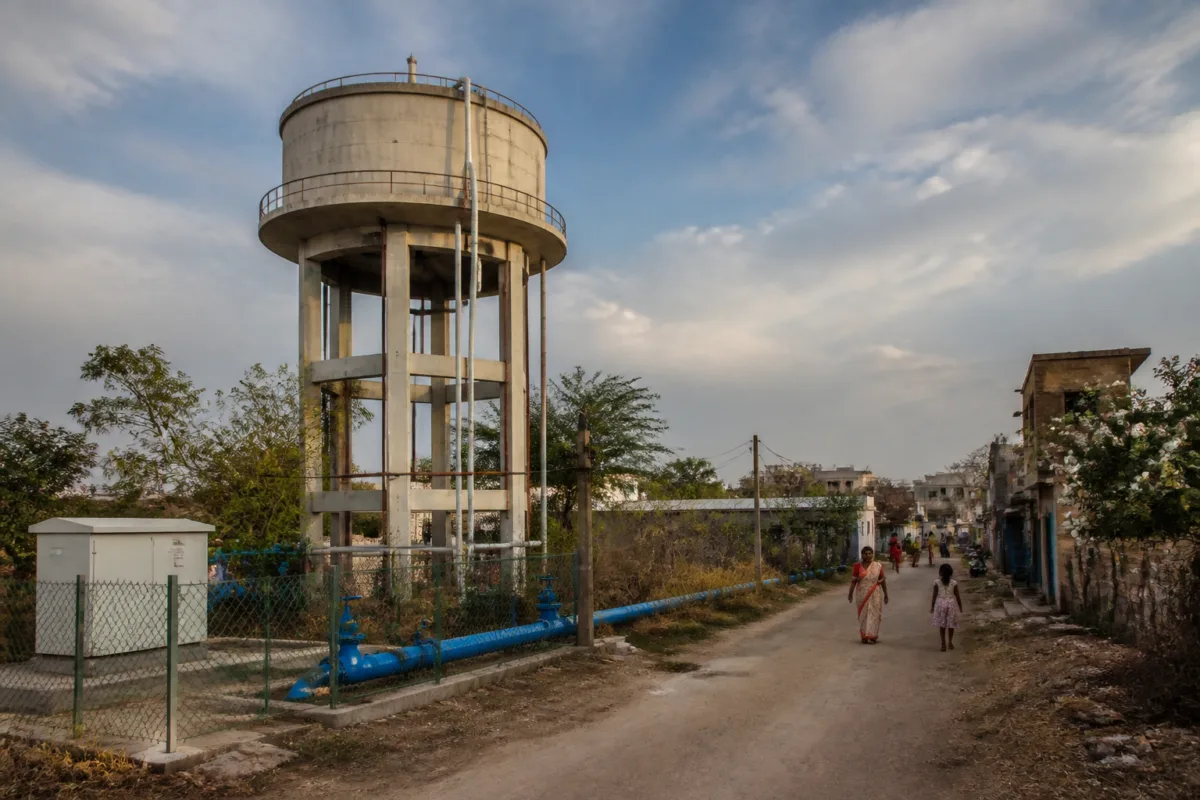
Nagpur’s bulk water supply plan for 12 peri-urban villages is more than a change in billing and distribution. Approved by the Maharashtra Jeevan Pradhikaran (MJP) board, the arrangement shifts the system from direct retail supply by MJP to bulk delivery at elevated storage tanks operated by municipal councils and gram panchayats. The stated objective is to reduce costs for nearly one lakh residents living outside Nagpur Municipal Corporation limits, while introducing tighter measurement and monitoring of the water entering each local distribution network.
The decision brings into focus a recurring problem in expanding cities: urban residents may depend on the same regional water infrastructure but face different administrative systems and prices depending on which boundary they live beyond. In this case, the complaints pursued by Revenue Minister Chandrashekhar Bawankule concerned differences between water supply charges within Nagpur city and those in surrounding peri-urban areas. The MJP approval addresses that disparity through a revised institutional model rather than by extending municipal distribution directly to all the villages.
The arrangement places MJP upstream and local governments downstream. MJP will supply treated water to elevated storage tanks operated by the respective municipal councils and gram panchayats. Those local bodies will then distribute the water to households through their own pipeline networks. This makes the storage tank the operational handover point between the state-level water agency and the local authorities responsible for last-mile delivery.
That distinction matters because bulk supply and household distribution involve different responsibilities. Under the approved framework, local bodies will have to sign formal agreements with MJP before accessing the arrangement. They must also pay current and outstanding water charges regularly. The report does not specify the revised tariff, the amount of arrears owed by each local body, or the exact reduction households can expect. The affordability objective is therefore clear, but the final financial impact on residents will depend on the agreements, local distribution costs and the way charges are passed on to households.
The current model is intended to replace an earlier arrangement in which MJP provided direct retail supply to residents outside the municipal limits. According to Bawankule, this system imposed a financial burden on peri-urban residents when compared with the arrangement inside Nagpur city. He said that providing clean water at equal and affordable rates to residents in the surrounding areas was a priority and described the board approval as major relief for the 12 villages.
The institutional issue is not simply whether water reaches the villages. It is also who measures the volume supplied, who pays the upstream agency, who maintains the local network and who is accountable when supply is irregular. The new model assigns a clearer physical transfer point, but it also creates a chain of obligations that must work together. MJP has to supply water to the tanks, local bodies have to maintain distribution systems and payments have to remain current for the bulk arrangement to function as intended.
The decision’s technology component is designed to make that chain more measurable. Internet of Things-enabled smart flow meters will be mandatory at each storage tank to record the quantity of water supplied. An automation system is also envisaged. These measures could give MJP and local authorities a common record of bulk deliveries, reducing the scope for disputes over volumes and charges. However, the supplied report does not establish the technology vendor, installation timeline, operating protocol or agency responsible for maintaining the meters.
The proposed monitoring system also reflects a practical challenge in multi-agency water supply. When a village receives less water than expected, the cause may lie in bulk availability, tank operations, pumping, electricity supply, leakage or the local pipeline network. A flow meter at the storage tank cannot by itself resolve every distribution problem, but it can establish how much water entered the local system. That makes it a potentially important administrative tool, provided the readings are accessible, regularly audited and connected to decisions about supply and billing.
Energy costs form the other major part of the approved framework. The MJP board has decided to consider a solar power project under the public-private partnership model to reduce electricity expenses and support uninterrupted supply. The wording is significant: the solar project is under consideration, not an operational commitment with a declared capacity, site, investor or commissioning date. Its eventual relevance will depend on whether it can reliably support pumping and storage operations and whether the partnership structure is financially workable for the participating local bodies.
For the 12 villages, the immediate question is how the revised structure will translate into household service. The report establishes that nearly one lakh people are expected to benefit and that the objective is lower-cost supply. It does not provide village-wise population figures, current service frequency, household connection numbers, existing pipeline conditions or the present level of water shortages. Those gaps matter because a lower bulk price will not automatically produce reliable household supply if local networks have limited capacity or require substantial repairs.
The plan therefore links affordability to local administrative capacity. Municipal councils and gram panchayats will control the final stage of distribution, but they will also carry the responsibility of signing agreements and clearing current and outstanding bills. This is a different balance from direct retail supply by MJP. It may give local authorities a more defined role in managing their water systems, while also making their financial discipline central to continued access to bulk water.
Nagpur’s peri-urban expansion makes that boundary question increasingly important. Villages on the outskirts can be functionally connected to the city through commuting, housing growth and shared infrastructure while remaining outside the municipal corporation’s administrative limits. Water systems, however, do not necessarily follow those social and economic connections. The approved model recognises that the surrounding settlements require a coordinated supply arrangement, but it stops short of merging their distribution systems with Nagpur city’s network.
The decision also shows why regional water governance cannot be judged only by the construction of a source or treatment plant. Delivery depends on contracts, storage, pumping, metering, energy, payment collection and local distribution. Each layer has a different institution attached to it. If any one of these links is weak, residents experience the failure as a water shortage or a high bill, even when the upstream system has sufficient capacity.
What the MJP approval confirms is a new framework for supplying water in bulk to the elevated storage tanks serving 12 peri-urban villages. It also establishes mandatory smart flow measurement, requires formal agreements and regular payment of dues, and opens the possibility of a solar power project under a public-private partnership. What remains unclear from the available information is the revised tariff, the implementation schedule, the status of each local body’s pipeline network and the terms of any future solar project.
The next stage will determine whether the arrangement produces the equal and affordable service promised by the state government. The formal agreements between MJP and the participating local bodies, the installation of tank-level meters and the treatment of outstanding water charges will provide the first evidence of how the bulk supply model works in practice. For Nagpur’s peri-urban residents, the outcome will depend not only on the board’s approval but on whether the new division of responsibility delivers reliable water beyond the city boundary.

