


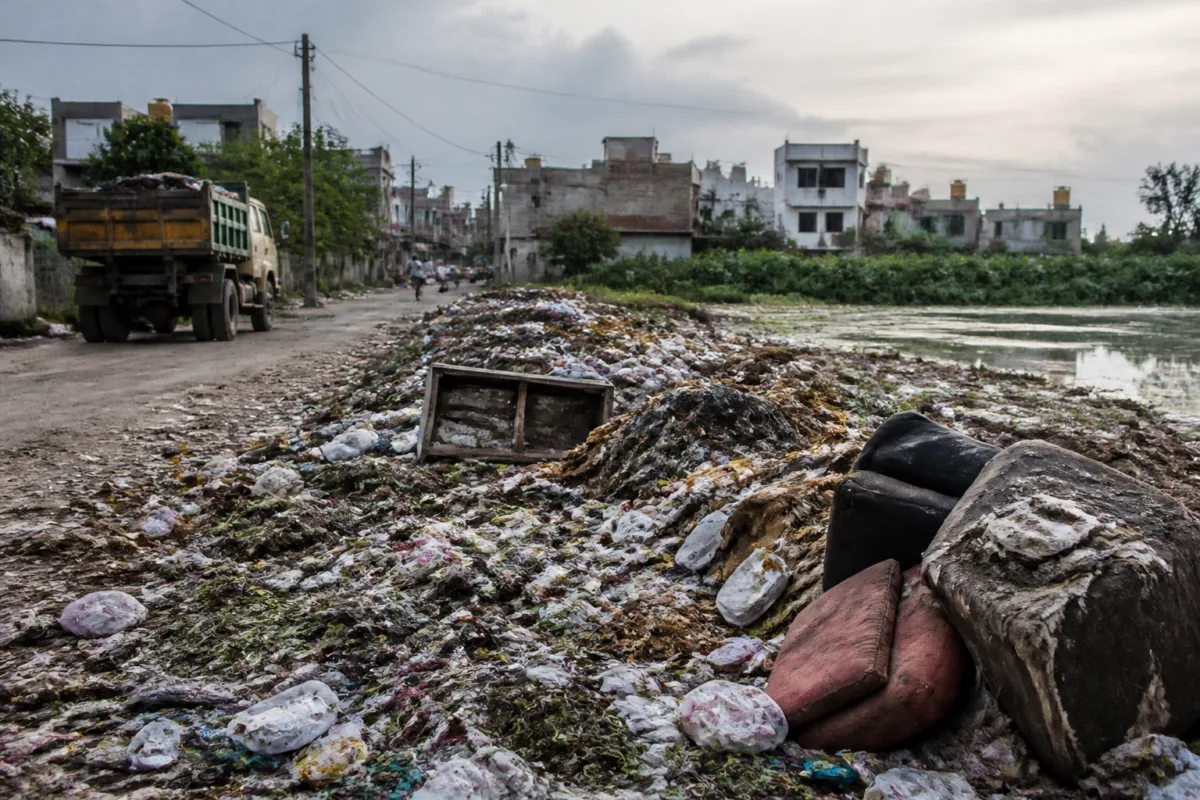
Chennai garbage dumping is spreading across a peri-urban belt where administrative boundaries do not match the way residents live, travel or generate waste. Along interior roads off Mount-Poonamallee High Road, plastic, discarded furniture and meat waste are reportedly accumulating across Porur, Thelliyaragaram, Iyyappanthangal, Paraniputhur, Kolathuvanchery, Mugalivakkam and Kundrathur Main Road. The immediate problem is visible in roadside piles and night-time burning. The deeper issue is that the waste system is divided among several local bodies without a common operating framework.
The areas identified in the report generate at least 200 tonnes of garbage daily. Yet collection and disposal are being handled through separate administrative arrangements covering Greater Chennai Corporation limits, panchayats and jurisdictions in Kancheepuram and Chengalpattu districts. Residents say this fragmentation makes it difficult to establish who is responsible for regular collection, safe transport, processing and enforcement against dumping.
That mismatch between urban growth and civic administration is central to the problem. Localities such as Paraniputhur, Kolathuvanchery, Mangadu and Koovur are close to Chennai’s built-up edge, but some fall under rural or district-level institutions rather than the corporation. Other adjoining areas towards Pallavaram are governed by Chengalpattu district, while parts of the wider belt remain within Chennai Corporation limits. Waste moves across these boundaries even when responsibility does not.
The result, according to residents, is a collection system that is irregular and incomplete. S Easwaran, secretary of the Jyothi Nagar residents’ welfare association, said a 30-acre waterbody in Periya Kolathuvanchery has remained a major dumping site for more than five years. He said panchayat officials collect waste only once or twice a week, often during the afternoon, and that waste from only some houses is picked up before being taken to the waterbody.
Easwaran also said waste from Mangadu is transported in an uncovered truck, leaving refuse along the road, before the material is burnt at night. These claims were reported by the Times of India and were not accompanied in the supplied material by an official inspection report or quantified assessment of the pollution. They nevertheless illustrate how collection, transport and disposal failures can combine into a single neighbourhood-level hazard.
## Chennai garbage dumping and the boundary problem
Municipal waste does not follow panchayat, district or corporation boundaries. A household may be located in one jurisdiction, a collection vehicle may operate from another, and an informal dumping point may sit near a third. When authorities plan and fund services separately, the waste stream can fall between institutional responsibilities even though the environmental and public-health consequences are shared.
The report does not establish that every local body in the affected belt operates in the same way. It does, however, identify a recurring administrative pattern: residents in areas near Chennai Corporation limits say they lack a coordinated system for addressing waste, while the reported dumping locations span several jurisdictions. This makes the issue more than a question of missed collection in one neighbourhood.
Urban planner S Naveen said the solution would require a coordinated waste-management system across local-body boundaries rather than treating each locality as an isolated unit. His proposed framework includes jointly mapping waste generation, fixing collection schedules and establishing common processing facilities. The emphasis is significant because it shifts the response from clearing individual dumps to organising the full chain from household collection to final disposal.
That chain has several points of failure. Waste must be collected frequently enough to prevent accumulation, transported in a way that does not release material onto roads, separated into useful and reject streams, processed at appropriate facilities and monitored until disposal. If any one of these stages is missing, waste can be diverted to open land or waterbodies. Burning then becomes a short-term method of reducing visible piles rather than a safe waste-treatment process.
## From collection gaps to processing capacity
Naveen said rural and peri-urban areas should segregate waste at source, compost organic waste locally and send recyclable material to authorised recovery centres. Only non-recyclable rejects, he said, should be transported to designated disposal facilities. The source material does not provide capacity figures for existing processing plants, details of contracts or a breakdown of how the reported 200 tonnes of daily waste is currently handled.
That absence of operational data is itself important. A functioning regional waste system requires authorities to know how much waste each locality generates, how frequently it is collected, where it is taken, how much is processed and how much remains as reject material. Without that information being jointly maintained, residents may see collection vehicles without being able to trace the destination of their waste, while authorities may respond to complaints without a complete picture of the wider flow.
The reported waterbody dumping also shows why disposal cannot be treated as an end-of-pipe problem. A waterbody is not simply vacant land available for temporary storage. Dumping there can obstruct local drainage and degrade an important urban ecological asset, although the supplied report does not quantify the specific environmental damage at Periya Kolathuvanchery. Night-time burning adds another exposure pathway, with residents reporting smoke and pollution in areas where waste has accumulated.
The report also points to a timing problem. If collection occurs only once or twice a week, and often during working hours, households may not have a reliable service when they need it. Waste can then remain in homes, be placed in open areas or be handed to informal collectors without a monitored destination. A schedule that exists on paper but does not match residents’ routines may still produce poor outcomes.
## An administrative system without a common operator
The institutional landscape described in the report includes the Greater Chennai Corporation, panchayats and district administrations in Kancheepuram and Chengalpattu. The report does not identify a single regional body with authority over the entire waste chain in these adjoining settlements. That does not necessarily mean no coordination mechanism exists, but it indicates that residents do not experience the current arrangements as a unified service.
For a cross-boundary system to work, local bodies would need clearly assigned responsibilities and a mechanism for resolving disputes over cost, land, vehicles, staffing and enforcement. Naveen called for joint monitoring and accountability to prevent dumping and burning in public places. The practical question is whether such coordination will be backed by shared budgets, common service standards and public reporting, rather than remaining an informal appeal for cooperation.
The response from Kancheepuram district collector D Sneha was that necessary action would be taken to ensure regular collection and resolve dumping at the earliest. Iyyappanthangal panchayat chairperson Jamila was unavailable for comment despite repeated attempts, according to the report. The available response therefore signals administrative attention but does not specify a collection timetable, an identified disposal facility, a cleanup plan or the authority responsible for monitoring compliance.
This gap between a promise of action and a defined implementation plan is where many urban sanitation complaints lose momentum. Removing an accumulated pile may provide temporary relief, but it does not answer whether waste will be collected regularly afterwards, whether vehicles will be covered, whether source segregation will be enforced or whether the same waterbody will become a dumping point again.
The evidence in the report confirms three connected conditions: substantial daily waste generation, inconsistent collection in at least some localities, and a fragmented jurisdictional structure across the urban fringe. It does not establish the full scale of illegal dumping across every named area, nor does it provide independent measurements of air, soil or water pollution. Those questions would require inspection records, waste-flow data and environmental monitoring.
The larger urban question is whether Chennai’s waste infrastructure is being planned for the metropolitan region that residents and waste streams already occupy, or only for the formal boundaries of individual institutions. As the city expands into adjoining panchayats and districts, the answer will determine whether peri-urban communities receive a continuous public service or inherit the gaps between neighbouring administrations. The immediate developments to watch are the promised action on regular collection, the identification of shared processing arrangements and whether joint monitoring is established across the affected jurisdictions.

