


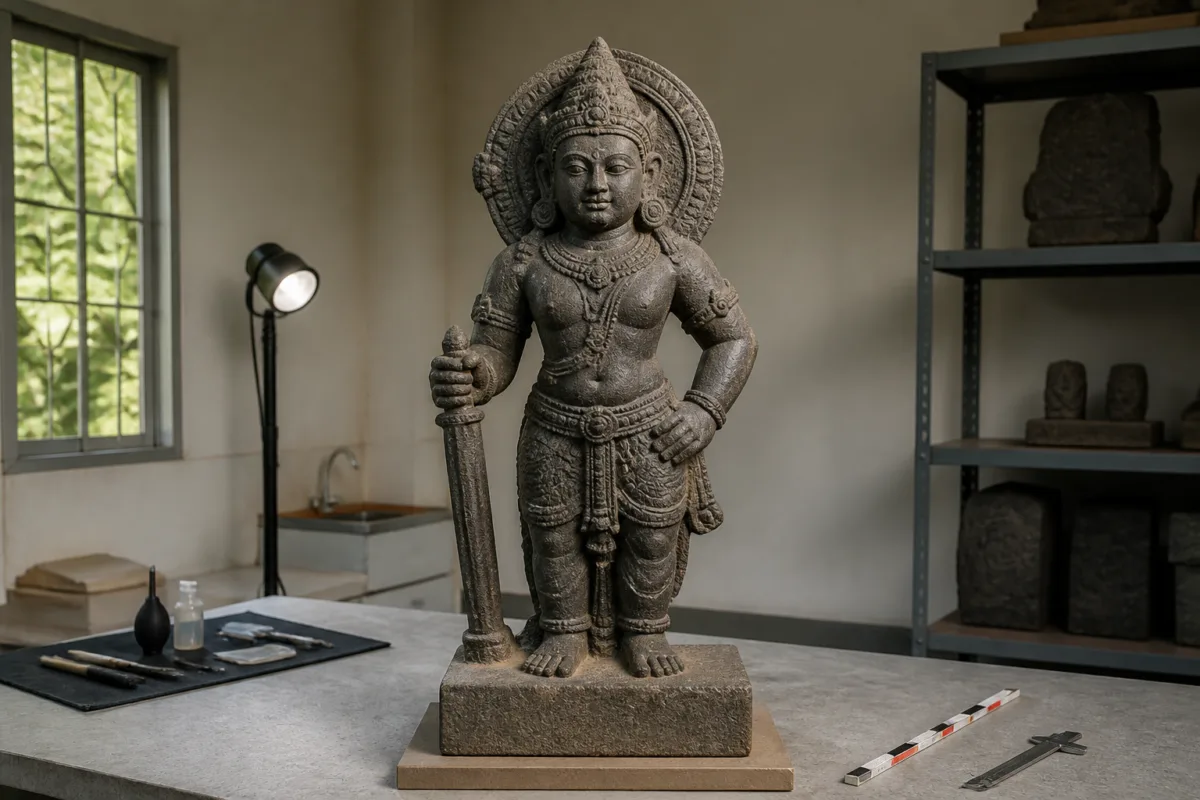
Goa folk deity sculpture dating to the 17th–18th century has been acquired by the state’s Directorate of Archaeology for documentation and further study, bringing a little-documented example of the region’s religious and artistic heritage into official custody.
The intricately carved schist stone sculpture was acquired from Honda in Sattari, according to additional director of archaeology Balaji Shenoy. It depicts a standing male deity or possibly a guardian figure, although its precise identity and original religious setting have not yet been established.
The two-handed figure holds a sword in one hand while the other rests on its waist. Its iconographic details include a decorated mukuta, or crown, kundala earrings, a necklace, armlets, bangles and a waist girdle. The sculpture also features an ornamented prabhavali, the decorative arch or halo surrounding the figure.
The department said the craftsmanship provides a glimpse into Goa’s traditional sculptural practices and cultural expressions. The use of schist stone and the detailed treatment of the figure’s ornaments are among the physical features that will be examined as part of the department’s investigation and documentation.
Based on its physical characteristics, archaeologists believe the sculpture may originally have been installed on a pitha, or pedestal. However, the department has not established where the sculpture was first located or the purpose it served. It was not found in the context of an existing religious site, leaving its provenance and original architectural setting unknown.
The absence of a confirmed original location means that the sculpture’s interpretation will depend on further examination of its form, iconography and material characteristics. The department has not identified the deity depicted or linked the piece to a particular temple, shrine or other structure.
Shenoy said the acquisition was carried out by the Department of Archaeology under the guidance of exploration officer Deepika Gaonkar. The stated purpose is to enable further investigation and documentation of the object.
The acquisition also expands the material available for studying Goa’s folk religious traditions, particularly forms of stone sculpture that have received comparatively less documentation. The department’s work will determine what additional information can be established about the sculpture’s age, original setting and cultural significance.

