


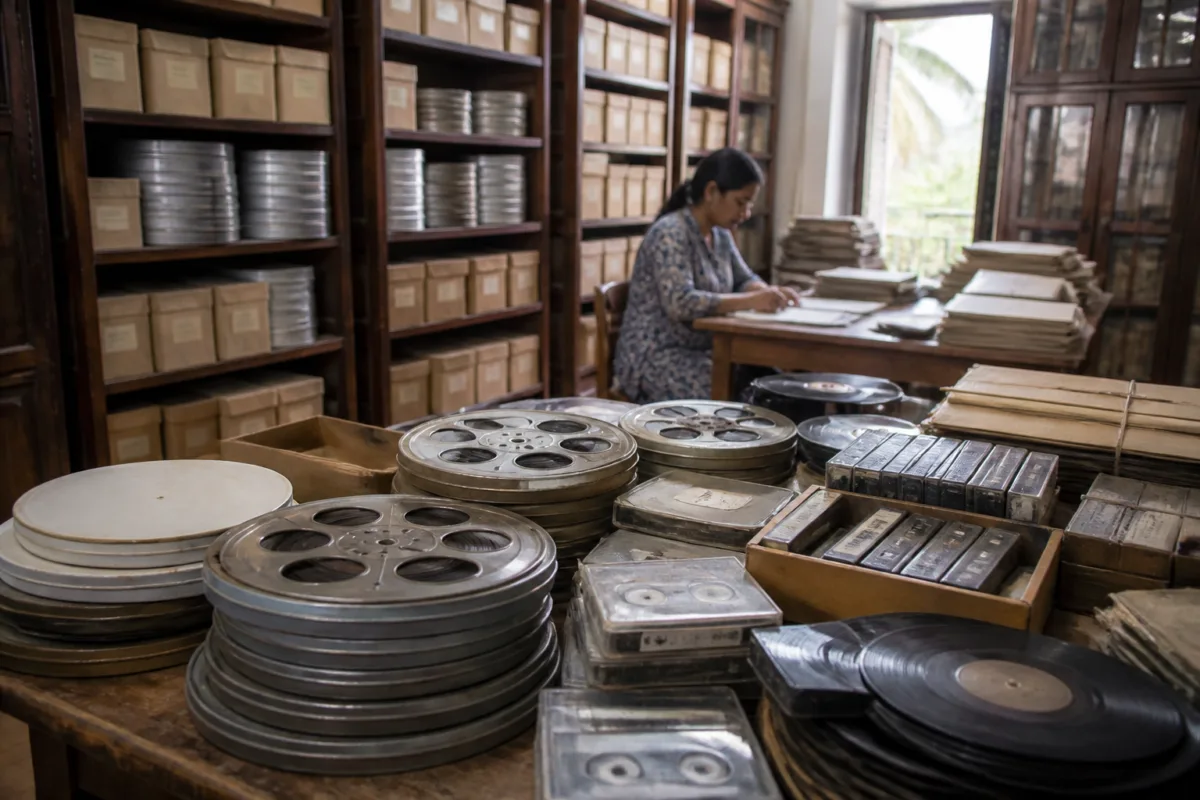
The Goa State Audiovisual Archives has launched a survey to identify privately held and institutional collections linked to the state’s cultural, historical and heritage record, creating an inventory of materials that may otherwise remain scattered or inaccessible.
The exercise covers audio cassettes, gramophone records, film reels and spools, video cassettes, microfilms and other archival material connected with Goa. Individuals, non-governmental organisations and other interested parties have been invited to share details of their holdings, while selected institutions are being approached directly by the archives department.
Gayatri Ghatwal, scientific officer and head of the Goa State Audiovisual Archives, told the Times of India that the initiative is intended to document the nature and extent of existing collections. The survey will record what material exists, who holds it and how it could potentially be accessed or preserved.
The department has clarified that the exercise is not a formal invitation to surrender or donate archival material. It is currently limited to assessing privately held and institutional resources that have a connection with Goa’s culture, history or heritage. This distinction is central to the survey because many of the records covered by it remain with individuals, organisations or institutions rather than in a public archive.
The survey form is available online through a QR code linked to a Google Form. The archives is also sending the form directly to institutions believed to hold relevant collections so that information can be compiled in a standardised format.
The formats listed by the department represent different stages of Goa’s recorded cultural and social history. Audio cassettes and gramophone records may contain music, speeches or other recordings; film reels and video cassettes can preserve visual documentation; and microfilms and paper-based records may hold institutional or historical material. The department has not stated that every collection identified through the survey will be acquired or digitised.
Instead, the immediate objective is to establish the scale and distribution of Goa-linked archival resources outside the formal custody of the state archives. The information could help the department identify material requiring preservation attention and understand the practical question of how such collections might eventually be accessed.
The initiative also places responsibility for heritage preservation across a wider group of custodians. Individuals and organisations holding older formats are being asked to disclose the existence and nature of their material, while the archives department seeks to create a common record of collections that are currently held in different locations.
Ghatwal said the information gathered through the survey could serve as an important first step towards identifying Goa-related archival resources and exploring ways to safeguard them for future generations. The department’s next step is to compile the responses and build the inventory of collections covered by the exercise.

