


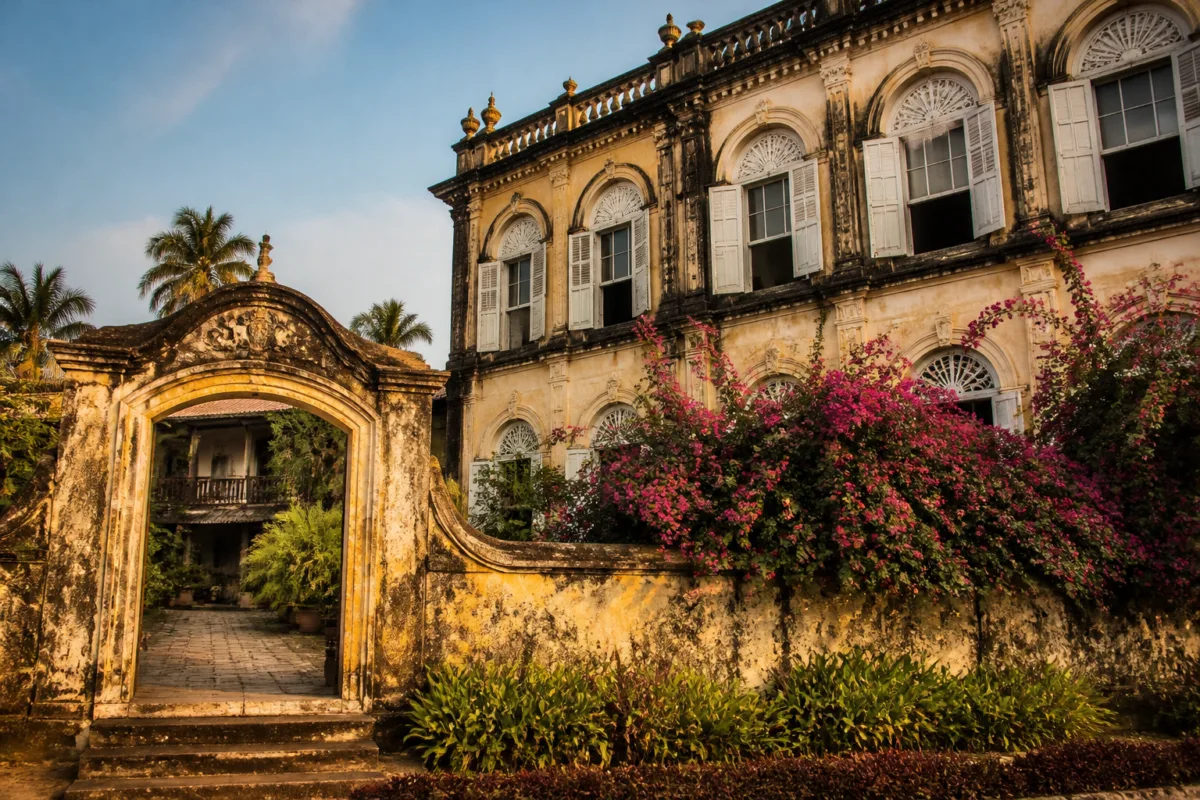
The Figueiredo mansion in Loutolim is not simply an old family residence preserved against time. It is a working example of how private stewardship can keep built heritage in use, connect architecture with family history and make a multicultural past accessible to visitors. The 400-year-old property has been restored into the Vicente Joao Figueiredo Museum and homestay, with rooms, objects and architectural details documenting Goa’s links with Hindu, Islamic, Catholic, Portuguese and wider international influences.
That makes the mansion significant beyond its collection of rare objects. Its survival shows that heritage is not preserved only through monuments, government museums or formal conservation programmes. It can also depend on decisions taken inside families: whether a property is divided, abandoned, altered or maintained as a coherent whole. In the case of the Figueiredos, a succession arrangement helped prevent disputes among heirs and kept the property intact across generations.
The mansion’s history reaches back to the 1590s, when the Figueiredo family moved from Sancoale to Loutolim following a bubonic plague outbreak, according to the account published by Times of India. The family was originally Goan Hindu and belonged to the podiar community of Sancoale before later converting to Christianity. That history is reflected in the house itself, where different cultural influences exist alongside one another rather than appearing as separate layers of a museum display.
Pedro Figueiredo told Times of India that the oldest section of the house dates to the 16th century, while an expansion in the 1790s added larger spaces, including a ballroom, music room and dining hall. The mansion’s higher ceilings and spacious halls reflect European influences of the period, including elements associated with Gothic architecture. Yet the building’s identity is not reducible to European design. Its courtyards, furniture, tiles, religious objects and household artefacts reveal a more complex story of exchange and adaptation.
The architectural evidence is visible from the entrance. Traditional oyster-shell shutters lead into a hall with art deco-style French windows. Four-poster beds and chamber pots coexist with later en suite bedrooms. These details record successive changes in technology, taste, domestic life and standards of comfort. Rather than presenting the building as frozen in one historical moment, the mansion shows how a house evolves while retaining traces of earlier periods.
The two major courtyards, described by Figueiredo as ‘raj aangans’, offer another example of the property’s layered cultural vocabulary. He told the newspaper that the courtyards resemble gardens in Muslim cultures that served as private retreats and exclusive leisure spaces for royal women. Within the family’s own history, the spaces were used by couples during the courtship period in arranged marriages. The courtyards therefore carry both architectural meaning and social memory.
Traditional craftsmanship and Islamic-inspired tile patterns appear alongside furniture that combines Hindu craftsmanship with Portuguese design. One set of chairs features a trimurthi, palm trees and dragons. A miniature statue of Baby Jesus has bangles and was sculpted in the likeness of Lord Krishna, according to Figueiredo’s account. These objects complicate any simple understanding of Goa’s built heritage as either purely Portuguese or purely local. They point instead to domestic spaces shaped by movement, conversion, trade, craftsmanship and family interpretation.
The mansion’s collection extends that story beyond the building’s walls. Among the objects described in the report is a custom-made East India Company crockery set bearing the family coat of arms. Its orange and gold colours and lotus motif are presented as signs of both the family’s Christian identity and its Hindu heritage. A silverware set reportedly gifted by King John V of Portugal in the 18th century connects the household to royal and colonial history, while a silk sari worn by Pedro’s grandmother, Maria de Lourdes Figueiredo, when she represented Goa in the Portuguese parliament in the 1960s links the house to modern political history.
Other objects document the global routes through which material culture entered Goan homes. The collection includes a 1920s Schiedmayer piano purchased from Karachi and a 1904 camera bought from Birmingham. A chest of drawers with intricate carving is described as one of only three made. These are not just decorative possessions. Read together, they show how a prominent Goan household participated in networks that connected the region to Europe, South Asia and commercial centres beyond the subcontinent.
The preservation of such a property raises a practical question for built heritage: who carries the cost and responsibility of keeping large historic homes functional? A building can retain its architectural value while becoming difficult to maintain because of its scale, ageing materials and changing domestic requirements. The Figueiredo mansion’s current form reflects an attempt to address that challenge by combining conservation with a museum and homestay. The house remains accessible as a lived and visited place rather than surviving only as a closed, static structure.
That approach also introduces a tension. Opening a private house to visitors can create resources and public access, but it requires the family to manage the relationship between everyday use, hospitality and the protection of fragile objects. The supplied report does not detail the museum’s operating model, visitor numbers, conservation costs or formal heritage status. What it does establish is that the family has chosen to use the property as a museum and homestay, making preservation part of the house’s present function.
The restoration journey began with Pedro’s mother, Fatima, after she visited the family home more than a decade ago. She had built a career in Lisbon but left Portugal permanently in 2016. Pedro joined her in 2017 after completing his university education. Their return illustrates another dimension of heritage conservation: the role of family members who decide to relocate or redirect their working lives to protect an inherited property. Without that intervention, the mansion may have faced a different future, although the supplied account does not establish what alternatives were being considered.
Succession was equally important. Pedro said Vicente Joao Figueiredo ensured that the property remained intact by leaving it to his daughter, Georgina, who dedicated her life to maintaining it. Georgina did not marry, and after her death in 2008, responsibility passed to Pedro’s grandmother before reaching the next generation. This continuity prevented the mansion from being fragmented among multiple heirs, a risk that can affect large family properties when ownership is divided across generations.
The succession story reveals an institutional gap in heritage preservation. Formal heritage systems may identify important buildings, but long-term survival often depends on ownership, inheritance arrangements and the ability to finance maintenance. The Figueiredo mansion’s experience suggests that conservation is not only a design or engineering problem. It is also a governance problem within families and communities, involving control, responsibility and decisions about future use.
Goa’s architectural inheritance is particularly exposed to this question because its historic houses embody multiple identities at once. The mansion described in Loutolim contains local craftsmanship, Catholic religious references, Portuguese design, Islamic-inspired patterns and objects acquired from distant cities. Protecting such a building preserves more than a façade. It protects evidence of how communities lived, travelled, converted, traded and adapted cultural forms inside a domestic setting.
The report also demonstrates why heritage should not be measured only by age. The mansion’s oldest section dates to the 16th century, but its value comes from the relationship between different periods. The 1790s expansion, art deco windows, modern en suite bedrooms and swimming pool added later show that continuity can include change. A living historic building is not necessarily one that remains untouched; it is one in which change does not erase the evidence of earlier lives.
At the same time, the available information leaves several questions open. It does not state whether the mansion is protected under a government heritage listing, what restoration methods were used, how original materials were conserved or whether public authorities provided technical or financial support. It also does not provide information on visitor access, operating costs or the wider condition of comparable Goan mansions. Those gaps prevent the property from being treated as evidence of a broader conservation trend, but they do not diminish the importance of the example it provides.
What the Figueiredo mansion confirms is that built heritage can remain relevant when preservation is connected to use, interpretation and public access. Its museum and homestay model gives the property an active role while retaining rooms, objects and architectural details that carry family and regional history. The larger urban question is whether other historic homes can find similarly viable futures without losing their character or becoming detached from the communities and histories that produced them.
For now, the mansion stands as a privately maintained record of Goa’s layered past. Its continued survival rests on the family’s succession history, restoration work and decision to open the property to visitors. As Pedro Figueiredo put it, history survives when someone chooses to protect it. The next measure of that principle will be whether the building, its collections and its public role can remain intact for future generations.

