


Sirpur’s entry into UNESCO’s tentative list is a formal recognition of the archaeological town’s significance, but it is not yet a World Heritage designation. The development begins a more demanding phase: documenting the site’s outstanding universal value, defining its boundaries, preparing conservation safeguards and building a management plan that can protect a large, layered settlement while allowing visitors to experience it.
That distinction matters because Sirpur is not represented by one isolated monument. The archaeological town in Mahasamund district, on the banks of the Mahanadi in Chhattisgarh, contains the remains of a historic urban centre that served as the capital of ancient Dakshin Kosala under the Panduvanshi rulers. Its significance lies in the concentration of temples, Buddhist monasteries, water bodies, gardens, sculptures, inscriptions and other remains within the same cultural landscape.
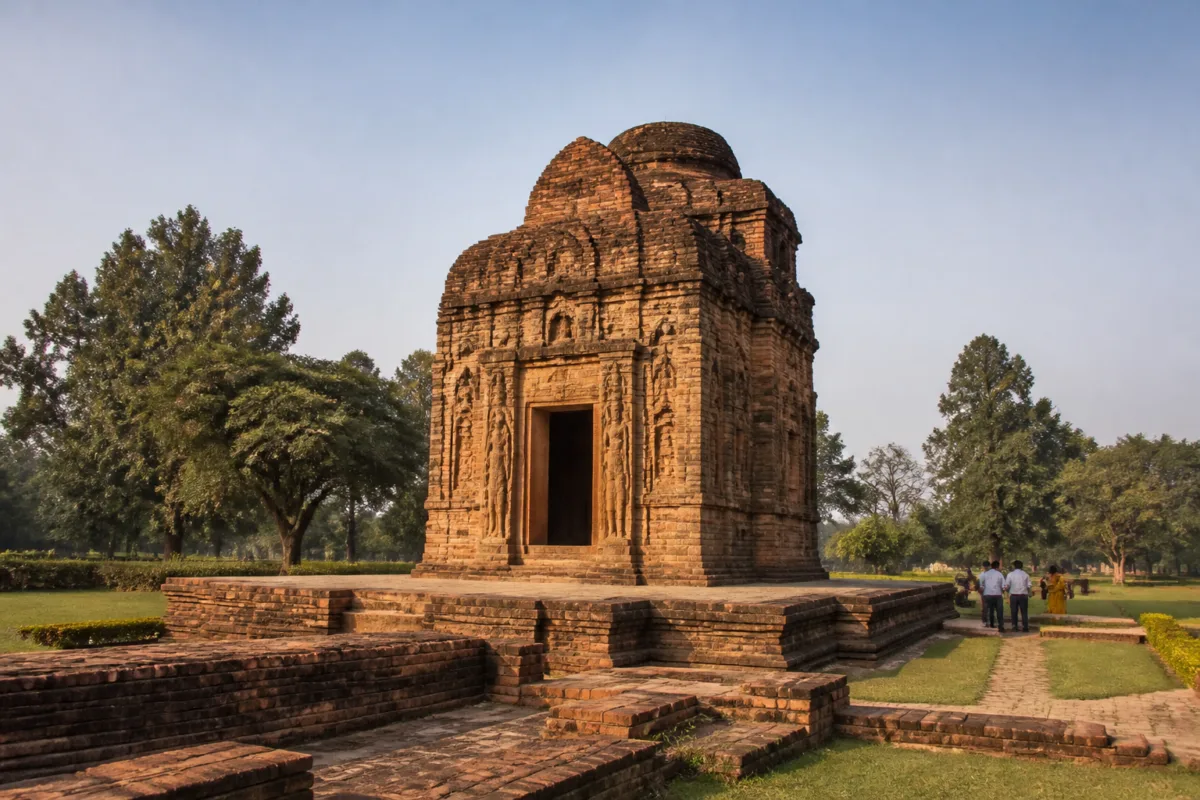
The seventh-century Lakshman temple is the site’s best-known architectural marker. Built largely of brick and placed on a high stone platform, it is regarded as one of the finest surviving examples of early brick temple architecture in India. Its sculpted panels and Vaishnava imagery offer a visible expression of the artistic and religious traditions that developed in Sirpur.
But the temple alone does not explain the UNESCO case. The evidence described in the state’s archaeology account points to a settlement where Shaiva, Vaishnava, Buddhist and Jain traditions existed in the same cultural space. The remains associated with these traditions show that Sirpur’s historical importance is connected to the way political authority, religious institutions, craft production and commercial activity came together in one ancient settlement.
This makes the site different from a heritage project focused only on restoring a single structure. The conservation challenge is landscape-scale. Archaeological remains can be distributed across a wide area, while their meaning often depends on their relationship with roads, water systems, open spaces, religious complexes and settlement patterns. A management approach that protects only the most visible temple could leave the wider historical system vulnerable or make it difficult for visitors to understand how the ancient city functioned.
## What the archaeological record shows
Successive excavations at Sirpur have yielded more than 2,000 antiquities, according to the state’s account cited in the report. These include sculptures, metal icons, ancient coins, ornaments, pottery, lamps, locks, chains, seals and everyday objects. The range is important because it extends the story beyond monumental architecture. It offers evidence of worship, domestic activity, administration, trade, craft and material culture.
A Chinese coin found at the site has been cited as evidence of wider commercial and cultural contacts. Coins linked to regional dynasties have also been recovered. These finds do not turn Sirpur into a simple story of long-distance trade, but they do add to the evidence that the settlement participated in networks extending beyond its immediate surroundings.
Sirpur was also an important centre of metal sculpture during the seventh and eighth centuries. Bronze and metal images of Buddha, Avalokiteshvara, Padmapani, Vajrapani, Manjushri, Tara, Rishabhanatha and Vishnu have been found in and around the site. Several are now housed in museums in different parts of India. The distribution of these objects creates a further management question: the historical identity of Sirpur is represented both in the archaeological landscape and in collections located elsewhere.
The account of the seventh-century Chinese traveller Xuanzang, cited by the state government, provides another layer of historical evidence. His description of a flourishing Buddhist presence is relevant to the understanding of Sirpur as a multi-faith centre rather than a site defined by one religious tradition. The archaeological remains and historical references together strengthen the argument that the town’s value lies in its cultural plurality and urban complexity.
The Panduvanshi period, particularly the reign of Mahashivagupta Balarjuna, is associated with the construction of temples, Buddhist viharas, water bodies and gardens. These features indicate that the ancient settlement was not simply a cluster of shrines. It had institutions, public or semi-public spaces, water infrastructure and landscaped elements that formed part of the city’s social and religious life.
## Why tentative-list status is only the beginning
UNESCO’s tentative list is a preliminary but necessary stage before a site can be considered for inscription on the World Heritage List. Sirpur’s inclusion therefore creates an opportunity, not a final outcome. A future nomination would need detailed documentation establishing the site’s outstanding universal value, clearly defined boundaries, conservation safeguards and a management plan. The dossier would then undergo international evaluation before any decision on inscription.
This process shifts the focus from recognition to administration. A heritage listing cannot substitute for the basic work of identifying what must be protected, deciding who is responsible for it, documenting the condition of structures and archaeological remains, and controlling activities that may damage the site. The quality of the nomination will depend on whether these institutional and physical details are addressed convincingly.
The report does not establish that the final nomination has been completed or that inscription is imminent. It records that Union culture and tourism minister Gajendra Singh Shekhawat visited Sirpur’s archaeological sites on January 1 and spoke about conservation and efforts to seek UNESCO recognition. The next stage therefore remains dependent on documentation, planning and evaluation rather than on the tentative-list announcement itself.
For local administration, this is also a question of coordinating different responsibilities. Archaeological protection, tourism facilities, access, interpretation and visitor movement may involve different agencies and levels of government. The supplied material does not specify the proposed institutional arrangement for Sirpur, but the requirement for a management plan makes coordination unavoidable. A heritage site with multiple monuments and a broad archaeological footprint cannot be managed effectively through monument-by-monument interventions alone.
## The infrastructure challenge at Sirpur
The immediate test will be to improve visitor infrastructure without compromising the character of the ancient site. That balance is especially important in a place whose value comes from the relationship between its monuments, landscape and archaeological remains. New facilities, access arrangements or visitor movement systems can improve public access, but poorly planned additions can also fragment the setting that gives the site its meaning.
The challenge is not limited to tourism branding. Sirpur’s archaeological landscape includes brick architecture, monasteries, temple remains, water bodies and recovered objects. Each category presents different conservation needs. Structures require protection from physical deterioration; excavated areas need careful interpretation and maintenance; water-related features need to be understood as part of the historic settlement; and artefacts removed from the site need to be connected to the story being presented to visitors.
The report identifies preservation as the immediate priority. That framing is significant because a UNESCO tag, if eventually granted, would bring visibility, but visibility can increase pressure on a fragile site. The available material does not provide visitor numbers, a carrying-capacity assessment, a current conservation budget or details of proposed facilities. Those gaps will matter as the nomination process develops because the credibility of the heritage case will depend not only on the past represented at Sirpur but also on the safeguards in place today.
Sirpur’s case also illustrates why urban heritage should not be reduced to surviving buildings. The ancient settlement’s importance is distributed across monuments, religious traditions, craft production, trade evidence, water systems, open spaces and historical memory. Protecting only the most photogenic structure would preserve an image of the city without necessarily preserving the city itself.
The larger question is whether the nomination process can translate archaeological evidence into a coherent conservation and management framework. The tentative-list inclusion confirms that Sirpur has entered the formal pathway towards possible World Heritage recognition. It does not confirm that the site meets the final threshold, that its boundaries have been settled or that its visitor infrastructure is ready for greater attention.
What is established is the strength and diversity of the archaeological record: a seventh-century brick temple, Buddhist monasteries, remains of temples and palatial complexes, more than 2,000 recovered antiquities, evidence of several faith traditions and indications of wider cultural contacts. What remains to be demonstrated is how these elements will be documented, protected and managed as one historic landscape. For Sirpur, that work—not the label alone—will determine whether recognition becomes a durable conservation gain.

