


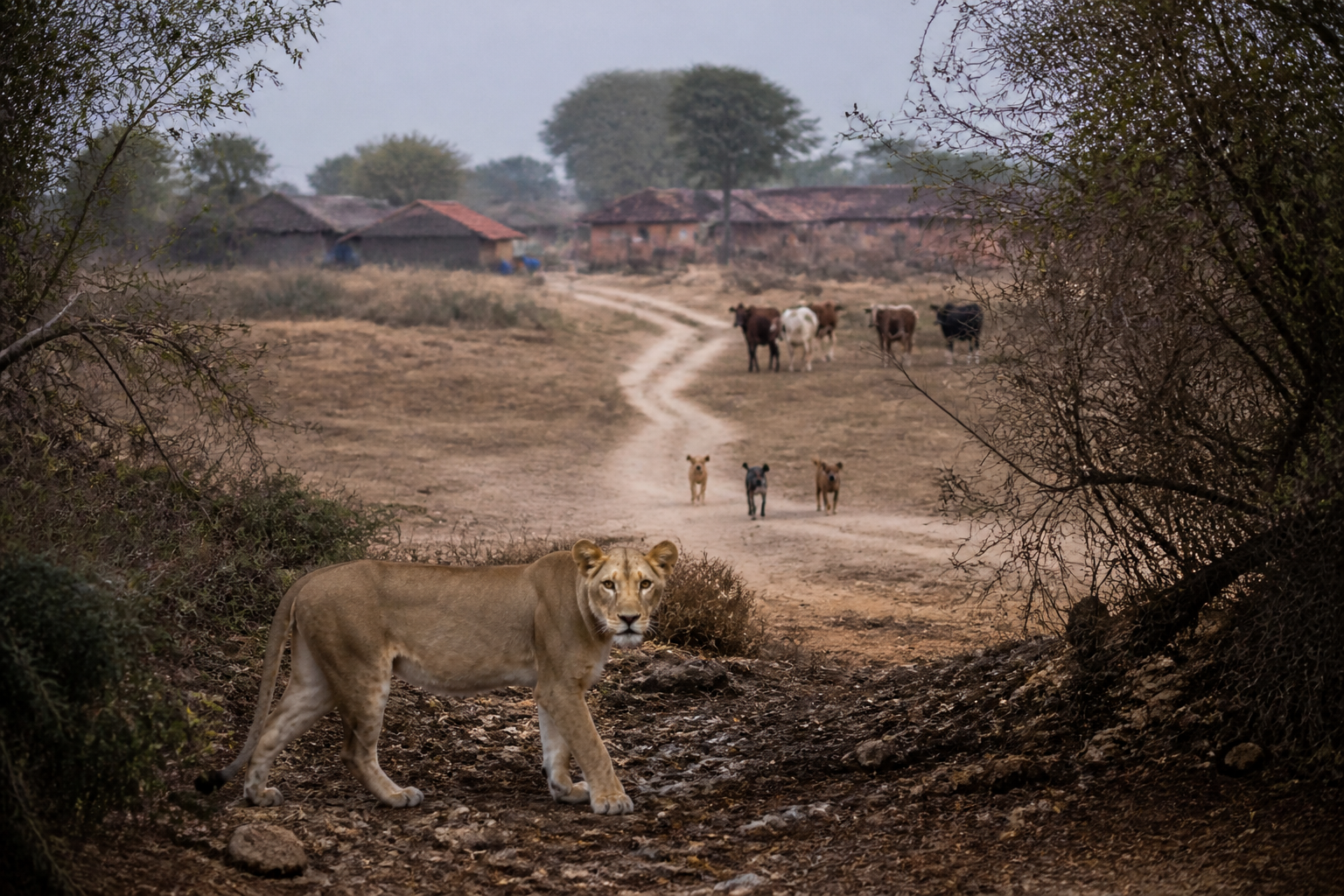
The rabies threat facing Asiatic lions in Gir is not confined to the protected forest. Two rabies-linked lion deaths within four months, including a lioness that attacked five people in Amreli before dying, have exposed how closely wildlife conservation, livestock management, public health and district administration are connected across the Greater Gir landscape.
The latest case remains officially unresolved. Several senior forest officials told the Times of India that the lioness had died of rabies, but Gujarat’s principal chief conservator of forests, Jaipal Singh, said laboratory confirmation was still awaited. The distinction matters because the incident has become a test of how quickly and transparently suspected disease cases are investigated in a landscape where wild animals, livestock and people share space.
The immediate human-health response also revealed a practical vulnerability. The five people attacked by the lioness were first taken to a primary healthcare centre, but the facility did not have anti-rabies vaccines. They were subsequently administered the vaccine at a private hospital and placed under observation, according to the report. The incident therefore involved two linked systems: the capacity to diagnose and contain disease in wildlife, and the ability of local public facilities to provide timely post-exposure treatment.
Gujarat has issued fresh directions to implement the Gujarat Rabies Control Regulations, 2023, more aggressively. District and municipal authorities have been asked to document dog-bite cases, report shortages of anti-rabies vaccines immediately and strengthen treatment protocols. The stated objective is to achieve zero human rabies deaths by 2030. Yet the Gir episode suggests that achieving that goal will depend on surveillance beyond the formal boundaries of forests and sanctuaries.
Rabies reaches the conservation debate through the animals that move between human settlements and wildlife habitat. Dogs are an obvious transmission route, but the report also identifies jackals and mongooses as possible carriers. The Greater Gir landscape contains villages, agricultural areas, livestock populations and roads alongside protected forests. That geography means that an infection-control strategy focused only on lions inside the sanctuary would overlook the places where contact between species is most frequent.
Data cited in the report underline the scale of the surrounding animal population. Information obtained from the Union government by former National Board for Wildlife member H S Singh indicates that Amreli, Junagadh, Gir-Somnath and Bhavnagar districts together have at least 100,000 feral dogs. The same region has approximately 80,000 stray cattle and around 84,460 wild ungulates outside protected forests. These figures do not establish how many animals are infected, but they show the size and complexity of the potential disease interface.
The numbers also shift the question from a single lion death to the management of a connected landscape. Feral dogs can carry rabies and canine distemper virus, while ticks associated with cattle can transmit parasites that cause babesiosis, another potentially fatal disease affecting lions. The presence of several possible pathogens means that unexplained wildlife deaths cannot be treated as isolated events without risking an incomplete understanding of how disease moves through the region.
Gir’s disease history makes this concern more than a new alarm. H S Singh told the Times of India that two lion deaths linked to rabies had been documented around 2020. The recent cases have brought the issue back into focus nearly six years later. The interval does not establish that rabies has become more prevalent, because the supplied evidence does not provide a continuous testing record or a confirmed trend. It does, however, raise questions about whether surveillance has been consistent enough to detect risks between high-profile incidents.
One of the central weaknesses identified in the report is that not every lion dying under suspicious circumstances is tested for rabies. An official said that even when a lion dies after attacking a person, rabies testing is not always conducted. In the latest case, suspicion increased because the lioness died within 20 hours of being rescued after attacking five people. That sequence triggered attention, but it also suggests that testing may depend on visible behavioural or public-health signals rather than a uniform protocol applied to all unexplained deaths.
The issue is complicated further by concerns over reporting of other diseases. A senior official alleged that the forest department had not been sufficiently transparent about canine distemper virus-related lion deaths and feared that rabies cases could similarly go underreported. The official said the department had listed possible causes of lion deaths without mentioning canine distemper virus or Babesia. These are allegations contained in the report, not independently established findings, but they point to the importance of publishing clear cause-of-death information and explaining when laboratory confirmation is unavailable.
This is where wildlife administration and municipal governance meet. The Gujarat government’s rabies-control directions require district and municipal authorities to record dog-bite cases and ensure the availability of anti-rabies vaccines. In the Gir region, those responsibilities cannot be separated from forest management. Dog populations around protected areas, livestock movement, carcass disposal, waste management and human access to healthcare all influence the risk environment. The report does not establish that any one of these factors caused the lioness’s death, but it shows why disease prevention cannot be assigned to the forest department alone.
The primary healthcare centre’s vaccine shortage is significant for the same reason. Post-exposure treatment is time-sensitive, and people living near wildlife corridors or forest edges may be among those most likely to encounter infected or aggressive animals. A local facility that cannot provide anti-rabies vaccination forces patients to travel or rely on private care. In this incident, treatment was eventually provided, but the episode exposed a gap between the state’s zero-human-deaths target and the readiness of frontline facilities.
The incident also demonstrates why the boundaries used for administration may not match the boundaries used by disease. The Asiatic lion population is associated with the Greater Gir landscape, while the potential carriers identified in the report move through settlements, grazing areas and forest margins. Wild ungulates outside protected forests add another layer to the ecological network. Effective surveillance would therefore need information from forest officials, municipal bodies, public-health departments, veterinary services and local healthcare providers rather than separate records that cannot be compared.
The supplied report does not provide a confirmed laboratory result for the latest lioness, a complete record of rabies testing among recent lion deaths, or a quantified estimate of infection among feral dogs, jackals, mongooses or livestock. Those gaps limit what can be concluded about the scale of the current outbreak. They do not diminish the public-interest importance of the case. When a suspected wildlife disease coincides with human exposure, vaccine shortages and incomplete testing, the absence of data becomes part of the governance problem.
The larger question for Gir is whether conservation success can be measured only by the number of lions protected inside designated habitat. Disease risks are shaped by the wider human-dominated landscape that supports the protected ecosystem. The report’s figures on feral dogs, stray cattle and wild ungulates show that the lion’s security depends on managing interfaces beyond the sanctuary, while the experience of the five people attacked shows that human safety depends on health infrastructure beyond the forest department’s direct control.
For now, the confirmed facts establish a serious surveillance and preparedness concern, not a proven rabies outbreak across Gir. Laboratory confirmation of the latest death, systematic investigation of unexplained lion deaths, transparent reporting of canine distemper virus and Babesia findings, and reliable tracking of dog bites and vaccine availability are the next developments to watch. The credibility of the response will depend on whether agencies treat the case as an isolated wildlife incident or as evidence requiring coordinated monitoring across the entire Greater Gir landscape.

