


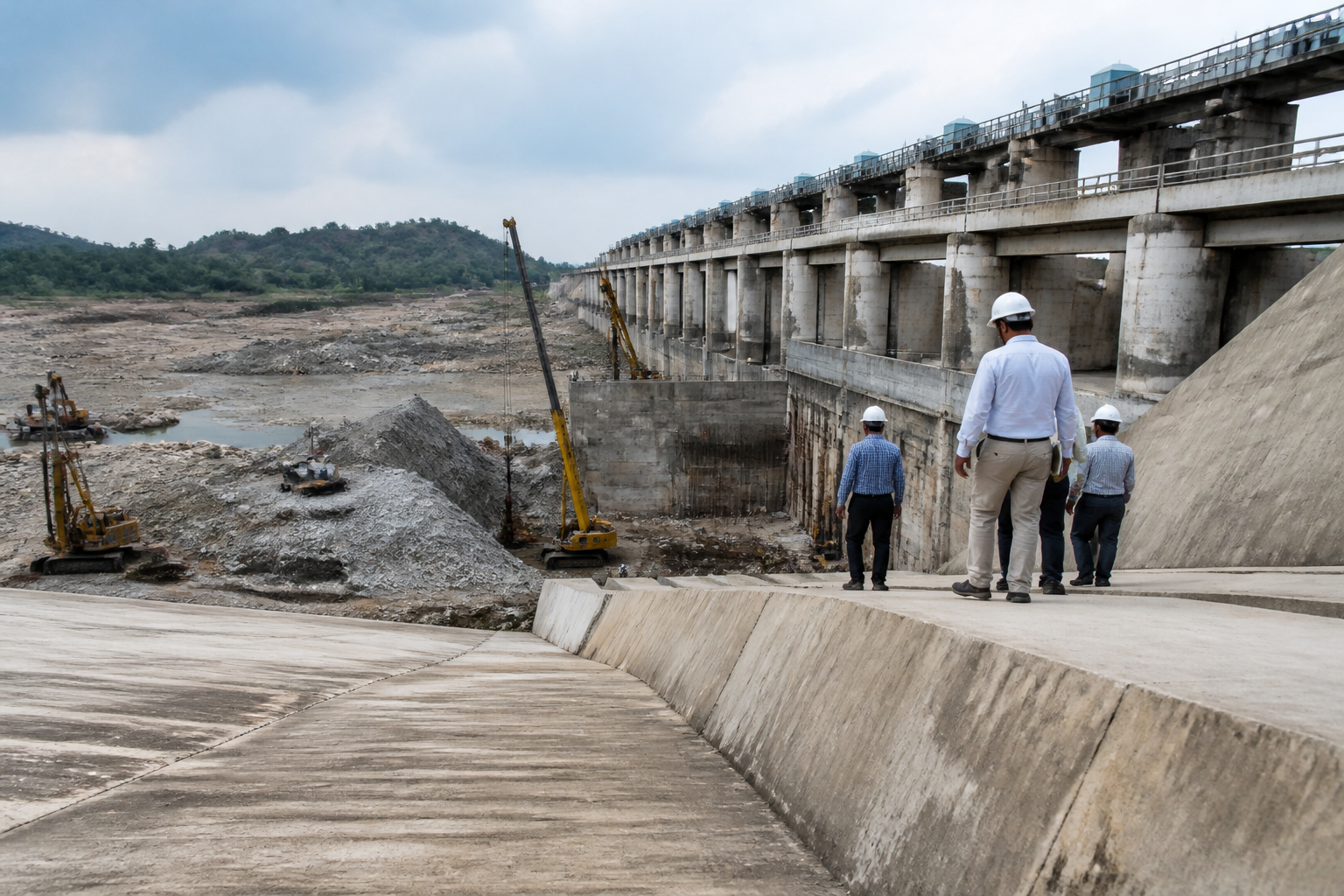
Telangana’s plan to spend nearly ₹2,100 crore restoring the Medigadda, Annaram and Sundilla barrages is not simply a repair programme. It is an attempt to bring a major public water infrastructure system back into operation while deciding who should pay, who should execute the work and how much of the original engineering can be relied upon.
The proposed rehabilitation comes more than two years after structural troubles surfaced at the three barrages of the Kaleshwaram Lift Irrigation Scheme. The state government has announced that work is expected to begin in mid-November and be completed by mid-June 2027. Before that schedule can be implemented, however, the technical scope, designs and final cost must be examined by a Union-level technical oversight committee.
That sequence matters. The barrages cannot be restored through a routine maintenance contract. The reported plans involve new diaphragm walls, extensions to stilling basins and other strengthening works. These are structural interventions that will determine how the barrages handle water and control the force of flows downstream. The final design is therefore as important as the headline allocation.
What the Kaleshwaram barrages plan involves
According to irrigation department officials cited by the Times of India, diaphragm wall construction is expected to account for about ₹1,800 crore of the estimated expenditure. Another ₹300 crore is expected to cover associated works, including the strengthening and extension of stilling basins.
At Medigadda, the stilling basin is proposed to be extended by up to 60 metres. At Annaram and Sundilla, the proposed extensions may range between 45 and 50 metres. A stilling basin is a concrete structure at the base of a dam spillway that dissipates the energy of fast-moving water and helps prevent erosion of the riverbed downstream. Its proposed enlargement indicates that the rehabilitation is addressing how water is released and managed, not merely repairing visible damage.
The estimates are not final. A senior irrigation official told the Times of India that the technical oversight committee meeting in Delhi would finalise the estimates and rehabilitation works. The official also said that costs could change depending on the designs. This leaves the ₹2,100 crore figure as a preliminary assessment rather than a locked project cost.
The committee was constituted by the Union Ministry of Jal Shakti and is headed by the technical member of the National Dam Safety Authority. It is expected to examine the rehabilitation plans, designs and investigation reports before the scope of the works is finalised. That review creates a formal technical checkpoint between the state’s intent to restart the barrages and the execution of the repairs.
The funding question is as important as the engineering
The proposed repairs expose a second challenge: the division of financial responsibility among the state government, the agencies that constructed the barrages and the contractors whose payments remain pending.
The agencies that built the barrages have reportedly declined to bear the rehabilitation cost on the grounds that their defect liability period has ended. At the same time, the state government has cancelled the completion certificates issued for the projects and has yet to clear around ₹800 crore in pending contractor bills.
The reported outstanding amounts include ₹460 crore owed to L&T, which built the Medigadda barrage, and ₹170 crore each owed to Navayuga Engineering Company for Sundilla and Afcons for Annaram. These figures place the rehabilitation programme within a wider settlement problem. The government is not only considering how to fund new structural work; it is also negotiating over earlier construction, outstanding payments and responsibility for defects.
A senior irrigation official said the government had decided in principle to bear the cost of new works, particularly diaphragm walls and other interventions that were not part of the original scope. The companies, the official said, had been asked to bear the cost of works already completed but requiring repairs because of poor quality. The same official indicated that clearance of pending bills remained linked to the discussions.
This arrangement, if implemented, would create a distinction between new engineering requirements and alleged deficiencies in existing work. The distinction is administratively significant because it affects the public cost of rehabilitation, the treatment of contractor claims and the government’s ability to recover money for work it considers defective. The supplied report does not establish the final legal or financial settlement, but it shows that the repair programme cannot be separated from the unresolved contract position.
A special agency could reshape control of the project
The Telangana government is examining the creation of a special purpose vehicle or dedicated agency to mobilise funds and oversee the rehabilitation. The proposal echoes the institutional model used for the original Kaleshwaram project, for which the previous BRS government established the Kaleshwaram Lift Irrigation Corporation Limited.
That corporation raised nearly ₹80,000 crore in loans for Kaleshwaram and another ₹10,000 crore for the Palamuru-Rangareddy Lift Irrigation Scheme, according to the report. A new agency would therefore not be a minor administrative arrangement. It could become the principal vehicle for raising funds, awarding contracts, coordinating technical decisions and managing the long-term financial obligations associated with the repairs.
The choice of institutional structure will influence how responsibilities are recorded. If rehabilitation is handled through a dedicated corporation, the government would need to define its relationship with the irrigation department, the technical oversight committee, contractors and lenders. The available information does not specify the proposed agency’s borrowing powers, ownership structure or reporting arrangements. Those details will be central to understanding how the ₹2,100 crore programme is financed and supervised.
The plan also raises a question about the difference between project execution and asset stewardship. The original project corporation helped raise funds and execute the scheme. A rehabilitation agency would inherit infrastructure already built, disputed liabilities and an incomplete public record of responsibility. Its effectiveness would depend not only on its ability to spend money, but also on the transparency of its technical and contractual decisions.
## The inquiry and the repair programme are moving on separate tracks
The rehabilitation exercise is unfolding alongside the Justice PC Ghose Commission’s inquiry into alleged irregularities in the planning, design and execution of the Kaleshwaram project. The commission reportedly identified serious deficiencies related to Medigadda, Annaram and Sundilla and fixed responsibility on key decision-makers.
However, the Telangana High Court in April restrained the state government from acting on the commission’s findings, while upholding the legality of the commission’s constitution. The court held that the inquiry had suffered from procedural lapses. As a result, the report cannot currently be used for punitive action, even as technical work to repair and restore the barrages continues.
This separation is important for public administration. The state cannot necessarily wait for the conclusion of accountability proceedings before addressing the condition of critical water infrastructure. At the same time, repair decisions made before the legal position is settled could affect how responsibility, cost recovery and evidence are assessed later. The technical restoration process and the accountability process therefore have different purposes, but they remain connected through the same engineering records, contracts and decisions.
The present plan does not resolve that tension. It establishes a route towards restoring the barrages while leaving the consequences of the inquiry subject to legal constraints. The final technical designs, investigation reports and cost estimates will become particularly important because they may shape both the repair programme and future questions about how the failures occurred.
## What the timeline reveals
The government has set a demanding sequence: technical review and finalisation of the rehabilitation scope, commencement of works in mid-November, and targeted completion by mid-June 2027. The report does not provide a detailed construction schedule, procurement method or interim operating plan for the barrages.
That missing detail matters because the programme involves three separate structures, different proposed stilling-basin extensions and major diaphragm wall construction. It also involves coordination between the state government, a Union-level technical committee, contractors and any new agency created to manage the work. The timetable will ultimately depend on the designs approved, the availability of funds, the resolution of contractor issues and the conditions under which construction can take place.
The public impact is equally substantial. The three barrages form part of the Kaleshwaram Lift Irrigation Scheme, and the state is preparing to restore them to operation. The supplied report does not quantify the number of beneficiaries affected by the current condition of the barrages or specify how water deliveries have been altered. It does, however, establish that the government considers restoration important enough to plan a multibillion-rupee rehabilitation programme and a dedicated institutional mechanism.
The next decisive milestone is the technical oversight committee meeting in Delhi. It is expected to determine the final design, scope and cost of the works. Until that process is complete, the ₹2,100 crore estimate, the proposed construction details and the mid-2027 completion target remain subject to revision.
The Kaleshwaram barrages now represent three overlapping tests for Telangana: whether damaged public infrastructure can be technically restored, whether the state can allocate financial responsibility between government and contractors, and whether institutional accountability can proceed alongside urgent rehabilitation. The evidence presently confirms that the government is preparing a large-scale repair effort. It does not yet establish the final cost, the final design or the eventual outcome of the legal and contractual disputes. Those are the developments that will determine whether restoration becomes a durable public infrastructure solution or another phase in a continuing administrative and financial burden.
