


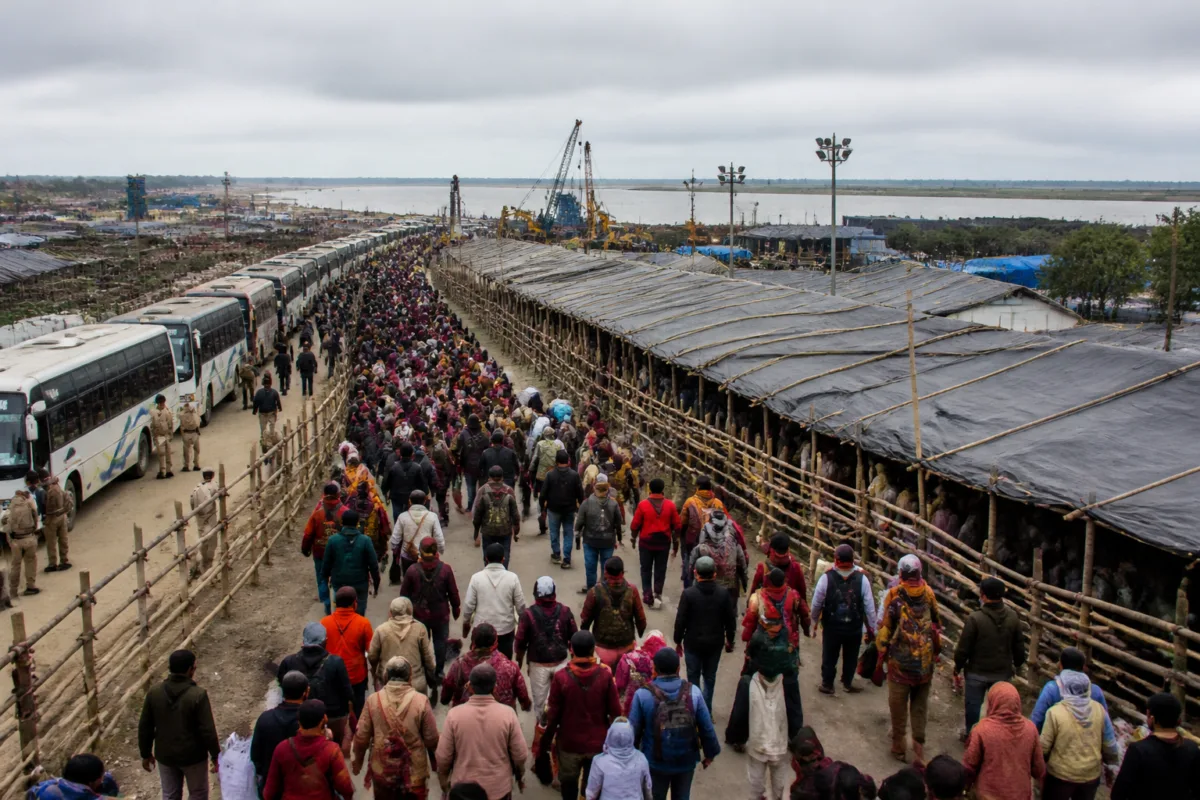
The proposed international expansion of Gangasagar Mela from 2027 places new pressure on the transport, accommodation and crowd-management systems serving Sagar Island, according to a report by The Statesman. The report says the fairground will grow from about 12 lakh square feet to 18 lakh square feet, while additional terminals, helipads, pilgrim facilities and medical arrangements are being prepared for a larger annual congregation.
The announcement was attributed to Suvendu Adhikari at a public meeting in Baruipur, South 24 Parganas. However, the supplied report also describes Adhikari as West Bengal Chief Minister, an office-title attribution that requires verification. The central infrastructure claims, including the fairground expansion and proposed facilities, should therefore be treated as reported plans pending confirmation from the relevant state departments or district administration.
The scale of the proposed upgrade is important because Gangasagar is not a conventional urban event site. The pilgrimage destination is located on Sagar Island, and access depends on a chain of road, bus, river-crossing and island-based facilities. Any increase in attendance places simultaneous demands on transport capacity, temporary accommodation, sanitation, medical care, emergency response and the management of pedestrian movement.
The reported increase of nearly six lakh square feet would expand the fairground by about half of its existing stated area. The report says the additional space is intended to improve crowd management and arrangements for the movement and accommodation of pilgrims and sadhus. It also links the expansion to expectations of higher attendance from within India and abroad, although no attendance forecast or capacity assessment is provided in the supplied material.
That gap matters because a larger event area does not, by itself, resolve the access constraints of an island pilgrimage centre. Visitors must still reach the district, travel towards the ferry or bridge access points, cross the Muriganga river where required, and move through Sagar Island to the fairground. The report refers to improved transport links and the construction of a bridge over the Muriganga, but it does not provide the bridge’s cost, carrying capacity, completion date or operating plan.
The district administration has reportedly begun strengthening arrangements through additional bus terminals, helipads and pilgrim accommodation facilities. These measures indicate that the planning challenge extends beyond the fairground boundary. Bus terminals affect how visitors are distributed before and after the pilgrimage, while helipads may support emergency access or the movement of high-priority visitors. Accommodation capacity is equally significant because a temporary surge can overwhelm local facilities even when the main event site has sufficient space.
The report also describes a proposed chain of special camps from Asansol to Gangasagar for pilgrims and sadhus arriving from Jharkhand. These camps would reportedly provide food, accommodation, rest and medical treatment and continue up to Sagar Island. Such an arrangement would distribute support facilities across the travel route rather than concentrating them only at the destination. The supplied report does not establish the number, location, ownership or operating arrangements of these camps.
This proposed route-based model reveals the administrative complexity of the mela. Pilgrimage infrastructure is not limited to a single municipal site. It involves coordination between district officials, transport agencies, police, health services, public works authorities, ferry or bridge operators and departments responsible for tourism and culture. The report refers to discussions between the state and Union ministries, but does not identify a final institutional framework for managing the expanded event.
National recognition is another part of the reported plan. The state government has renewed its demand for national fair status for Gangasagar Mela, while the report says that proposals and requests have reached the Union Ministries of Culture and Tourism. It also says the government is pursuing inclusion under the Centre’s PRASHAD scheme, which is intended to develop and modernise important pilgrimage destinations. No approval under the scheme or formal national fair designation is confirmed in the supplied material.
The distinction between an announced ambition and an approved programme is central to understanding the project. A declaration that the mela will become an international event by 2027 sets a political and administrative target. It does not establish that all required funding, land, permissions, tenders, transport upgrades or operating protocols are in place. The report says preparations have begun, but it does not provide a consolidated project schedule or budget.
Connectivity is likely to remain the decisive infrastructure issue. The report says a bridge over the Muriganga river has made considerable progress and that improved rail and road links have been sought from the Union Railway Ministry. Yet no details are supplied on the current level of rail connectivity, the bridge’s planned opening, the number of vehicles or passengers it will handle, or how traffic will be managed during peak pilgrimage days.
For an event that attracts visitors from different parts of the country and potentially from abroad, transport capacity must be matched with safe dispersal. Crowds arriving in concentrated waves can create bottlenecks even when total daily capacity appears adequate. The report’s references to bus terminals, route-side camps, accommodation and medical treatment suggest that authorities are considering the full travel chain, but the operational details remain unclear.
The same applies to public health and basic services. Food, rest and medical treatment are listed among the proposed camp facilities, while accommodation is mentioned both along the route and on Sagar Island. The source does not provide information on drinking water, toilets, solid waste, sewage, power supply or emergency evacuation. These services are part of the practical capacity of a large temporary settlement and will require verification as planning advances.
The PRASHAD proposal also raises questions about the division of responsibilities and funding. If the site is included in the scheme, the Centre and the state would need to establish which components qualify for support and which would remain the responsibility of state departments or local administration. The supplied report does not state whether any funding has been sanctioned, whether a detailed project report has been approved or whether construction contracts have been awarded.
The proposed expansion therefore has two distinct dimensions. One is the visible development of the fairground, terminals and pilgrim facilities. The other is the less visible administrative system needed to operate a larger event safely. The second dimension includes inter-agency coordination, real-time crowd information, emergency response, public health arrangements and the management of movement across the mainland, river crossing and island.
The report presents the 2027 target as part of a wider effort to establish Gangasagar as a major religious congregation. It also records an earlier assurance that efforts would be made to secure national fair status and says several rounds of discussions have taken place with the Centre. These developments show that the proposal is being positioned simultaneously as a tourism project, a pilgrimage infrastructure programme and a case for greater national institutional support.
What remains unestablished is whether the announced physical expansion is supported by measurable demand projections and a complete implementation plan. The source provides the existing and proposed fairground areas, but not expected visitor numbers, peak-day loads or the capacity of transport and accommodation systems after the upgrades. Those figures will be necessary to judge whether the proposed infrastructure can match the ambition of international status.
The next milestones are therefore formal verification of the announcement, confirmation of the responsible office and authorities, clarity on national fair status, any decision under the PRASHAD scheme, and published details of the Muriganga bridge and related road and rail works. Until those details are available, the 2027 plan is best understood as a reported expansion proposal whose success will depend less on the size of the fairground alone than on the capacity and coordination of the wider pilgrimage network.

