


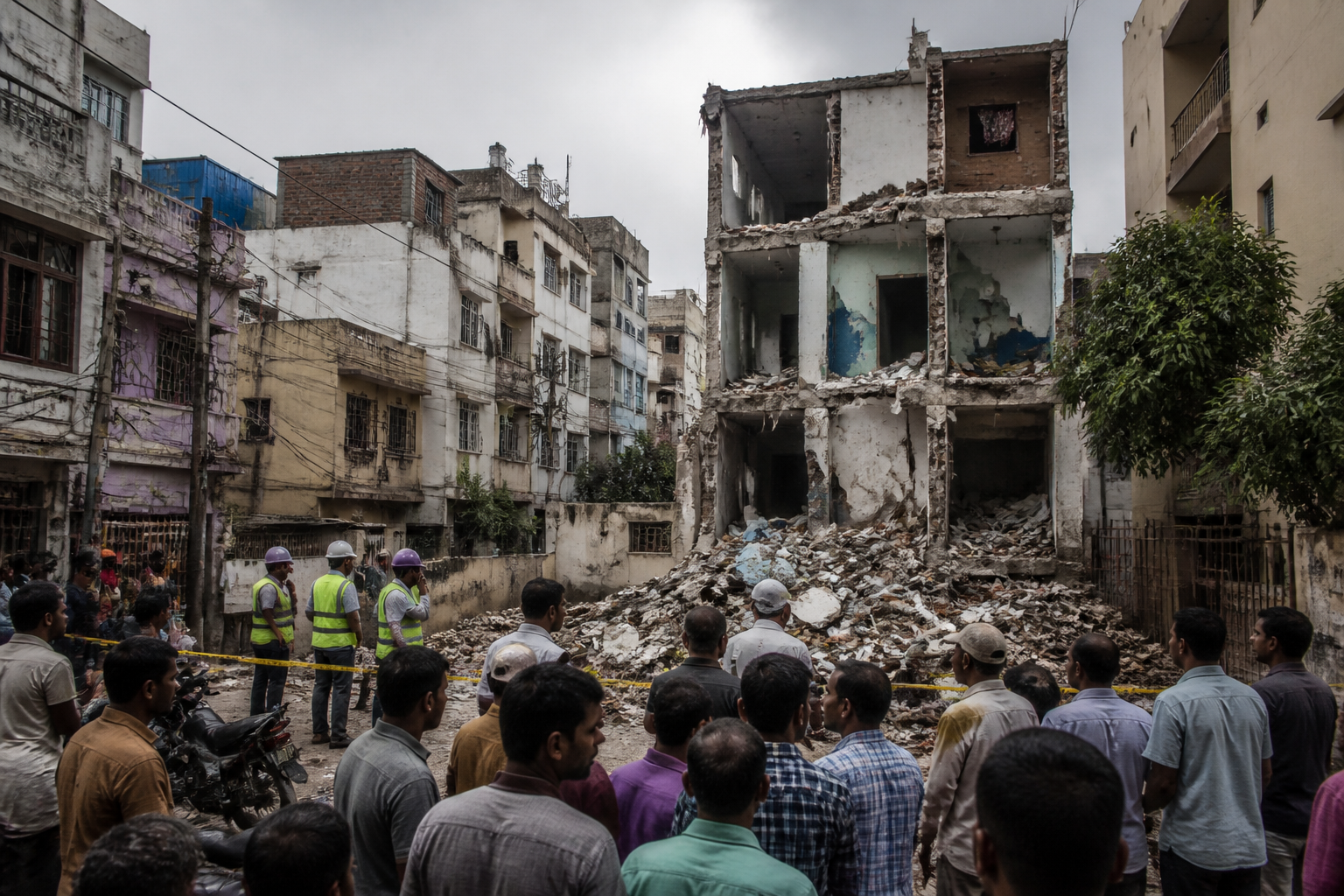
The Gachibowli building collapse, which killed two workers in an unauthorised G+6 structure, has become a wider test of how Hyderabad monitors construction on small plots. A month after the Anjaiah Nagar incident, residents and resident welfare associations are asking not only how the building failed, but how it was allowed to reach that scale in the first place.
Those questions gained urgency after a four-storey building in NTR Nagar, Gopanpally, developed a dangerous tilt and was evacuated before being demolished by civic authorities. The two incidents are not described as structurally identical in the supplied report, but together they have intensified concern over unauthorised construction, building safety and the ability of the Cyberabad Municipal Corporation (CMC) to identify risks before they become emergencies.
The issue is therefore larger than one collapsed building. It concerns the entire chain through which urban construction is approved, monitored and occupied: the accuracy of applications, the interpretation of zoning rules, inspections at critical construction stages, certification of completed structures and enforcement against violations. The report records allegations at several points in this chain, but it does not establish that every allegation has been independently proven.
The immediate trigger was the collapse of an unauthorised G+6 building in Anjaiah Nagar, Gachibowli, in which two workers died. The subsequent evacuation and demolition of the tilted building in Gopanpally brought the safety of other structures into the public conversation. Residents and RWAs have since questioned whether the civic system is acting mainly after a structure becomes visibly dangerous, rather than identifying unsafe buildings while construction is under way.
This distinction matters in dense urban neighbourhoods. A building can become a public-safety concern not only when it collapses, but also when its construction departs from approved plans, when structural conditions are not adequately checked, or when neighbouring buildings are built with little space between them. According to the report, several buildings in the affected areas have been constructed edge-to-edge, leaving little or no setback. Residents allege that some narrow high-rises have also been built without adequate soil testing or proper structural engineering.
These allegations point to the limits of treating approval as a one-time administrative event. A digital permission may record the information submitted by an applicant, but construction safety also depends on whether the submitted plot dimensions, structural details and building configuration match what is actually built. It depends on inspections at the ground level and on action when deviations are detected. The report says residents have alleged that incorrect structural data and plot dimensions were uploaded on automated approval portals to avoid scrutiny. These claims require examination by the relevant authorities; they cannot be treated as established findings solely on the basis of resident allegations.
The governance concern is that responsibility may become fragmented across different stages. Town-planning officials may examine permissions, enforcement teams may issue notices or order demolitions, and other civic wings may be involved in monitoring compliance and structural fitness. RWAs have called for a review of how these departments function and how they coordinate. Their concern is not limited to the existence of unauthorised buildings, but also to whether officials responsible for monitoring construction have acted when violations were visible.
The report says the commissioner deployed enforcement teams for demolition drives and issued notices to under-construction sites in parts of Gachibowli and Madhapur. Some RWAs, however, alleged that authorities were focusing on buildings still under construction while overlooking risks posed by occupied structures. That creates a difficult enforcement problem: action against an active construction site may be administratively simpler, while inspecting and regulating an occupied building can involve residents, ownership questions, access issues and the possibility of displacement.
A credible safety system has to address both categories. Notices and demolition drives can respond to visible violations, but they do not by themselves establish whether occupied buildings are structurally safe. The report says residents want a comprehensive audit to identify hazardous and unauthorised structures, particularly buildings constructed on 50-square-yard plots in Anjaiah Nagar and elsewhere within the CMC’s limits. It also records allegations that unauthorised multi-storey buildings have proliferated on 50- and 75-square-yard plots.
The small-plot question is central to the dispute. Residents and RWAs have questioned how construction permissions were generated through a digitised system for restricted 50-square-yard plots. They allege that zoning rules were misinterpreted to permit commercial-scale vertical construction on small residential plots. They have also questioned whether fitness certificates were issued without adequate checks on structural stability and foundation strength.
The available report does not provide the number of such buildings, the number of permissions issued, the applicable rule text, or the number of fitness certificates under dispute. Those gaps are important because the scale of the problem cannot be assessed through individual incidents alone. A database would help establish how many buildings are involved, where they are located, what was approved, what exists on site and whether any complaints or notices were previously recorded.
The absence of a comprehensive database, as described by residents, is itself an administrative weakness if confirmed. Without a reliable inventory, enforcement is likely to remain complaint-driven or incident-driven. Officials may know about individual structures, but the civic body would find it harder to prioritise buildings by risk, identify clusters of similar violations or track whether notices result in compliance. A structured record could also clarify which agency is responsible for each stage of action.
The allegations about altered or fake blueprints raise a related issue: the difference between formal compliance and actual compliance. A plan can satisfy an automated check while the constructed building departs from the approved design. If ground-level inspections are not conducted at critical stages, the approval system may validate documents without validating the physical structure. The report attributes these allegations to residents and does not cite an official finding confirming them.
That distinction is particularly relevant as construction approvals become digitised. Digital systems can standardise submissions and reduce discretion, but they cannot independently verify every physical condition on a plot. They may also reproduce errors if incorrect dimensions or structural information are entered at the application stage. The effectiveness of digitisation therefore depends on field verification, transparent records and consequences for false submissions or unauthorised deviations.
The Gachibowli building collapse also exposes the tension between fast urban development and the institutional capacity to regulate it. Areas such as Gachibowli, Madhapur, Anjaiah Nagar and Gopanpally have seen intense construction activity, but the supplied report does not provide a quantified account of population growth, building approvals or construction volumes. What it does show is a pattern of public concern around vertical construction on small plots, narrow building forms, limited setbacks and the safety of occupied structures.
That pattern shifts the policy focus from demolition after failure to prevention before occupation. A building that is visibly tilted can be evacuated and demolished, as happened in Gopanpally. A collapse that kills workers, however, represents a failure that has already moved beyond enforcement into loss of life. The unresolved question is whether the same risks could have been identified earlier through inspections, complaints, structural review or a systematic audit.
The responsibility for answering that question lies with the civic administration and the agencies involved in town planning, construction monitoring and structural certification. Residents have called for a review of these functions, while an RWA office-bearer cited in the report sought a comprehensive audit of buildings and identification of those violating norms. The report does not record a detailed official response addressing each allegation, nor does it state whether the CMC has announced a citywide audit, published a list of unsafe buildings or initiated proceedings against specific officials or builders.
For residents, the problem is not only the risk of a dramatic collapse. Unauthorised additions, inadequate foundations, absent setbacks and construction between closely packed buildings can affect access, emergency response and the safety of neighbouring properties. The report does not provide technical assessments of those consequences in the buildings mentioned, so the risks must be investigated rather than assumed. But the concerns explain why RWAs are asking for action beyond isolated demolition drives.
The larger urban question is whether Hyderabad’s construction-control system can keep pace with the physical intensity of development in its expanding neighbourhoods. Permission portals, zoning rules, inspections, fitness certificates and enforcement teams are separate parts of the same safety chain. If one link records inaccurate information, fails to inspect or does not act on a violation, the weakness can remain hidden until a structure tilts or collapses.
The evidence currently available confirms two incidents that have prompted public concern, along with a series of allegations about unauthorised construction and civic oversight. It does not establish the full number of unsafe buildings, prove wrongdoing by named officials or developers, or explain how permissions and fitness certificates were issued in the cases cited. The next significant steps are therefore clear: an official audit or database of hazardous structures, a documented review of approvals and inspections, and a public account of how the CMC will address buildings already occupied as well as those still under construction.
