


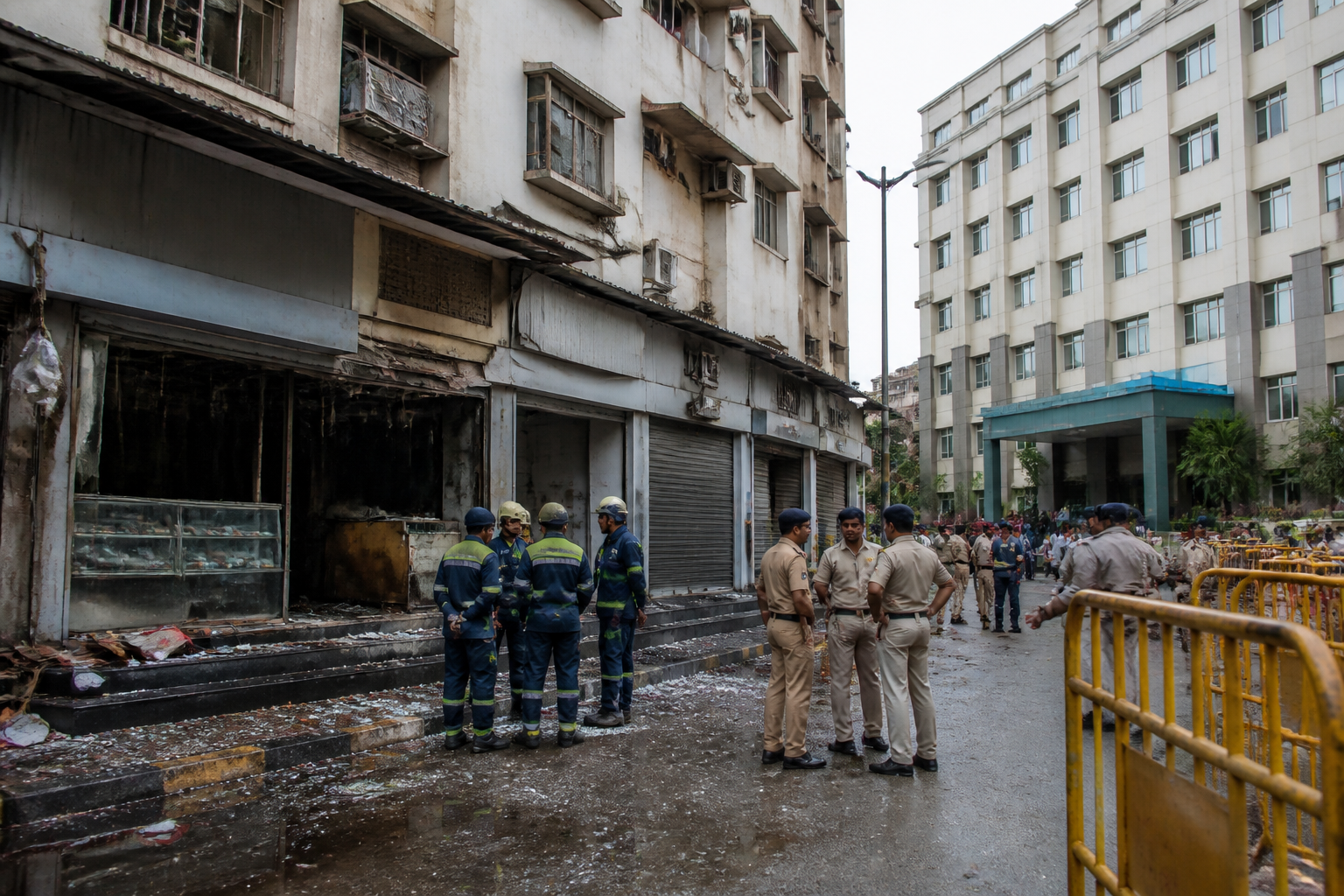
The Navi Mumbai LPG blast at a Sanpada eatery has turned fatal after one of the two brothers injured in the explosion died during treatment, while the documented damage extended beyond the commercial unit to neighbouring shops, an apartment above the eatery and a hospital across the road. The incident brings into focus how a gas leak in a small ground-floor business can affect an entire urban cluster of homes, shops and healthcare facilities.
The explosion occurred at around 6 am on September 15 at an eatery operating from a ground-floor commercial unit in Pratik CHS, Sector 1, Sanpada. According to the report, the blast was triggered by leakage from an LPG cylinder. Arjun Yadav, 46, and his brother Manish Yadav, 26, who were running the eatery, sustained severe burns.
Dr Sunil Keswani, a plastic surgeon at National Burns Hospital in Airoli, said Arjun had suffered burns over 92% of his body and was on ventilator support in the intensive care unit. He succumbed during treatment on Friday, three days after the blast. Manish, who suffered 42% burns, was discharged against medical advice at the request of his family and taken to a hospital in Rajasthan for further treatment, the doctor said.
The scale of the incident is significant because the damage was not confined to the eatery where the leak originated. Three shops, including the eatery, were damaged in Pratik CHS. Three additional shops in the neighbouring Abhimanyu CHS were also affected. The blast also shattered the glass facade of Suraj Hospital, located about 50 feet away across the street, and damaged interior walls inside the hospital premises.
The hospital’s patients and staff were not injured, according to the report. However, the fact that a nearby healthcare facility sustained damage is important for understanding the urban consequences of such incidents. A hospital is not simply another building in the street network: it contains patients who may have limited mobility, staff working in occupied interiors and equipment that can be affected by structural or facade damage. In this case, the reported absence of injuries at the hospital limited the human toll, but the blast reached a facility whose operations are built around continuous care.
The explosion also affected the residential space above the eatery. Flooring tiles in the first-floor apartment were damaged, showing how a commercial incident at ground level can transmit force into the homes located immediately overhead. The arrangement described in the report places a food business, shops, residences and a hospital within a short distance of one another. That proximity is a normal feature of dense urban neighbourhoods, but it also means that a failure inside one premises can quickly become a multi-property emergency.
This is the central built-environment issue raised by the Sanpada blast. The immediate trigger identified in the report was LPG leakage, but the consequences were shaped by the surrounding urban form: a commercial unit in a housing society, an apartment directly above it, neighbouring shops and a hospital across the road. The incident therefore cannot be understood only as an event inside one eatery. Its documented impact followed the connections between buildings and uses that share the same street and, in some cases, the same structure.
The report does not establish the precise cause of the leakage, whether any inspection had taken place before the incident, or whether any safety violation was identified. Those questions remain outside the facts supplied. It does establish the sequence of events: a leak-triggered explosion at the eatery, severe burns to the two occupants, damage to multiple nearby properties and the subsequent death of one injured person.
The institutional response described so far involves medical treatment and police procedure. Arjun was treated at National Burns Hospital in Airoli, where doctors provided details of his condition and death. After his death, Rabale police conducted an inquest panchnama and sent the relevant documents to Sanpada police station. Deepak Surve, senior inspector of Sanpada, said police would subsequently register an accidental death case.
The transfer of documents between Rabale and Sanpada police stations reflects the administrative steps that follow a serious urban accident. The incident occurred in Sanpada, the injured man died at a hospital in Airoli, and the police process involved the station that conducted the inquest as well as the station handling the original incident. The report does not specify the final findings of any investigation into the LPG equipment, the premises or the cause of the leakage.
The case also illustrates the different layers of public response required after a fire or blast in a dense neighbourhood. Medical teams handled severe burn injuries; the hospital received a patient requiring ventilator support; police documented the death and began the process for an accidental death case; and the affected buildings and shops were left with physical damage. These functions address different parts of the same event, but the supplied report does not indicate whether a broader safety assessment of the affected premises has been completed.
The numbers in the report convey the intensity of the blast. One victim suffered 92% burns and died despite treatment. The second suffered 42% burns and was discharged for further care elsewhere. Three shops in Pratik CHS were damaged, three shops in the neighbouring Abhimanyu CHS were also affected, and Suraj Hospital, approximately 50 feet from the eatery, suffered damage to its glass facade and interior walls. The apartment above the eatery also sustained damage to its flooring.
Taken together, these details show a pattern of impact across multiple building types rather than a single-room fire. The blast affected a business where the cylinder was located, other commercial units, a residential apartment and a healthcare building. The spread of damage was physical, but it also created the potential for disruption across different urban functions. The report does not state how long the shops or hospital spaces remained affected, whether residents were evacuated or whether any building was declared unsafe, so those outcomes cannot be assumed.
For municipal and building-safety institutions, the documented case raises a basic question about how risks are managed where commercial activity operates within or beside residential developments. The source material does not identify the responsible licensing, fire-safety or inspection authority, nor does it report any official finding on compliance. It would therefore be premature to assign responsibility. What can be established is that the consequences crossed property boundaries, making the incident relevant to more than the operator of the eatery.
The role of the hospital across the road further demonstrates why emergency risk in cities is connected to land-use proximity. A building may be exposed to an incident without being the source of that incident. Suraj Hospital was about 50 feet from the eatery, yet its facade and interior walls were damaged. Its patients and staff were unharmed, according to the report, but the physical impact shows that neighbouring facilities can become part of the emergency even when the initial failure occurs elsewhere.
The death of Arjun Yadav is the latest development in a case that began with a blast on September 15. Police are moving towards registering an accidental death case after completing the relevant inquest documentation. The supplied report does not provide the findings of that case or any subsequent determination about the LPG cylinder, the eatery’s operations or the condition of the affected properties.
What the evidence confirms is a fatal LPG leak-related explosion whose consequences travelled through a compact urban setting. What remains uncertain is the precise mechanism of the leak, the safety status of the premises before the incident and the remedial action, if any, ordered for the damaged shops, apartment and hospital. Those pending facts will determine whether the episode is treated only as an individual accident or also prompts a wider review of safety in similar mixed-use buildings.
