


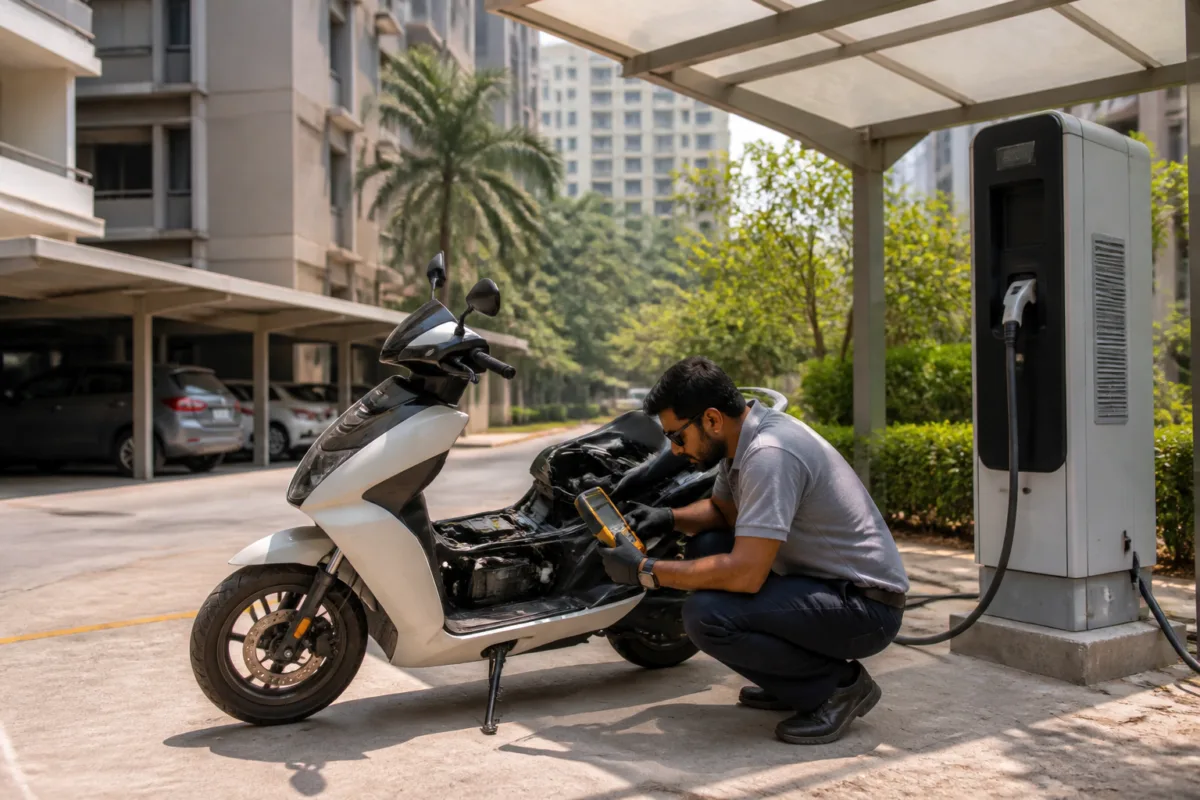
India’s electric vehicle transition is placing a less visible part of urban mobility under greater scrutiny: what happens to a battery after a vehicle has been driven hard in hot weather. Research underway at IIT Madras and comments from an electric mobility company indicate that battery safety cannot be treated as a one-time product feature. It has to be managed through driving, charging, inspection and maintenance across the vehicle’s operating life.
The immediate concern is thermal stress. A lithium-ion battery produces heat both when it discharges electricity to move a vehicle and when it charges. The harder it works, the more heat it generates. For an electric scooter returning from a long ride, that means the battery may remain hot even after the vehicle has stopped. Connecting it immediately to a charger introduces another heat-generating process before the battery has had time to cool.
This does not mean that every electric vehicle becomes unsafe when it is plugged in after a ride. The supplied evidence does not establish a universal rule or document a specific incident caused by immediate charging. It does, however, identify a condition that manufacturers, operators and users need to manage: battery temperature during the period between operation and charging.
Researchers at IIT Madras are studying cooling technologies intended to help electric vehicles function in India’s extreme weather conditions. Their work is significant because much of the public discussion around electric vehicle adoption focuses on purchase prices, charging availability and range. Thermal management adds another layer to the transition: whether the vehicle can reliably control heat under the combined pressure of high ambient temperatures, demanding operation and charging.
In an experiment cited in the report, a 60 ampere-hour battery cell crossed 45 degrees Celsius when the ambient temperature was 35 degrees Celsius or higher and the cell operated at a discharge rate of 1C or above. The researchers regard 45 degrees Celsius as an important threshold for battery thermal management. The result illustrates the narrow operating challenge faced by vehicles in hot conditions. The battery does not need to be exposed to an extraordinary event to experience thermal stress; ambient heat and normal vehicle use can combine to push temperatures upwards.
The significance of the 45-degree threshold is not that it marks a simple boundary between safe and unsafe operation in every vehicle. Battery packs differ in design, chemistry, software controls, cooling systems and operating conditions. Rather, it shows why temperature has to be measured and managed as part of the vehicle system. A battery operating in a hot environment while delivering power at a high rate may require a different charging response from a battery that has been used lightly in cooler conditions.
The charging stage matters because it adds heat after the battery has already generated heat during discharge. If a rider completes a demanding journey and immediately begins charging, the battery may face thermal stress from two successive processes. High temperatures can also accelerate battery ageing, gradually reducing the battery’s ability to hold charge. That creates a connection between safety and economics: thermal management affects not only the risk profile of a vehicle but also the durability of one of its most expensive components.
For cities, this issue is closely tied to how electric mobility is actually used. Electric two-wheelers are often parked, charged and operated in homes, apartment buildings, workplaces and commercial premises. The battery’s condition is therefore influenced by everyday routines rather than only by formal testing or the moment of purchase. A user may complete a long journey, park the scooter in a confined area and plug it in without knowing the battery temperature. The report does not establish how widespread this behaviour is, but it shows why charging instructions must be understandable and practical for routine urban use.
The responsibility also extends beyond individual riders. Naveen Gupta, founder and chief executive officer of Trev Mobility, told NDTV that battery safety must be addressed throughout a vehicle’s lifecycle rather than only when a customer purchases it. He said high temperatures can affect battery performance and accelerate degradation, while heat generated during driving and charging makes thermal management an important part of the overall system.
Gupta’s comments point to a shift in the way electric vehicle safety is organised. A purchase-centred model places emphasis on the specifications and safeguards delivered at the time of sale. A lifecycle model adds continuing responsibilities: battery health monitoring, regular vehicle inspections, dependable charging infrastructure, manufacturer guidance and operating procedures that reflect battery temperature and local conditions.
That distinction is particularly important for fleets. A private user operates one vehicle and may notice changes in range or charging behaviour over time. A fleet operator may manage many vehicles that are used repeatedly, charged on a schedule and exposed to different levels of mechanical and thermal stress. Gupta said fleet operators need to monitor vehicles consistently and ensure that maintenance and charging procedures are followed systematically. The operational question is not simply whether a vehicle can be charged, but whether the timing and conditions of charging are appropriate for its recent use.
This places software, service networks and charging infrastructure alongside battery chemistry in the safety chain. A battery management system may monitor temperature and state of charge, but the vehicle still depends on charging equipment, inspection regimes and user behaviour. The report does not provide details of a particular manufacturer’s software or charging protocol, so it cannot establish which safeguards are already standard across India’s electric vehicle market. It does show that safety outcomes depend on the interaction between technology and operating practice.
The policy landscape around electric mobility has often been framed through adoption: how many vehicles are sold, how quickly charging networks expand and how effectively electric vehicles reduce dependence on conventional fuels. The material in this report adds a maintenance and governance dimension. If battery safety is a lifecycle responsibility, then the relevant ecosystem includes manufacturers, dealers, service providers, fleet managers, charging operators, building managers and vehicle users.
Each actor controls a different part of the risk-management process. Manufacturers determine battery and thermal-management design. Charging providers influence the reliability of the equipment and the information available to users. Service networks inspect vehicles and identify battery-health concerns. Fleet operators establish schedules and maintenance systems. Users decide where and when vehicles are charged. The report does not assign legal responsibility among these actors, but its evidence makes clear that a single handover at the point of sale cannot cover the full operating life of a battery.
The available data is limited but useful. The cited experiment combines an ambient temperature of at least 35 degrees Celsius with a discharge rate of 1C or above and records a cell temperature above 45 degrees Celsius. Those numbers provide a concrete illustration of how heat can accumulate. They should not be treated as a national estimate of battery failures, because the report supplies no fleet-wide incident data, comparative testing across models or statistics on charging-related accidents.
That absence matters. Public understanding of electric vehicle safety can be distorted in two directions: isolated incidents may be treated as proof that the technology is inherently unsafe, while the absence of reported incidents may be treated as proof that operating procedures do not matter. The evidence here supports neither conclusion. It supports a narrower and more practical finding: temperature management is a material part of reliable electric vehicle operation, especially when high ambient heat and demanding use coincide.
The larger urban question is how quickly cities can build the institutional habits required by a new mobility technology. Electric vehicles are not only cleaner substitutes for internal-combustion vehicles; they are also battery-dependent systems that introduce new maintenance, charging and safety requirements into homes, workplaces, parking facilities and transport fleets. The success of electrification will therefore depend on the quality of everyday systems around the vehicle as much as on the vehicle itself.
The report’s central lesson is that battery safety begins before charging and continues long after purchase. IIT Madras researchers are examining cooling technologies for hot conditions, while industry guidance points to monitoring, inspections, dependable infrastructure and adherence to manufacturer instructions. What remains unclear from the available evidence is how widely these practices are followed across India’s electric vehicle market and how different vehicle designs respond to heat. Those questions will determine whether thermal management becomes a routine part of urban mobility operations or remains an issue addressed only after problems appear.

