


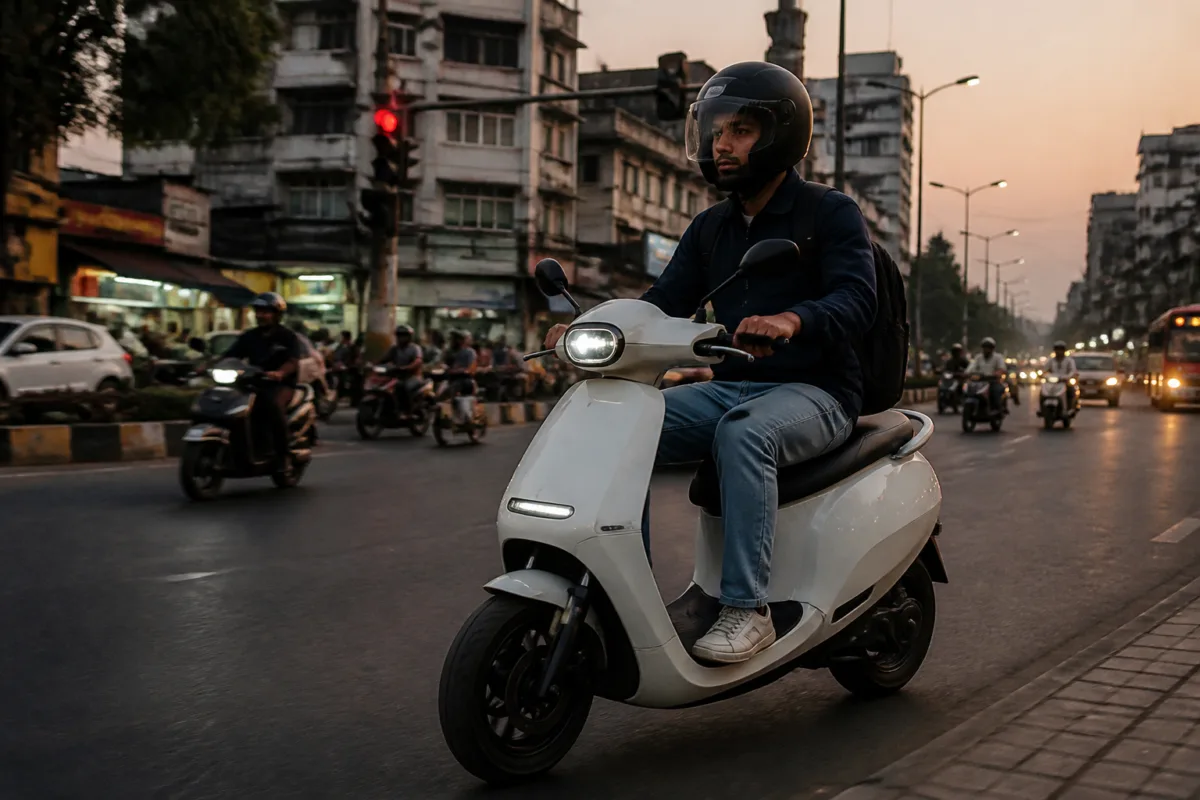
Ola Electric has secured nearly ₹600 crore through a rights issue, but the fundraising arrives as its registrations fall in a growing electric two-wheeler market. That divergence turns the company’s latest capital raise into more than a balance-sheet event: it is a test of whether a major electric mobility player can convert investor support into reliable products, stronger sales and lower cash consumption.
The company allotted 37.03 crore partly paid-up shares at ₹27 apiece, collecting ₹599.84 crore from shareholders. Investors will be required to contribute another ₹399.89 crore through a subsequent call, expected by October 31, 2027. The issue therefore provides immediate capital while leaving a substantial portion of the planned funding to be collected later.
For India’s urban mobility transition, the timing is important. Electric two-wheelers occupy a practical space between public transport and private cars. They are used for daily commuting, household travel and commercial movement, making product availability, service reliability and delivery consistency central to whether electric mobility becomes a routine part of city life. The registration data in the report shows that industry growth alone is not translating into stronger performance for every manufacturer.
According to Vahan data cited by The Hindu BusinessLine, Ola Electric’s October registrations fell 10.1 per cent to 12,096 from 13,458 in September. The decline represented a fourth consecutive monthly fall, while the company’s market share dropped to 5.40 per cent from 6.45 per cent. At the same time, India’s electric two-wheeler market expanded 7.3 per cent to 2,23,886 registrations in October, described in the report as a 2026 high.
This contrast is the central evidence in Ola’s current position. The addressable market is expanding, but Ola’s share of that market is contracting. The numbers do not establish a single cause. They do, however, show that the company’s challenge is not simply weak overall demand for electric two-wheelers. It is also the company-specific task of retaining customers and competing as other manufacturers gain ground.
The rights issue gives Ola more financial room, but it does not by itself resolve the operational gap. The rights shares were priced at ₹27, a 22.5 per cent discount to the company’s Monday closing price of ₹34.85. The lower price may help attract participation, but the report notes that the cushion could narrow if the stock weakens. More importantly for the business, a discounted issue price does not automatically improve registrations, margins or service performance.
Kranthi Bathini, Director, Equity Strategy at WealthMills Securities, said the discount provides a lower entry price but cannot substitute for operational recovery. He identified declining registrations, margins and cash consumption as the issues investors must assess. That framing is relevant beyond the company’s shareholders because the viability of a large electric two-wheeler manufacturer affects the continuity of products, service networks and customer support available to urban users.
The structure of the fundraising also reveals how different stakeholders are positioning themselves. SoftBank, one of Ola’s earliest institutional backers, sold 1.12 crore of approximately 4.33 crore rights entitlements. Its equity stake has declined to about 11.7 per cent from 12.9 per cent through open-market transactions during the year. The sale does not by itself establish a view on Ola’s future, but it shows that an early institutional investor has reduced its exposure while the company is seeking fresh shareholder capital.
Other investors took different routes. ANI Technologies, the Ola Cabs operator, renounced approximately 1.28 crore entitlements to Motilal Oswal Financial Services. Indus Trust, whose trustee Ankush Agarwal is the brother of founder Bhavish Aggarwal, transferred around 1.10 crore entitlements to Calliope Capital Advisors, which is linked to Motilal Oswal group Managing Director Navin Agarwal. Both recipients applied for shares, according to the report.
Bhavish Aggarwal subscribed to his full entitlement and pledged 20 crore Ola shares, representing approximately 4.32 per cent of the company’s equity, to finance the investment. The promoter’s participation signals continued financial commitment, while the pledge adds another layer to the funding structure. The supplied information does not establish how the pledge will affect the company’s operations or shareholding beyond its role in financing the investment.
The latest issue follows a larger institutional placement in June, through which Ola raised ₹780.24 crore at ₹35.86 per share. That price was approximately 25 per cent above the rights issue price. The sequence points to repeated reliance on capital markets within a relatively short period. It also creates a clear performance question: whether the new funds can produce an improvement in the operating indicators that weakened between the two fundraisings.
Ola reported ₹215 crore in operating cash outflows during April-June and delivered 39,192 vehicles against guidance of nearly 45,000. These figures place the company’s registrations decline in the context of both sales execution and cash use. A company can raise capital while still facing pressure if the funds are absorbed by ongoing operating losses, debt obligations or underperformance against delivery plans.
The allocation of the nearly ₹1,000-crore rights issue provides a partial map of the immediate financial priorities. About ₹350 crore is earmarked for debt-related payments, ₹400 crore for organic growth and ₹233.99 crore for general corporate purposes, before issue expenses. The allocation indicates that the proceeds are not directed exclusively towards expansion. A significant portion is intended for debt-related payments and broad corporate requirements, while the organic-growth allocation is expected to support the company’s business development.
That mix matters for urban mobility because the quality of a two-wheeler ownership experience depends on more than the vehicle itself. The report specifically identifies product appeal, service reliability and consistent delivery as areas where Ola needs to rebuild customer confidence. These are operational factors with direct consequences for riders. Delays, weak after-sales support or uncertainty around service can influence whether a consumer chooses an electric vehicle and whether existing users remain willing to recommend or replace one.
Aveek Chattopadhyay, an automobile industry analyst cited in the report, said Ola’s decline amid industry growth highlights competitive pressures. He also said rebuilding customer confidence through product appeal, service reliability and consistent delivery remains critical. His assessment connects the registration data to the wider market structure: as the category expands, manufacturers are competing not only for first-time demand but also for trust in the ownership system surrounding electric vehicles.
The market-share movement makes that pressure measurable. Ola’s share fell from 6.45 per cent in September to 5.40 per cent in October even as total electric two-wheeler registrations increased. The fall does not reveal which competitors captured the difference, and the supplied report does not provide a manufacturer-by-manufacturer comparison. It does establish that market expansion is currently benefiting the category more broadly than it is benefiting Ola.
The company’s next reported results will therefore be important for reading whether the capital raise is beginning to alter the operating picture. September-quarter results were due by November 14, according to the report. The relevant indicators will include registrations, deliveries against guidance, operating cash outflows and the use of funds for debt and growth. These measures will show more clearly whether the fundraising is functioning as a bridge to operational recovery or primarily as short-term financial support.
The larger urban question is whether India’s electric mobility growth can remain broad-based when individual manufacturers face uneven demand, service and funding conditions. Rising category registrations suggest that consumer interest exists, but Ola’s decline shows that market growth does not remove the need for dependable products and support systems. For cities, the transition depends on whether electric two-wheelers can operate as reliable everyday transport rather than merely as a fast-growing sales category.
The evidence currently confirms a financing boost alongside a weakening position in the electric two-wheeler market. Ola has raised ₹599.84 crore immediately, with another ₹399.89 crore due through a later call, but its October registrations and market share fell while the overall market expanded. The next milestone is whether the company’s results and subsequent operating data show stronger deliveries, reduced cash consumption and renewed customer demand.

