


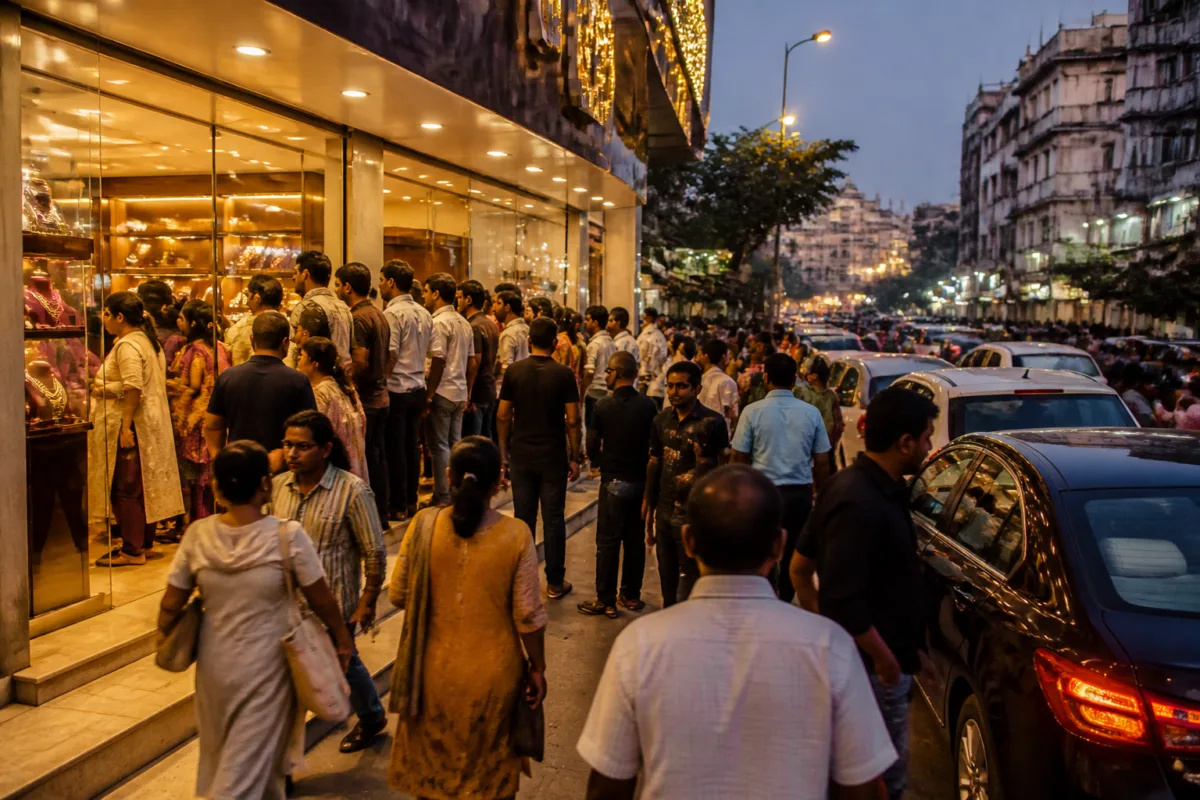
Kolkata’s Dhanteras shopping rush brought together gold jewellery, consumer durables, cars and everyday household goods, but the city’s retail activity also revealed a more uneven picture of urban consumption. While jewellery and luxury vehicles saw strong demand, retailers said rising prices and stagnant or inadequate income growth were limiting purchases in other categories.
The pattern matters because festive consumption is not only a measure of spending. It also shows how households distribute money across savings, status, mobility and basic domestic needs. In Kolkata on Friday, those priorities appeared at every price point: a luxury SUV for one buyer, a gold bangle for another, and a broom or phone cover for a household shopping with a much smaller budget.
The reported rush was visible across the city. Stores were busy from noon, with crowds intensifying in the evening as families came out after work. Popular shopping zones faced a familiar urban constraint: demand for retail space and access rose faster than the availability of parking. Jewellery stores recorded some of the longest queues, while billing counters remained crowded and employees worked to process customers through the day.
This street-level pressure is significant because the festival exposes the dependence of city commerce on physical access. A retail sale requires more than consumer willingness to spend. It also depends on whether customers can reach a store, park nearby, complete a transaction and take delivery. The report does not provide a citywide assessment of parking capacity or transport access, but the difficulty of finding parking in busy shopping areas shows how festive demand can test the operational limits of established commercial districts.
Jewellery was the clearest centre of demand. At the Moulali branch of Senco Gold and Diamonds, almost every counter was reportedly occupied. Customers included those purchasing traditional bridal jewellery, lighter everyday designs and gold as an investment. Aniketa Bose, a Hatibagan resident who works in sales for a private company, had booked a gold bangle on Monday and chose to take delivery on Dhanteras. Her purchase illustrates how the festival can shape the timing of transactions that were planned earlier rather than generate all demand on the day itself.
Retail executives described a broad-based increase in jewellery business. Senco Gold managing director and chief executive Suvankar Sen said the company recorded growth of more than 25 per cent in sales value compared with the previous year. He also said footfall had increased, diamond jewellery sales had grown strongly, and wedding customers and families buying jewellery as part of their savings had participated in the market.
Those claims come from company executives and describe business performance rather than an independently verified citywide estimate. Even so, they identify several distinct forms of demand operating together. Jewellery was being purchased for weddings, daily use and savings, meaning that the same retail category served household obligations, personal consumption and wealth preservation. The report does not establish how much of the increase came from higher volumes or higher prices, but the distinction is important when interpreting growth in sales value.
The role of gold as a savings instrument was also reflected in comments from jewellers. Annargha Uuttiya Chowdhury, director of Anjali Jewellers, attributed a positive and robust market to a fall in gold prices and said the business was seeing first-time customers as well as older patrons. The source does not provide the price movement or transaction data needed to measure the effect of lower prices, but the retailer’s account suggests that affordability and purchase timing were influencing demand.
The most visible expression of high-value consumption came from the automobile market. Mercedes-Benz dealer Landmark Cars had around 30 deliveries scheduled at its Topsia showroom. One buyer, Savita Newar, took delivery of a Mercedes-Benz Maybach GLS 600, a black SUV booked three months earlier. The vehicle purchase demonstrates how Dhanteras functions as a delivery milestone for high-value goods, not simply as a day of spontaneous shopping.
Automobile dealers reported strong activity beyond the luxury segment. Landmark Cars chief executive Neelmani Sharma said luxury car sales had grown by almost 10 per cent in Bengal. Akhil Agrawal, managing director of Gajraj Group, which deals in Hyundai, Kia and Skoda cars, said more than 130 deliveries were lined up across the group’s dealerships in Bengal. The figures are dealer-reported and cover different parts of the state, so they cannot be directly treated as a measure of Kolkata’s overall automobile market. They do, however, show that festive demand was spread across multiple vehicle price bands.
Vehicles also connect festive consumption to the city’s wider built environment. A car purchase creates demand for showroom access, road connectivity, parking and delivery logistics. Luxury deliveries at Topsia and dealership activity across Bengal occurred within a retail system that relies on road-based movement. The report does not detail congestion or transport arrangements around the showrooms, but the contrast between vehicle demand and parking pressure in shopping districts points to the same underlying issue: urban commerce is shaped by the capacity of streets and commercial premises to absorb concentrated activity.
Consumer durables presented a more restrained picture. Appliance stores were busy, but crowds were thinner than at jewellery showrooms. Pulkit Baid, director of Great Eastern Retail, said phone prices across segments had risen by almost 30 per cent since the previous year and that prices of other consumer durables had also increased. He added that income growth had not been sufficient to offset inflation.
This is the clearest evidence in the report of an uneven consumption recovery. The same city that produced queues at jewellery counters and scheduled luxury-car deliveries also had households postponing or limiting purchases of appliances and phones. Rising prices can increase the value of sales even when the number of items sold does not grow at the same rate. Without volume data, the report cannot establish the scale of that effect, but it does show why festive retail turnover should not automatically be read as a uniform improvement in household purchasing power.
The range of purchases made on Dhanteras further complicates the idea that the festival belongs only to affluent consumers. Sumati Das, who lives in Garia and works as a cook, bought a phone cover for her daughter and a broom for her home. She described the occasion as being about buying something new, regardless of the item. Her purchase places the festival within the everyday economy of the city, where ritual participation can mean a modest household object rather than precious metal, a vehicle or an appliance.
That difference in purchasing power does not remove the shared cultural meaning of the festival, but it changes the commercial form through which that meaning is expressed. Retailers therefore serve customers whose budgets, motivations and financial positions differ sharply. A jeweller may see savings and wedding demand, an automobile dealer may see planned high-value deliveries, and a neighbourhood household may focus on a low-cost domestic item. Treating all of these transactions as one measure of prosperity would conceal the distribution beneath the headline numbers.
The report also highlights the administrative and logistical side of festive commerce. Retailers had to manage deliveries booked earlier, evening crowds, long billing queues and pressure on parking. These are not isolated store-level concerns. They are part of how commercial areas function when demand peaks on a working day and customers arrive in concentrated periods. The source does not identify any special municipal traffic or parking intervention, nor does it provide information about enforcement, public transport use or pedestrian access. Those gaps limit what can be concluded about the city’s preparedness for seasonal retail surges.
The evidence nevertheless supports a measured conclusion. Kolkata’s Dhanteras market was active across jewellery, automobiles, consumer durables and low-cost household goods, but the strength of demand varied by category and purchasing capacity. Jewellery retailers reported strong footfall and higher sales value, car dealers reported substantial scheduled deliveries, and consumer-durable retailers pointed to price increases and insufficient income growth.
The larger urban question is not whether Kolkata spent more during one festival. It is what the composition of that spending says about households and the city’s commercial infrastructure. The available account shows strong participation, but not a single, uniform consumer mood. It shows a market where planned purchases, savings behaviour, cultural expectations and everyday affordability operate at the same time.
Further assessment would require independent sales, price and volume data across categories, along with information on household incomes, retail footfall, parking demand and transport access. Until those figures are available, the Dhanteras evidence is best read as a snapshot: Kolkata’s festive economy is vigorous, but its benefits and pressures are distributed unevenly across households, products and commercial spaces.

