


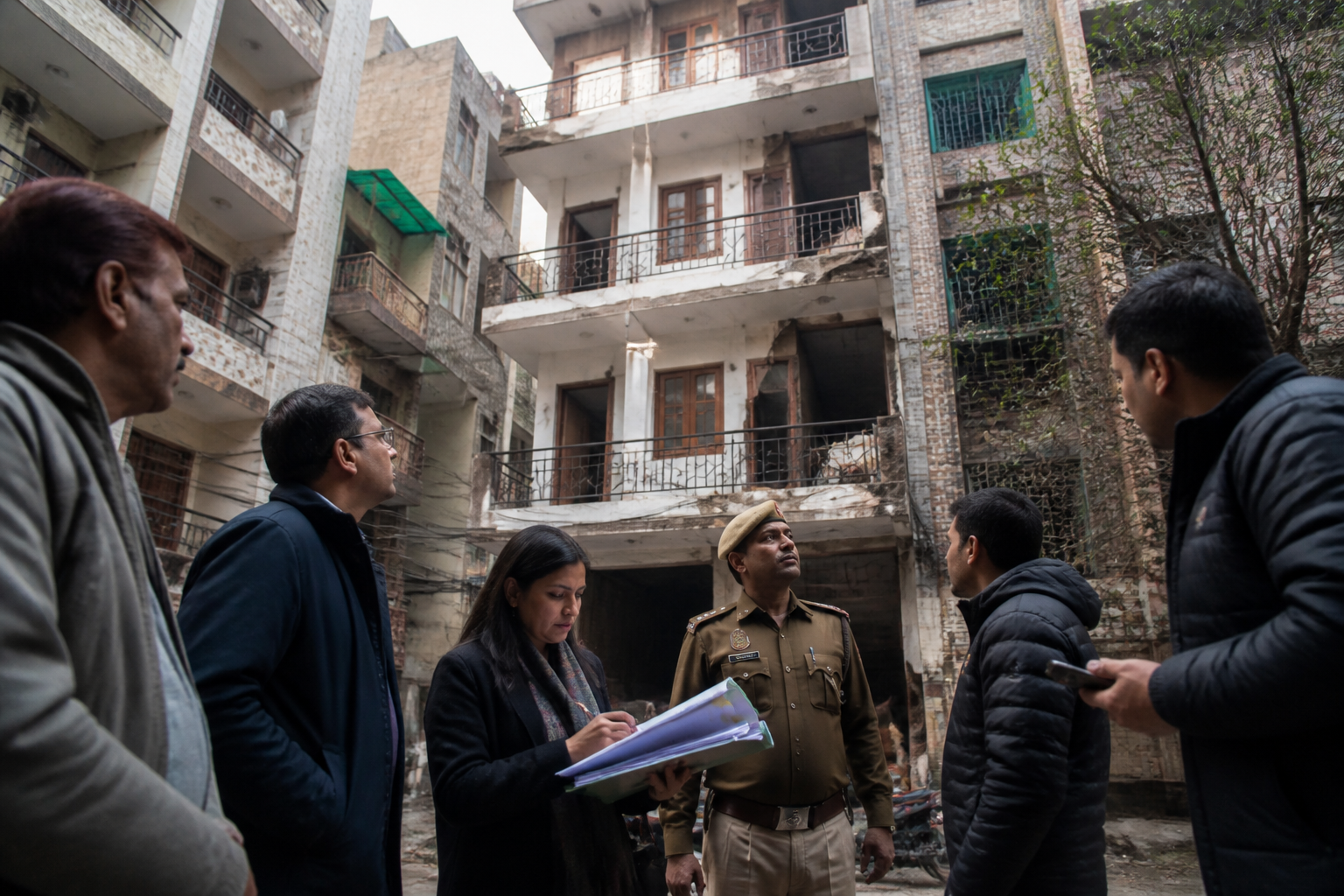
The directive has come after the collapse of a four-storey-plus-ground-floor PG building in Satya Niketan killed seven people. It places paying-guest accommodation, building records and the responsibility for illegal additions at the centre of Delhi’s immediate enforcement response.
The question now is not only whether demolition teams will act, but whether the inspection campaign can establish how such buildings were altered, occupied and allowed to operate before a fatal failure occurred.
Delhi Chief Minister Rekha Gupta has directed the Municipal Corporation of Delhi to inspect paying-guest accommodations across the capital and take action against unauthorised construction. The order followed the collapse of a building known as Hostel Daze in Satya Niketan, where seven people died. The civic body has also been instructed to conduct inspections and demolition drives in several parts of the city, with senior officials remaining on the ground during the action.
The immediate response is therefore an enforcement operation. But the facts reported so far point to a wider urban governance problem: buildings used for rental accommodation can change substantially over time, while the records, approvals and jurisdictional responsibilities needed to assess their safety may not keep pace.
## The collapse and the official response
The Satya Niketan building collapsed at around 1pm on Sunday. Police received information about the incident at 1.34pm. According to the report, the structure had a ground floor and four upper floors and housed several students and other residents.
The First Information Report, as cited in the report, records that a local inquiry found the building was more than 30 years old. It also alleges that additional floors had been constructed to generate rental income. The available account does not establish when those additions were made, which approvals were obtained, or whether the structure was formally assessed after the changes.
Those unanswered questions are central to the inspection order. The chief minister has instructed officials to examine PG accommodations for unauthorised construction, scrutinise building records, determine when illegal construction took place and establish under whose jurisdiction it occurred. The language of the directive makes the records themselves part of the enforcement exercise, rather than treating the visible structure as the only evidence.
The MCD has been asked to undertake action against illegal structures, including demolition drives in several parts of Delhi. Senior municipal officials have also been told to remain on the ground while the action is carried out. The reported response combines inspections, record examination and physical enforcement, although the material available does not specify the number of properties to be inspected, the timetable, or the criteria that will determine which structures face demolition.
## Why PG accommodation is a difficult enforcement category
Paying-guest housing sits at the intersection of several urban systems. It is residential in its use, but often operates through rental arrangements that can be more intensive than the original design or approval of a building. A property may house students and other residents, generate income for its owner and depend on local demand, while its formal records may reflect an earlier and different use.
The reported facts do not establish that every PG accommodation in Delhi is unsafe or unauthorised. They do show why the category has become the focus of official attention after the Satya Niketan collapse. The chief minister’s directive specifically links the inspection of PG hostels with checks on unauthorised construction and building records. That connection suggests that the administration is treating the safety question as one involving both physical structures and the legality of the changes made to them.
The alleged construction of additional floors for rental income illustrates the pressure that can shape buildings in established urban neighbourhoods. Where demand for rooms is strong, adding space can increase revenue without requiring a new plot. But the report does not provide structural assessments, approved plans or evidence showing whether the alleged additions directly caused the collapse. That distinction matters. The collapse creates an urgent need for investigation, but enforcement decisions still require property-specific findings.
## Records, timing and jurisdiction
The directive’s emphasis on determining when illegal construction took place and under whose jurisdiction is significant. It identifies two recurring difficulties in urban enforcement: the timing of a violation and the institutional responsibility for addressing it.
A building’s present condition may reflect decisions made years or decades earlier. The Satya Niketan structure was reported to be more than 30 years old, while the additional floors were allegedly built later. Establishing the sequence would require officials to compare building records with the structure on the ground and identify when its form or use changed.
Jurisdiction adds another layer. The order asks officials to determine under whose jurisdiction the illegal construction occurred, indicating that responsibility may not be straightforward in every case. The supplied report does not identify the specific agencies involved or explain how responsibilities are divided. It does, however, show that the administration sees accountability for unauthorised construction as a question that must be traced rather than assumed.
This is important because demolition, inspection and record review are not interchangeable actions. A demolition drive can remove a structure or part of one. An inspection can identify visible risks. A record review can establish what was approved, when changes were made and which authority had responsibility. A citywide safety response needs all three forms of information if it is to move beyond a short-term reaction.
## Enforcement after a fatal failure
The order comes days after the collapse, making it a direct response to a high-fatality incident. That timing gives the inspection campaign urgency, but it also creates a test for how enforcement is conducted after public attention has intensified.
The report confirms that inspections and demolition drives are planned in several parts of Delhi, but it does not state how the MCD will classify buildings, whether occupants will receive notice, or what arrangements will exist for residents asked to leave unsafe premises. It also does not specify whether the campaign will focus only on PG properties or include other buildings with suspected unauthorised additions.
Those details will determine the practical effect of the directive. A building found to have unauthorised construction may require action, but residents also need clear information about the safety status of the premises and the immediate consequences of enforcement. The available material does not record any relocation or rehabilitation plan, nor does it report a procedure for residents to access inspection findings.
The absence of those details is not evidence that no such measures exist. It means they remain unestablished in the material currently available. The same applies to the scale of the citywide operation. Without a stated inventory of PG accommodations, inspection numbers, deadlines or published findings, it is not yet possible to assess whether the directive is a targeted investigation or a broad enforcement campaign.
## What the evidence establishes—and what it does not
The available evidence establishes four linked facts. First, seven people died when the Hostel Daze building in Satya Niketan collapsed. Second, the building was described as more than 30 years old and had a ground floor plus four upper floors. Third, an FIR-cited local inquiry allegedly found that additional floors had been constructed to generate rental income. Fourth, the chief minister has directed the MCD to inspect PG accommodations, examine building records and act against illegal construction.
The evidence does not yet establish the technical cause of the collapse. It does not identify whether the alleged additional floors exceeded the building’s structural capacity, whether construction materials or maintenance contributed, or whether any prior warning had been issued. It also does not establish which authority approved, monitored or failed to act on the building’s changes.
That distinction should shape the next phase of reporting. The enforcement order is an official response to a fatal incident, but the facts needed to explain the failure will have to come from structural assessments, approval records, inspection reports, the FIR and subsequent findings by the authorities. The current report provides the trigger and the administrative direction, not a completed account of causation.
## The larger urban question
Delhi’s PG inspections bring a basic built-environment question into focus: how does a city keep track of buildings whose use, occupancy and physical form change over time? The Satya Niketan case, as reported, involves an older building, additional floors allegedly built for rental income and accommodation used by students and other residents. Each element points to a city in which housing demand can place pressure on existing structures.
The administration’s response acknowledges that safety cannot be assessed only by looking at a building after a collapse. It requires records, inspections and clarity over responsibility before failure occurs. Whether the current campaign achieves that will depend on the information it produces: which buildings are inspected, what violations are found, when alterations occurred, who had jurisdiction and what action follows.
For now, the confirmed development is the inspection and enforcement directive. The unresolved issue is whether Delhi can convert a post-collapse demolition drive into a reliable system for identifying unsafe or unauthorised rental accommodation before residents are placed at risk. The next milestones are the MCD’s inspections, the publication or disclosure of building-record findings, and the authorities’ account of the Satya Niketan collapse.
