


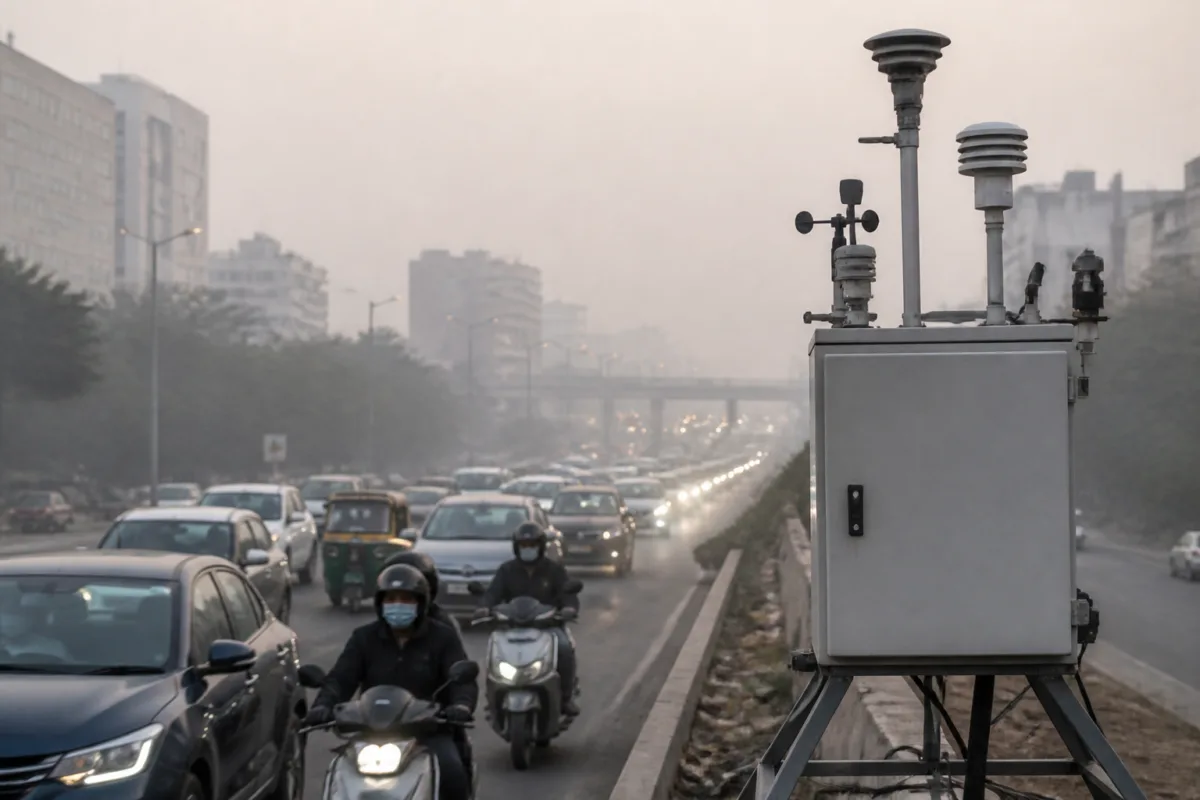
Delhi’s missing PM2.5 data has exposed how much the city’s official air-quality picture can depend on the completeness of its monitoring system. Hourly readings released by the Delhi Pollution Control Committee show that PM2.5 reached 3,744 micrograms per cubic metre at Mundka during the early hours after Diwali, more than 60 times the national standard of 60 micrograms per cubic metre.
The data was released by the DPCC at around 8 pm on Monday after hourly readings for Diwali night were absent from the Central Pollution Control Board’s publicly available record. The newly released figures do not merely add a few missing numbers to an existing dataset. They change the understanding of the intensity and geographical spread of the pollution episode, while also raising questions about how Delhi’s air-quality information is collected, checked and communicated.
The highest DPCC reading was recorded at Mundka at 2 am on November 9. Other extreme readings included 3,023 micrograms per cubic metre at Jawaharlal Nehru University at 4 am and 3,008 micrograms per cubic metre at the western campus of Netaji Subhas University of Technology at 5 am. The monitoring station at Mandir Marg recorded 2,908 micrograms per cubic metre at 3 am, while Nehru Nagar recorded 2,808 and Wazirpur recorded 2,721 micrograms per cubic metre during the night.
Eleven DPCC stations recorded PM2.5 levels above 2,000 micrograms per cubic metre. The scale of the readings is significant because the official air-quality index does not continue rising in a simple proportion once pollution reaches extreme levels. According to the report, PM2.5 concentrations above approximately 420 micrograms per cubic metre already push the index to its upper limit of 500. Readings several times higher can therefore indicate a far more dangerous concentration without producing an equally larger AQI number.
This creates an important distinction between the concentration of a pollutant and the headline AQI figure. The AQI is designed to communicate air quality through a public index, but at the highest levels it can compress the difference between very severe and exceptionally severe pollution. A reported AQI of 370 or 384 does not mean that the underlying pollution concentrations are close to ordinary poor-air conditions. In this case, the hourly PM2.5 readings show that several locations experienced concentrations far above the level at which the index had already reached its ceiling.
The missing data also affects the reliability of citywide interpretation. The report said that 125 station-hour records missing from CPCB data were later reflected in the DPCC release, and that all of these station-hour readings were above 1,000 micrograms per cubic metre. At 1 am, CPCB records did not contain a PM2.5 reading for 36 of Delhi’s 59 stations. Without those observations, the public record provided an incomplete account of what was happening across the city during the most polluted period of the night.
At the same time, the supplied report says the readings that had already been published by both agencies were identical. This is an important qualification. The available information does not establish that the overlapping data was altered or that the two agencies used different readings for the same station and hour. The immediate issue is that a substantial set of hourly records was missing from one public record and released later by another agency.
That distinction matters for urban governance. Air-quality data is not only a scientific measurement; it is also an administrative input used to communicate risk, trigger emergency responses and judge the performance of pollution-control measures. When data is missing during a major pollution episode, residents cannot easily determine whether the gap reflects equipment failure, a transmission problem, a quality-control delay or another technical cause. The report attributes the missing records to technical difficulties but does not provide a detailed station-by-station explanation of the failure.
A government official cited in the report said that air-quality monitors were now providing hourly readings and that all 43 stations were supplying data. The official also said technical difficulties had caused the earlier problem. This indicates that the monitoring network had returned to regular reporting, but it does not by itself explain why CPCB records showed missing information for so many station-hours during the Diwali episode or how the agencies will prevent similar gaps.
The episode also shows the institutional complexity of Delhi’s pollution information system. The CPCB maintains a national-level public record, while the DPCC operates within Delhi’s pollution-control administration. Both sets of information are used to describe conditions in the capital, but the episode demonstrates that the timing and completeness of releases can differ. For citizens, the distinction between the agencies may be less important than the practical question of which dataset represents the most complete picture at any given time.
The reported AQI figures illustrate the effect of that uncertainty. With the additional readings included, the AQI was estimated at approximately 384, compared with 370 reported by the CPCB. Delhi’s average AQI was 376 on Sunday, while it was recorded at 371 on Monday morning after a modest decline. These figures appear relatively close when viewed as index values, but the underlying station-level readings were much more extreme in several locations.
This gap between the citywide index and local hourly concentrations is especially relevant in a city where pollution exposure is uneven. The supplied data identifies very high readings at Mundka, JNU, NSUT’s western campus, Mandir Marg, Nehru Nagar and Wazirpur. A single citywide number cannot show how pollution varies between these locations, when the highest exposure occurs or whether residents near a particular station are experiencing conditions substantially worse than the city average.
The data also reinforces the importance of publishing raw or near-real-time station readings alongside summary indicators. A citywide AQI is useful for broad communication, but it cannot replace information about hourly peaks and local variation. The Diwali readings show that an index capped at 500 may conceal the extent to which concentrations exceed the upper end of the scale. For public understanding, both the index and the underlying pollutant measurements are necessary.
The political dispute over the missing readings adds another layer to the governance problem. Saurabh Bharadwaj, the Delhi unit chief of the Aam Aadmi Party, accused the government of manipulating pollution data and alleged that water was being sprayed on monitoring stations to reduce recorded AQI levels. The supplied report presents these as political allegations and does not provide independent evidence establishing them. They should therefore be distinguished from the documented fact that hourly readings were missing and later released by the DPCC.
That distinction is central to credible pollution reporting. A technical failure, an incomplete public record and deliberate manipulation are not interchangeable explanations. Establishing the cause would require a documented account of the affected monitors, their operating status, data transmission logs, quality-control procedures and the timeline of publication by each agency. The material supplied for this report does not establish those details.
What the available evidence does establish is narrower but still consequential: extreme PM2.5 readings existed across multiple Delhi monitoring locations; a substantial number of station-hour records were absent from the CPCB record during the Diwali episode; the DPCC later released the missing hourly data; and the additional readings altered the estimated AQI while revealing concentrations far beyond the index’s practical upper range.
The larger urban question is whether Delhi’s pollution response can be effective when the public receives a summary number without a complete and timely account of the measurements behind it. Monitoring stations are part of the city’s essential environmental infrastructure. Their reliability affects not only public communication but also emergency decisions, regulatory scrutiny and the ability of residents to understand their exposure.
The next point to watch is whether the agencies publish a fuller explanation of the missing records and maintain continuous reporting from all active stations. Until that information is available, the Diwali episode remains both a record of extreme pollution and a test of the transparency and resilience of Delhi’s air-quality monitoring system.

