


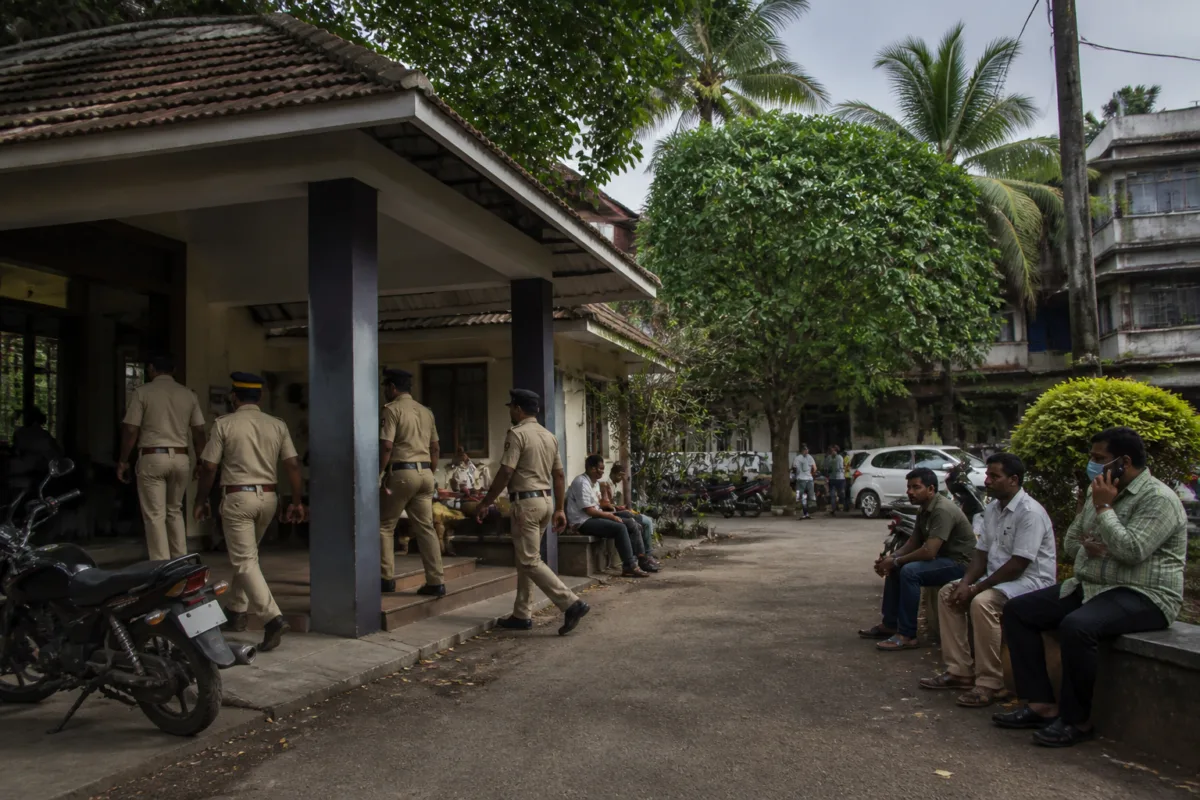
More than 40 police personnel in Ernakulam have faced scrutiny since 2023 in around 15 incidents involving alleged drug theft, extortion, sexual crimes, bribery, custodial torture and links with illicit mining and drug networks. Taken together, the cases raise a question larger than the conduct of individual officers: who independently investigates the police when the allegations concern the institution itself?
The latest case involved the arrest of a sub-inspector from Ernakulam Central police station for allegedly stealing 87 grams of MDMA from a station strongroom. According to the report, the officer allegedly replaced a packet containing 202 grams of the drug. The episode has also raised questions about how the officer obtained access to such a large quantity of seized narcotics and how materials kept as evidence are monitored inside police facilities.
The allegation remains subject to investigation and legal process. Its institutional significance lies in the location and nature of the alleged act. A police station strongroom is not merely a storage room; it is part of the chain through which evidence is preserved, documented and presented in a criminal case. If seized material can allegedly be removed or substituted, the issue extends beyond the conduct of one officer to the reliability of evidence management and internal controls.
The Ernakulam cases described in the report cover several types of alleged misconduct. An officer from Elamakkara police station was arrested earlier this year for alleged sexual harassment and extortion. The officer allegedly used information obtained during a drug investigation to intimidate and exploit people whose names appeared in the contact list of a drug-case accused. The allegations included demands for sexual favours and money.
In January, four officers from Kuruppampady police station were suspended for allegedly accepting bribes to protect two cyberfraud suspects wanted by Gujarat Police. An officer attached to Kalady Police was also found to have suspected links with drug rackets, according to the report. In another case, an sub-inspector was booked for allegedly extorting Rs 4 lakh from a police officer who had visited a spa.
The report also refers to the suspension, a year earlier, of two officers from the same station for alleged involvement in operating a brothel under the guise of a lodge. These allegations differ in their immediate circumstances, but they share a common institutional setting: officers allegedly using access, information, authority or official position for purposes unrelated to lawful policing.
That pattern matters because police power is unusually dependent on public trust. Officers can stop, search, arrest, question and detain people. They also control information at the early stages of an investigation, when citizens may not know what records have been created, what evidence has been seized or which officer is responsible for a decision. The same authority that enables crime prevention can become difficult to challenge when oversight is internal, slow or opaque.
The report cites former State Police Complaints Authority chairperson Justice (retd) K Narayana Kurup, who questioned the practice of an officer investigating allegations against a junior colleague. “No man should be a judge in his own court,” Kurup said, arguing that the public could perceive an investigation as biased even when the investigating officer acted sincerely. He suggested that the State Police Complaints Authority could be given greater powers to investigate police misconduct.
Kurup’s point concerns the appearance as well as the substance of fairness. An internal inquiry may be procedurally valid, but the public’s confidence can still be weakened if the investigator and the subject belong to the same chain of command, have worked together for years or depend on the same institutional hierarchy. In policing, perceived independence is not a cosmetic concern. It affects whether complainants come forward, whether witnesses cooperate and whether disciplinary findings are accepted as credible.
The distinction between criminal investigation and departmental action is also important. Criminal cases determine whether an offence can be established under law, while departmental proceedings examine breaches of service conduct and discipline. The report says that in many cases departmental action revealed the offences. That suggests internal mechanisms can detect wrongdoing, but it does not establish whether those mechanisms are timely, independent or consistently applied.
The available account does not provide a complete record of how many officers were convicted, cleared, charge-sheeted, suspended or returned to duty. It also does not set out the status of every one of the approximately 15 incidents. Those gaps limit what can be concluded about the final outcomes. The evidence does, however, establish the scale and range of scrutiny reported in Ernakulam since 2023, as well as the recurring concern about who should investigate police misconduct.
Criminologist Ajitkumar Varma described the incidents as evidence of a possible systemic failure involving inadequate supervision, institutional protection and an absence of accountability. He said that misconduct by officers was not only an individual problem but also a matter of public confidence in the police force. His observation shifts attention from the personal morality of an accused officer to the conditions that can allow misuse of authority to continue or remain hidden.
That shift is necessary, but it must not erase individual responsibility. A system does not commit an offence in the same way a person does. Officers accused of crimes must face due process, and the entire force should not be judged solely on the basis of allegations against a group of personnel. A senior officer cited in the report made precisely that point, saying it was wrong to assess the whole police force based on the misdeeds of a handful of officers.
Both statements can be true. Individual cases should be investigated fairly, while repeated cases should trigger an institutional review. The number cited in the report is not evidence that every officer is compromised. It is evidence that the police organisation must be able to demonstrate how allegations are received, recorded, investigated and resolved, particularly when they involve evidence rooms, drug cases, extortion, sexual abuse or protection of suspects.
For an urban police system, the accountability chain has several levels. The station is the first point of contact for residents. Senior officers supervise stations and investigations. Departmental authorities can suspend or initiate proceedings. Criminal investigations may involve other police units or agencies. Complaints authorities are intended to provide an external avenue. If responsibility is divided without clear independence, however, a complainant may move through several offices without knowing which body has the power to reach a final finding.
The cases also show how urban crime networks and police misconduct can intersect. Allegations involving drug rackets, cyberfraud suspects, illicit mining, prostitution, extortion and sexual exploitation are not identical. But each area depends on information, access and control over enforcement. Where officers allegedly use confidential case information to threaten people, accept money to protect suspects or interfere with seized evidence, policing itself becomes part of the risk environment that residents must navigate.
The report does not establish that such conduct is widespread across Ernakulam or Kerala. Nor does it provide comparative figures for other districts or states. Without those figures, it would be premature to describe Ernakulam as an outlier or to claim that misconduct is increasing. What can be said is narrower and more defensible: the reported cases are sufficiently varied and repeated to raise questions about supervision, evidence controls and independent investigation.
The immediate public-interest issue is therefore not only whether the allegations in individual cases are proved. It is whether the institutions responsible for policing can show that misconduct is detected without dependence on informal protection, that complainants have a credible route outside the accused officer’s chain of command, and that seized evidence is secured through controls that do not rely solely on personal integrity.
The State Police Complaints Authority’s powers, the structure of internal inquiries and the management of station evidence are the areas that now require the clearest scrutiny. The supplied report does not record any announced reform or institutional response on these questions. Until the cases reach documented outcomes, the central fact is that more than 40 officers have reportedly come under scrutiny in Ernakulam since 2023, while the larger accountability mechanism remains contested.

