


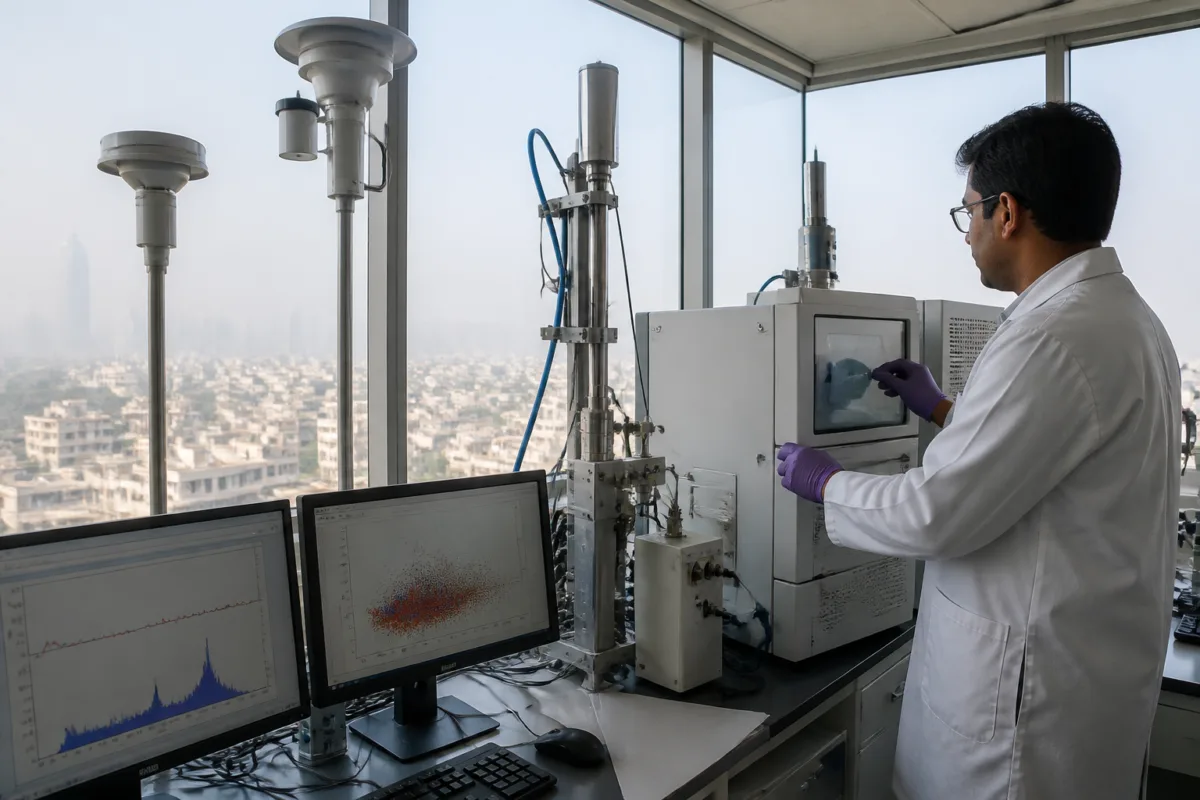
Delhi’s new real-time pollution laboratory is designed to change the city’s air-quality debate from a question of how polluted the air is to a more consequential question: what, exactly, is in it and where did it come from? The Integrated Atmospheric Chemistry and Aerosol Toxicity Analysis Laboratory, or AATAL, inaugurated by the Indian Institute of Tropical Meteorology in New Rajendra Nagar, has found that vehicles were Delhi’s largest single contributor to PM2.5 on Saturday, accounting for 25% of the total. But its early data also shows that secondary organic and inorganic aerosols together contribute 34.9%, demonstrating that pollution is not only a matter of visible emissions at street level.
That distinction matters because particulate pollution can be emitted directly or formed later through chemical reactions in the atmosphere. AATAL is intended to identify pollutants, trace their sources, study how they change in the atmosphere and assess their potential health impacts. The laboratory therefore adds a composition and toxicity layer to a policy system that has often relied on aggregate air-quality readings and source estimates.
The facility has been equipped with 25 advanced instruments, with an estimated instrument cost of Rs 79.5 crore. It will complement two existing IITM systems: the Air Quality Early Warning System, which provides AQI forecasts, and the Decision Support System, which estimates the contribution of local and regional pollution sources. A revamped version of the early warning system was also launched alongside the laboratory.
Together, these systems represent different stages of the air-quality management problem. Forecasting can indicate what conditions may develop. Source estimation can identify the likely contribution of different sectors or regions. Real-time laboratory analysis can examine the composition of the particles and the atmospheric processes that produce them. The institutional challenge is to ensure that these distinct forms of information are used together rather than treated as separate technical exercises.
The initial results from five days of data show why a single, fixed explanation for Delhi’s pollution is inadequate. Vehicles, secondary organic aerosols and secondary inorganic aerosols consistently ranked among the leading contributors, but their shares changed from day to day. On Saturday, vehicles accounted for 25%, secondary organic aerosols for 18.4%, secondary inorganic aerosols for 16.5%, road dust for 10.9% and waste burning for 5% of PM2.5.
On Friday, when Delhi’s AQI was in the poor category, secondary organic aerosols were the largest contributor at 24.6%. Vehicles and secondary inorganic aerosols each accounted for 20.7%. Road dust remained a significant contributor, ranging between 5% and 10% of PM2.5 in recent days. These figures do not eliminate the importance of transport, dust or waste burning. They show instead that the relative importance of each source can shift with atmospheric conditions and the composition of emissions entering the air.
The distinction between primary and secondary pollution is central to interpreting the data. Primary particulate matter is emitted directly into the atmosphere. Secondary aerosols form after gases undergo chemical reactions and become particulate matter. According to Sachin Ghude, AATAL’s project director, the initial findings indicate that about 40% of Delhi’s PM2.5 is primary particulate matter and about 60% is secondary.
Ghude told the Times of India that primary particles, secondary inorganic aerosols and secondary organic aerosols each account for roughly 30% of total PM2.5, while the remaining 10% consists of metals, toxic elements and other components. The figures are an early indication from the laboratory rather than a complete long-term assessment, but they establish the importance of examining the chemical processes that connect emissions from different sources.
Secondary organic aerosols form when volatile organic compounds released by vehicles, industries, solvents and vegetation react in the atmosphere. Secondary inorganic aerosols are formed through reactions involving gases such as sulphur dioxide, nitrogen oxides and ammonia, producing sulphates and nitrates. This means that a pollution-control strategy focused only on the location where particles are measured may miss the gases and activities that helped create them.
It also complicates the administrative geography of clean-air action. Delhi’s pollution is influenced by sources within the city and by regional pollution, while atmospheric chemistry can transform emissions after they are released. A road, industrial area or waste-burning site may be part of the emissions story without accounting for the full quantity or toxicity of the particles eventually measured elsewhere. The source-apportionment system is intended to provide measurement-based evidence for identifying sectors and locations that contribute to deteriorating air quality.
The laboratory’s planned work on the interaction of aerosols with moisture, fog and haze is particularly relevant to winter conditions in northern India, according to officials. The supplied report does not establish how these processes will alter future policy decisions, but it makes clear that the facility is intended to study the conditions under which pollution accumulates and changes. Its value will therefore depend on sustained measurements across different periods rather than isolated readings.
AATAL also marks the return of real-time source-apportionment data for Delhi after a gap of nearly three years. The previous system operated by IIT Kanpur ceased in November 2023 after the Delhi government halted the project. Officials said the initiative would now be resumed with the help of IIT Delhi. That interruption is significant from a governance perspective because continuity is essential for comparing pollution sources over time and assessing whether interventions change actual atmospheric conditions.
The new laboratory is expected to support the Commission for Air Quality Management and other agencies in identifying major pollution sources, prioritising interventions and assessing their effectiveness. The institutional promise is straightforward: agencies should be able to connect a measured pollution problem to a more specific set of sources and then examine whether action against those sources produces a measurable result.
That promise also creates a higher standard for public policy. An AQI number can communicate the severity of pollution, but it cannot by itself show whether a control measure is working, whether a source has shifted in importance or whether a pollutant’s composition presents a particular health concern. Union minister of state Jitendra Singh said the facility would help move the discussion beyond whether pollution was at 100 or 200 and towards understanding its composition and source contributions.
Singh also said the facility would provide insights into smaller constituents of air pollution, including metallic elements and other potentially harmful components. His statement reflects the laboratory’s broader purpose: to examine not only concentration but also composition and potential toxicity. The supplied material does not provide health-impact measurements from AATAL, so the laboratory’s findings should not yet be read as a quantified assessment of exposure risks from individual constituents.
The data already points to a more distributed urban problem than a simple vehicle-versus-dust argument suggests. Vehicles remain the largest single contributor in the Saturday reading, while secondary aerosols together form a substantial share of PM2.5. Volatile organic compounds, nitrogen oxides, sulphur dioxide and ammonia can originate from different activities and may interact after release. The result is an air-quality challenge that crosses transport, industry, waste, construction and regional coordination.
For Delhi’s institutions, the next test is not merely whether AATAL can produce technically detailed data. It is whether that data becomes part of routine decision-making by agencies responsible for transport, dust control, waste management, industrial emissions and regional air-quality coordination. The laboratory is expected to help CAQM and other agencies prioritise action, but the supplied report does not identify specific measures or implementation schedules linked to the first findings.
The evidence currently confirms three things. Delhi’s PM2.5 is produced by a changing combination of direct emissions and secondary atmospheric reactions; vehicles are important but not the only major contributor; and the city has regained a real-time source-apportionment capability after nearly three years. What remains to be established is how these shares evolve across seasons, how consistently the measurements perform and whether agencies use the findings to evaluate interventions. Those developments will determine whether AATAL becomes a research facility or a functioning part of Delhi-NCR’s pollution-management system.

