


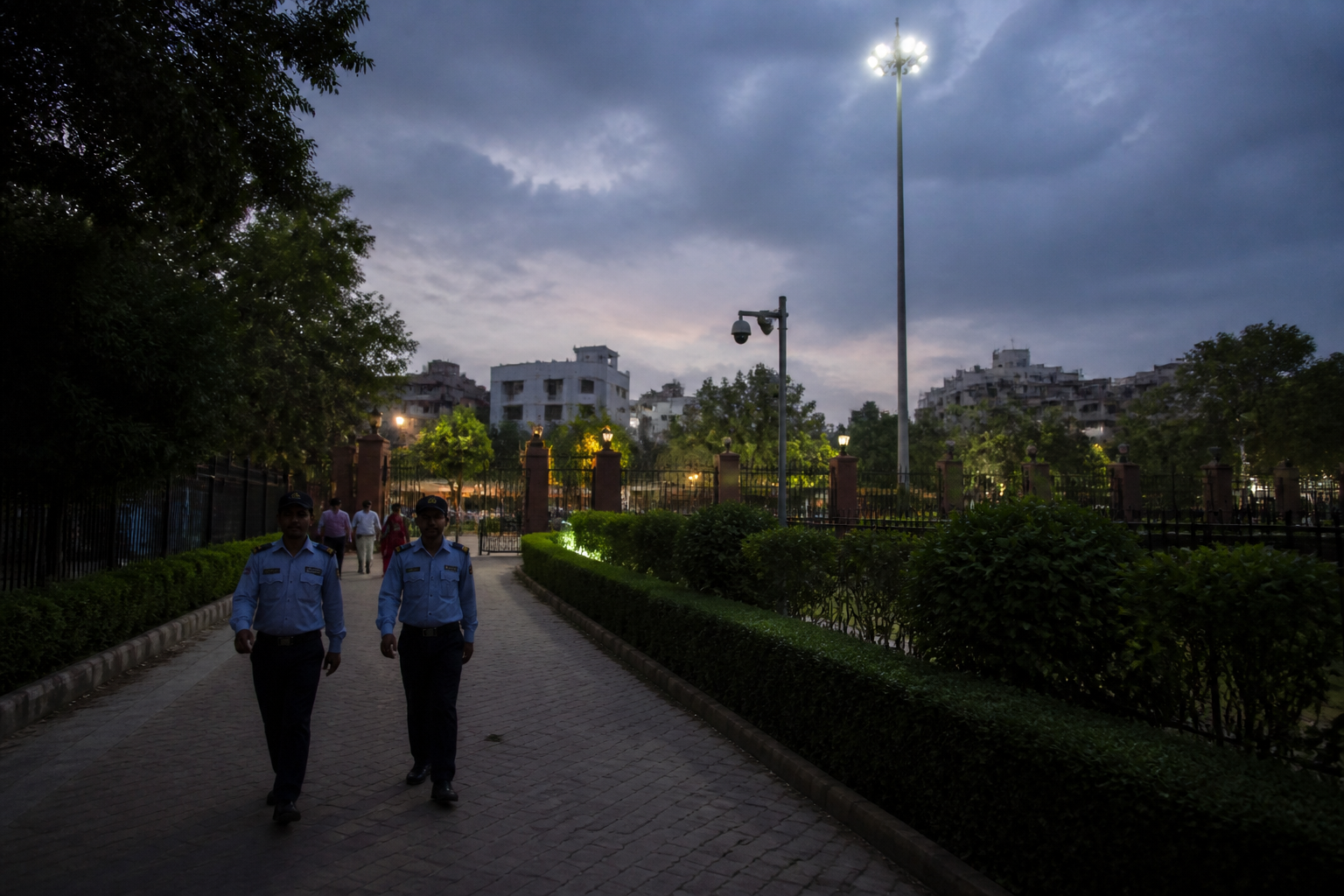
A reported gang rape of a teenager at south Delhi’s Aastha Kunj Park has pushed the safety of the capital’s public green spaces back into focus. The police audits that followed show that the problem is not limited to one park: across several major green spaces, officers found inadequate lighting, missing or insufficient CCTV coverage, damaged boundary walls, limited guarding and vulnerable areas that are difficult to monitor.
The findings matter because Delhi’s parks are not marginal pieces of the city. They are daily public infrastructure used by residents for walking, exercise, recreation and access to open space. The audited parks range from the 170-acre Swarn Jayanti Park in Prashant Vihar to smaller urban green spaces in residential districts. Their visitor numbers, operating hours and security arrangements differ, but the audit indicates that safety depends on a combination of physical design, staffing, surveillance and routine policing rather than on any single measure.
The police action began after the incident at Aastha Kunj Park, but the inspection exercise has widened considerably. Delhi Police has directed its units to audit all major parks measuring one acre or more on priority and submit reports to the joint commissioners of police in the respective ranges within a week. Almost 300 large parks and more than 800 smaller parks are being audited, according to the report.
That scale turns the exercise from a response to one incident into a test of how the city assigns responsibility for public-space safety. Police can identify dark spots, crime patterns and patrol requirements, but several of the physical deficiencies recorded in the audits—lighting, CCTV systems, boundary walls, overgrown vegetation and gate conditions—depend on agencies responsible for maintaining parks and civic assets. The report says police wrote to the agencies concerned after auditing 113 parks in Dwarka and more than 200 parks in West district.
The inspection findings show how unevenly safety infrastructure is distributed. Swarn Jayanti Park, also known as Japanese Park, receives between 500 and 1,000 visitors during peak hours. It has four gates and 27 guards providing round-the-clock security, yet police found insufficient lighting and CCTV coverage and identified several dark spots. The park has also witnessed cases of motor vehicle theft and snatching.
The District Park in Sector 1, Avantika, Rohini, presents a different combination of risks. The 100-acre park attracts around 400 to 500 people during morning and evening periods, but it has no CCTV cameras and a damaged boundary wall. The police report cited cases under the Arms Act, Gambling Act and Narcotic Drugs and Psychotropic Substances Act, as well as cases of hurt, having taken place inside the park.
These details point to a basic problem in the way park safety is often understood. A park can have guards and gates and still contain spaces that are effectively unobserved. It can attract hundreds of users while lacking the surveillance infrastructure needed to monitor isolated corners. A boundary wall may define the site on a map but fail as a security feature if it is damaged. Similarly, a park’s total number of guards does not by itself show whether they are positioned where visitors need protection at the times when risk is highest.
The audit’s focus on operating conditions is therefore significant. Police are assessing the availability and shortage of guards, lighting arrangements including high-mast lights, CCTV coverage, the height and condition of boundary walls, overgrown bushes and trees, and the timings at which gates are closed after sunset. These are physical and administrative details, but together they determine whether a public park is visible, accessible and manageable after dark.
The comparison between parks also shows that safety conditions are not uniform across Delhi. Roshanara Bagh in north Delhi covers nearly 50 acres, has 21 CCTV cameras and 12 guards, and receives between 500 and 700 visitors daily, mainly between 4.30am and 8.30pm. Police reported no crime from the park and found its lighting, boundary and connecting road to be in good condition.
DDU Park in IP Estate, spread across 16 acres, has security guards and receives between 150 and 250 visitors during its main gathering hours, from 6am to 10am and 4pm to 7pm. Police found its lighting, boundary and road to be in good condition. In Mandawali, east Delhi, Amruth Park covers around 9 lakh square metres and has two gates and four guards, but no CCTV coverage. Police reported no crime there and assessed its lighting, boundary and road condition as satisfactory.
The evidence does not establish that the absence of reported crime means that a park is fully safe, nor does it show that CCTV alone prevents offences. What it does establish is that parks with different levels of surveillance, staffing and physical maintenance are being used by substantial numbers of people. The audit is creating an administrative record of those differences, including locations where vulnerabilities have already been identified.
Visitor patterns are central to that record. Swarn Jayanti Park’s peak use can reach 1,000 people, while the District Park in Avantika sees up to 500 visitors during its principal periods. Roshanara Bagh receives as many as 700 daily visitors, and DDU Park’s main gathering periods draw up to 250 people. These numbers show why safety planning cannot be based only on a park’s area. A large green space may have extensive boundaries and isolated areas, while a smaller park may have concentrated movement around a few gates and paths.
The same numbers also expose the limits of treating parks as passive amenities. Their users arrive early in the morning, remain into the evening and move through spaces with different levels of visibility. The report identifies peak visiting hours, gate arrangements and sunset closure timings as matters for assessment. That approach recognises that risk changes over the day and that security cannot be measured simply by counting guards or installing equipment.
Delhi Police has also stepped up patrolling in and around major parks. Personnel are using horses to cover areas that are difficult to patrol on foot or by vehicle, with attention to crowded stretches, isolated corners and other vulnerable spots. This is a policing response to the geography of large parks, where roads and paved paths may not reach every area and where visibility from outside the park may be limited.
But the audits also raise a question about institutional coordination. Police can flag a missing camera or a dark stretch, yet the correction requires an agency to fund, install, operate and maintain the equipment. A boundary wall may need civil repair; lighting may require electrical work; bushes and trees may need regular maintenance; and gate timings may need coordination between park managers, security staff and local police. The report identifies these gaps but does not establish whether the agencies have accepted responsibility, set budgets or fixed completion dates.
That uncertainty is important. A safety audit has value only if its observations become tracked actions rather than a one-time inventory. The current process includes a deadline for police units to submit reports to joint commissioners, and letters have already been sent to agencies concerned in Dwarka and West district. The supplied report, however, does not provide a citywide repair timeline, funding allocation, procurement plan or compliance mechanism for the deficiencies identified.
The larger urban question is how Delhi should treat safety in public open spaces. Parks are often planned as green relief within dense neighbourhoods, but their success depends on more than landscaping. They require functioning access points, lighting, visibility, maintenance, surveillance where appropriate, trained personnel and a clear chain of responsibility. When any one of these systems fails, the park may remain open in formal terms while becoming difficult to use safely in practice.
The audit therefore offers a more useful starting point than a simple increase in police presence. It maps the relationship between public use and public management: how many people visit, when they arrive, which areas are visible, where guards are posted, whether boundaries hold, and whether agencies can respond to identified defects. The reported assault has made the issue urgent, but the infrastructure gaps recorded across Delhi show that the challenge is broader than the security arrangements at one location.
What the exercise confirms is that the capital’s major parks have sharply different safety conditions and that some high-use spaces contain clear deficiencies in lighting, surveillance or physical boundaries. What remains unclear is how quickly the responsible agencies will address those gaps and how the city will verify that repairs and staffing changes are sustained. The next important milestones are the submission of the audit reports within a week and the response of the agencies that have received police findings.
