


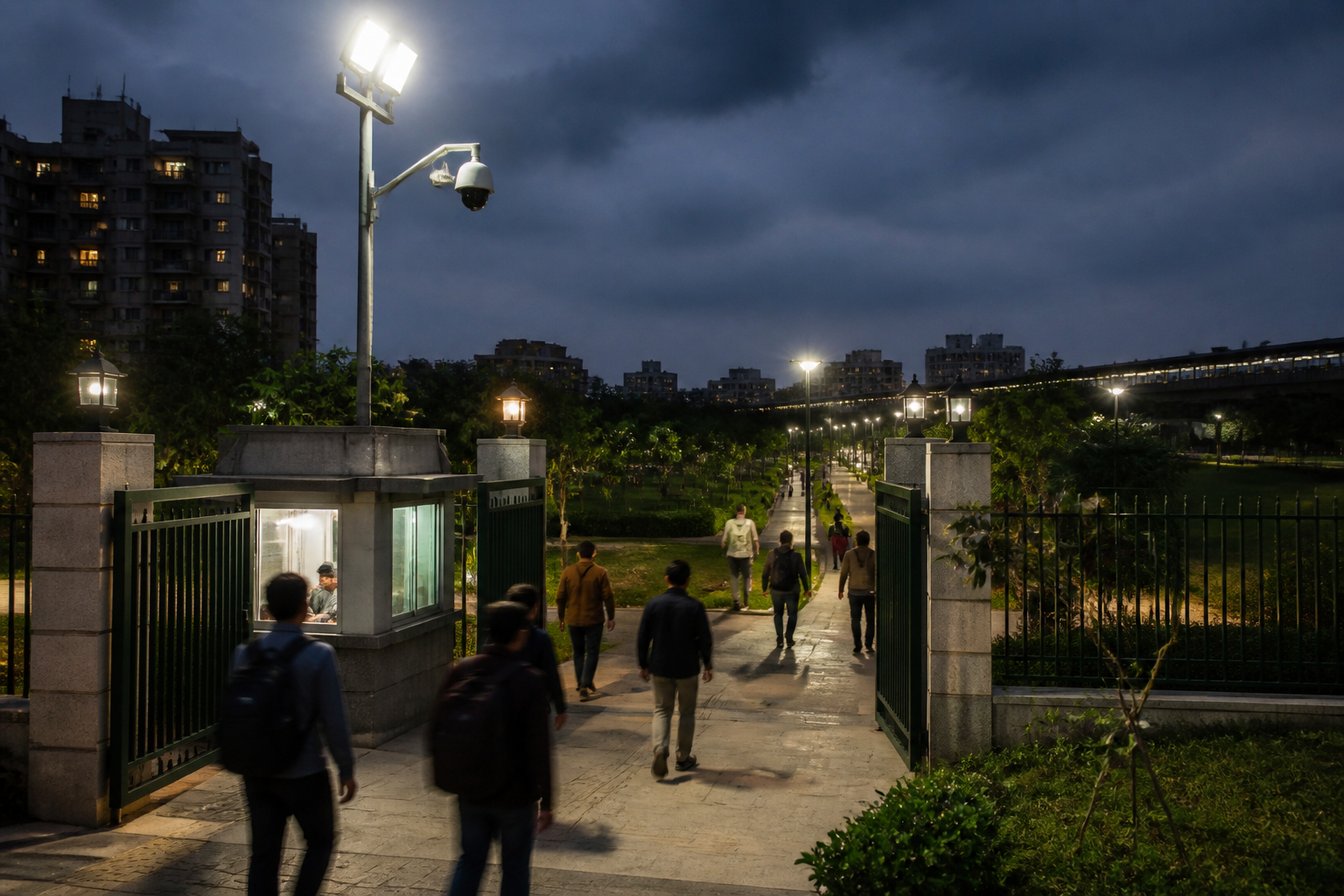
Delhi’s latest response to the alleged gang rape of a 17-year-old girl at Aastha Kunj Park has brought a familiar urban safety question back into view: when a public space becomes dangerous, do authorities make it safer, or simply make it harder to use? The distinction matters because access controls can reduce exposure to a specific risk while leaving the physical and institutional failures that enabled the crime unresolved.
The Delhi Development Authority’s response to the Aastha Kunj incident includes measures with an evident preventive purpose. The Lieutenant Governor directed a comprehensive safety audit of Delhi’s parks within a week. The DDA ordered increased evening vigilance, controlled access after sunset, CCTV cameras at entry gates, additional security personnel at vulnerable points, identification of dark spots and new lighting where required. Parks with multiple gates are to restrict access through selected entrances before closing time, while safety boards are to display park rules and emergency contacts.
These measures are not identical in their purpose or effectiveness. Fewer open gates may make a large park easier to monitor. Lighting can reduce concealment. Cameras can support investigations, and visible guards may deter some forms of crime. But the reporting from Aastha Kunj shows why the central issue is not simply whether a gate is open. It is whether the space behind the gate is managed as a functioning public environment.
Aastha Kunj Park covers 143 acres and has 29 access points. The alleged assault took place between around 7.30pm and 8pm after three men, according to police, approached the girl and her male friend while posing as policemen. The accused allegedly took the girl to a secluded part of the park. Times of India reporting found that a guarded entrance could be followed by an unmanned gate or a dark stretch. A guardpost a few metres from the reported location had no guard, while a tea seller said the post had never had a security guard and had been stripped by thieves.
The park is officially open from 4am to 9pm. However, a police officer told the newspaper that the gates remained open through the night because the park functions as a shortcut between a metro station, Garhi village and Okhla mandi. Closing the gates could lead people to climb over the barriers, the officer said. This creates an important administrative complication: a park may be treated as a recreational facility in one policy document and as part of the city’s everyday movement network in practice.
The access question is therefore not only about visitors entering a park after dark. It is about the movement systems that connect neighbourhoods, transit stations, workplaces and markets. If a large park is used as a shortcut, a night-time closure can shift the problem to boundary walls, poorly lit roads or longer routes. The supplied reporting does not establish whether the new restrictions will be accompanied by safe alternatives for people who currently cross the park. That gap is significant because urban safety cannot be assessed only within the formal boundary of a public asset.
The Aastha Kunj case also exposed a weakness in surveillance. Police had no working CCTV footage from the park’s entrance at the time of the crime, while the secluded areas had little or no lighting. Investigators instead relied on descriptions of the accused, including their clothing, nicknames and physical features. Police later traced them through local inquiries, CCTV footage from outside the park, phone-location data and other evidence. The sequence suggests that technology is useful only when cameras are working, footage is available and the system covers the routes people actually use.
This is the difference between installing safety infrastructure and operating it. A camera at a formal entrance cannot compensate for an unlit interior. A guard roster cannot guarantee that a guard is present at a vulnerable location. An official closing time cannot determine how a park functions if gates remain open because the surrounding area depends on it as a passage. The reporting does not prove that any single measure would have prevented the alleged assault. It does show that the park’s safety arrangements had visible operational gaps before the new orders.
The same pattern appears in responses to other incidents described by the newspaper. After a 16-year-old girl was allegedly sexually assaulted inside a sleeper bus in Delhi, authorities prohibited curtains and films on bus glass and ordered operators to ensure functional panic buttons and vehicle location tracking devices. They also required stops at authorised and safe locations, secure parking, verification of drivers and conductors, and safety sensitisation for crew.
Removing curtains is a direct response to a visibility problem. But the reported circumstances raised a broader transport-governance question: the bus was allegedly being taken for repairs rather than operating on a passenger route, yet it picked up a stranded teenager. The source also notes that officials have acknowledged difficulties in enforcing verification requirements for private bus staff. In this case, the curtain was one blind spot, but vehicle authorisation, crew verification and passenger protection were separate control points.
The distinction between these controls matters. Urban safety failures rarely arise from one missing object or one unlocked gate. They develop across a chain: who is allowed to operate a vehicle, who is responsible for monitoring it, where it can stop, whether emergency systems work, and whether authorities can identify the operator after an incident. A visible intervention may address one point in that chain without repairing the others.
Institutional campuses provide another example. After a rape allegation involving a second-year student at a Kolkata management institute in July 2025, the institute temporarily restricted guest entry to its campus and hostel, asked students not to venture outside for a few days, moved deliveries to the gate and changed entry and exit arrangements. The institute already had a formal guest-entry system requiring advance email approval, signatures at the main gate and hostel entrance, and departure records.
That detail points to a recurring governance problem: a security protocol can exist on paper while failing in practice. Registers, permissions and access rules are administrative instruments, not proof of safety. Their value depends on whether staff follow them, whether exceptions are controlled, whether complaints are acted upon and whether the institution understands the risks beyond its formal perimeter.
In October 2025, after a gang rape and assault involving a second-year MBBS student in West Bengal, Nagpur’s Mayo hospital barred food-delivery agents from entering hostel buildings. Deliveries were to be made at the guard post, while a regular tiffin provider was to be accompanied by a guard. The Government Medical College and Hospital said entry into hostel buildings was already prohibited, and women doctors were accompanied by women guards when moving between hostels and wards at night.
The immediate visible change was simple: delivery workers no longer crossed the gate. That may reduce one category of unauthorised movement, but it also illustrates how institutions often respond by narrowing access for an entire group. The source describes this alongside CCTV, lighting and security measures, but the public-facing rule remains the restriction. That is why the question of prevention cannot be separated from the question of who bears the cost of safety measures.
The historical examples are even clearer. After the alleged gang rape of a 19-year-old woman near Habibganj station in Bhopal in 2017, the government decided that coaching institutes would have to close by 8pm and proposed an SOS and location-tracking app. A minister also suggested that evening coaching could be restricted to boys. In Gurgaon, after a 2012 case involving the abduction and alleged gang rape of a 23-year-old woman, the district administration required permission for women employees to work beyond 8pm at malls, commercial establishments and pubs. Employers also had to provide transport and maintain vehicle and driver records.
Some of these measures included legitimate security requirements, such as CCTV, visitor records, bouncer verification and police vigilance. Yet the central restriction in both cases changed when women and girls could use education, employment or public services. The event occurred because the environment was unsafe, but the administrative response partly placed the burden of prevention on the potential victim’s schedule.
The consequences are not limited to the site of a crime. After the Aastha Kunj incident, women students from Delhi colleges told the newspaper about dark approach roads, harassment and anxiety while travelling home. A Gargi College student who had to reach college at 5am for NCC activities described inadequate lighting outside the college gate. A PCR vehicle stationed nearby after a harassment incident was no longer present. A Bhagini Nivedita College student described discomfort while waiting for a delayed DTC bus after dark.
These accounts widen the definition of public space safety. A college gate, park entrance or bus interior is only one part of a journey. The route to the gate, the wait for transport, the connection between a metro station and a neighbourhood, and the transition between public and institutional space all shape whether people can use a city freely. Security measures that end at a boundary may leave the most vulnerable parts of the journey untouched.
This does not mean that access restrictions are always ineffective or unjustified. Controlled entry can help staff monitor a sprawling park. A hostel can reasonably limit access to residential buildings. A bus without curtains may be easier to observe from outside. Visitor registers and delivery controls may support accountability. The evidence in the supplied reporting supports the usefulness of some of these interventions, but it does not support treating them as complete solutions.
The more durable test is operational. Are dark spots illuminated? Are cameras functional and monitored? Are guards actually present where they are assigned? Do official closing times match conditions on the ground? Are alternative routes safe when a public space is closed? Are private vehicles and their crews properly verified? Are complaints and earlier warnings recorded and acted upon? These are questions about municipal administration, transport regulation, institutional management and policing rather than only about individual behaviour.
The recurring pattern across Delhi, Kolkata, Nagpur, Bhopal and Gurgaon is therefore not that every restriction is wrong. It is that restriction is often the most visible and fastest administrative response after a failure. It changes access, timing or movement, while the less visible work of maintaining lights, cameras, guards, routes and records requires sustained coordination.
The evidence presented in the reporting confirms that public space safety cannot be measured by the presence of a gate or a rule. It depends on whether the system remains functional beyond the gate and along the entire journey. Delhi’s park audit and its new security measures will show whether the response becomes an operating system for safer public spaces, or remains another set of restrictions that narrows who can use them and when.
