


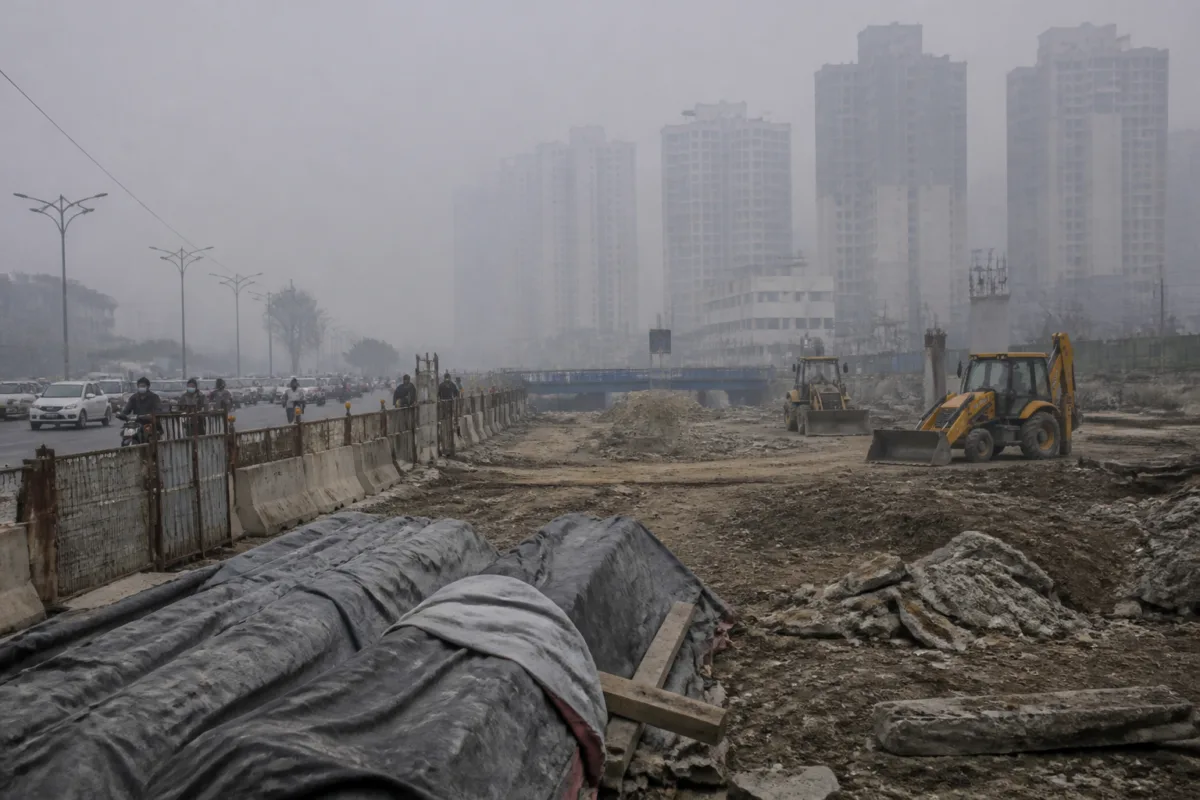
The Commission for Air Quality Management (CAQM) has directed government and private offices in Delhi and five surrounding NCR districts to operate with no more than 50 per cent of their staff from November 5 to November 20, while the remaining employees work from home. The commission has also ordered a halt to dust-generating demolition and outdoor construction activity across the National Capital Region during the same period to limit pollution during the most vulnerable part of the season.
The office measure covers Delhi, Gurugram, Faridabad, Sonipat, Ghaziabad and Gautam Buddh Nagar. It applies to government and private offices, but excludes industrial units and essential services where working from home is not considered feasible. Employers have been instructed to limit the number of employees physically present to half of their total workforce during the specified period.
The construction restrictions extend across the NCR and include demolition and outdoor works that can generate dust. The order covers public infrastructure projects such as highways, roads, flyovers, overbridges, electricity transmission lines, pipelines and telecommunications work. The measure therefore applies not only to private construction sites but also to several categories of public works.
CAQM has exempted activities linked to railways, metro services, airports, inter-state bus terminals, hospitals, water supply and sanitation. National security and defence-related activities, along with projects of national importance, are also exempt. The order does not specify in the supplied report how individual projects will be assessed for exemption or how employers and construction agencies will report compliance.
The commission issued the directions in an order dated October 30 under Section 12 of the Commission for Air Quality Management in National Capital Region and Adjoining Areas Act, 2021. According to the order, the measures are precautionary and limited to a defined period and geographical area, reflecting the region’s seasonal vulnerability to deteriorating air quality.
CAQM cited historical daily Air Quality Index data for November from 2018 to 2025. The data showed that pollution in Delhi-NCR repeatedly rises sharply from the beginning to the middle of November, with some days reaching the ‘severe’ and ‘very severe’ categories. The commission attributed the deterioration to a combination of local emissions, seasonal agricultural-residue and biomass burning, and other pollution events.
The order also pointed to weather conditions that restrict the dispersal of pollutants during this period. Slow wind speeds, a lower atmospheric boundary layer and reduced vertical mixing can limit the movement of pollutants away from the region, allowing emissions to accumulate closer to the ground. CAQM said the measures are intended to reduce emissions at their sources and minimise the build-up of pollutants during historically high-risk periods.
The directions will take effect on November 5 and remain in force until November 20. During that period, offices, construction agencies and enforcement authorities will have to operate within the exemptions and restrictions specified in the CAQM order.

