


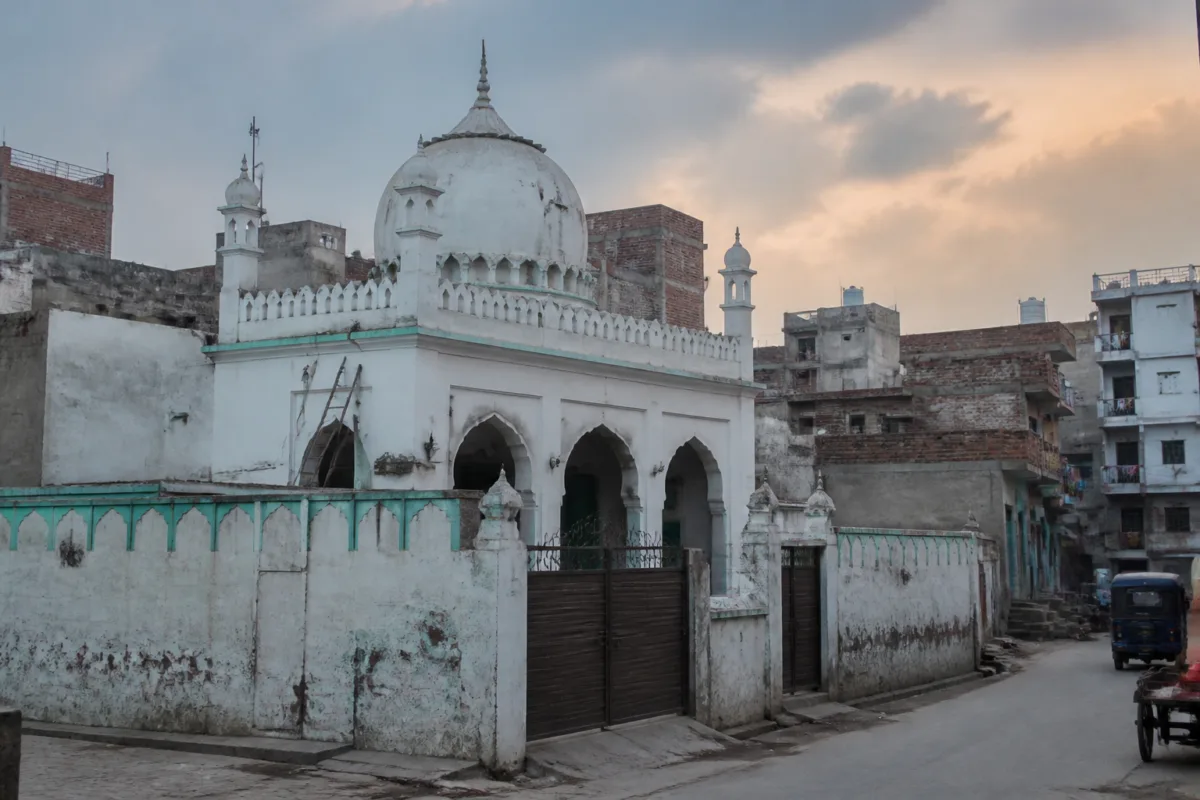
The acquittal of five men accused of vandalising and setting fire to Allah Wali Masjid in Karawal Nagar has shifted attention from the alleged attack itself to the evidentiary failures that prevented the prosecution from proving its case. The order shows how contradictions in police testimony and weaknesses in the certification of CCTV footage can determine whether accountability is established for damage to a religious structure during urban communal violence.
Additional Sessions Judge Praveen Singh acquitted Ankit, Sourabh Sharma, Rohit, Rahul Kumar and Sachin in a case arising from violence in Shahid Bhagat Singh Colony during the northeast Delhi riots of February 2020. The accused faced charges including rioting, unlawful assembly, damage to property and arson. In an order dated October 31, the court said the prosecution had failed to prove the case against them.
The ruling is significant not because it establishes that no incident occurred, but because it records that the prosecution evidence was not reliable enough to establish the charges against these five individuals. The court said there was a probability that no arson or vandalism had taken place at Allah Wali Masjid on February 25, 2020, in the manner claimed by the prosecution. That finding followed its assessment of conflicting accounts from police personnel and an independent witness.
According to the report, two police personnel testified that they had seen the mosque being vandalised and set ablaze at around 11 am on February 25. An independent witness living opposite the mosque gave a different account. He said the mosque was vandalised and set on fire only once, at around 8.15 pm, and that he remained confined to his house for four days after the incident.
The timing conflict was not the only difficulty before the court. The judge also noted contradictions in the police witnesses’ accounts of their movements through the area on the day of the incident. Their testimonies included references to their presence at other riot-hit locations, creating uncertainty about whether they could have witnessed the events at the mosque as claimed.
Judge Singh wrote that the police witnesses were not credible and could not be relied upon to establish the accused persons’ guilt in relation to the alleged riot, vandalism and arson at Allah Wali Masjid. In a criminal trial, the question is not simply whether a violent incident may have taken place. The prosecution must connect the accused to the specific acts charged and establish that connection through evidence that can withstand judicial scrutiny.
The case also illustrates the increasingly important role of digital records in prosecutions involving urban violence. The prosecution relied on CCTV footage stored on DVDs and hard disks. The court rejected that material as inadmissible because the mandatory requirements under Section 65B of the Indian Evidence Act had not been fulfilled.
The court said the certificate accompanying the hard disks did not provide details of the computer system used to transfer the data. It also found that the person who issued the certificate had no control over the data supplied. These were not treated as minor technical defects. They went to the legal admissibility of the recordings themselves, meaning that the footage could not be used as prosecution evidence in the manner intended.
That part of the order points to an institutional challenge in investigating incidents across dense, rapidly changing urban environments. CCTV systems may capture events across multiple locations, but recordings still require a documented chain of custody. Investigators must establish how the footage was obtained, which system generated or stored it, who transferred it and whether the person certifying the record had the necessary control or knowledge of the data. Without that documentation, potentially important visual evidence can fail before the court.
The case therefore sits at the intersection of public safety, policing and the protection of urban religious properties. Allah Wali Masjid was located in Karawal Nagar, an area that became one of the sites of violence during the northeast Delhi riots. The alleged attack involved a public religious building, and the charges included damage to property and arson. Yet the acquittal demonstrates that the urban visibility of an incident does not automatically translate into legally usable evidence against identified individuals.
The judgment also reveals the distance between an event as experienced on the ground and an event as reconstructed in court. The independent witness described remaining inside his house for four days after the incident, while the police accounts placed the alleged vandalism and arson at a different time. The court was required to assess not only what each witness said, but whether the accounts were internally consistent and compatible with the surrounding circumstances described in the evidence.
That distinction matters in riot cases, where investigations often have to reconstruct events from fragmented testimony, damaged sites and electronic records. The source report does not provide details of the broader investigation, the number of witnesses examined, the condition of the mosque after the incident or whether any other case connected to the alleged attack remains pending. It does establish that, in this prosecution, the court found the central witness accounts unreliable and the CCTV material inadmissible.
The order also highlights the responsibilities of different institutions. Police investigators must record witness movements and statements accurately, preserve digital evidence and complete the statutory certification required for electronic records. Prosecutors must present a coherent chain linking the accused to the alleged conduct. Courts, in turn, must test whether the evidence satisfies the criminal standard of proof rather than relying on the seriousness of the allegation alone.
The numbers and time markers in the case show how small inconsistencies can become decisive. Five men were accused. The alleged incident was placed at both approximately 11 am and 8.15 pm on February 25, 2020. The independent witness said he remained confined for four days. The CCTV evidence was stored across DVDs and hard disks but did not meet the requirements identified by the court under Section 65B. Each detail affected the reliability or usability of the prosecution case.
For cities, the wider issue is not limited to one mosque or one acquittal. Urban communal violence produces competing accounts from residents, police personnel and other witnesses, often in neighbourhoods where movement becomes dangerous and public buildings are damaged. When investigations do not preserve reliable testimony and admissible digital records, the legal system may be unable to determine individual responsibility even when the public consequences of an incident are substantial.
The acquittal does not resolve every factual question about what happened at Allah Wali Masjid on February 25, 2020. It establishes only that the prosecution failed to prove its case against the five accused on the evidence presented. The key issues for assessing accountability in similar cases remain the credibility of first-hand witnesses, the consistency of official timelines and the legally compliant preservation of CCTV and other electronic records.

