


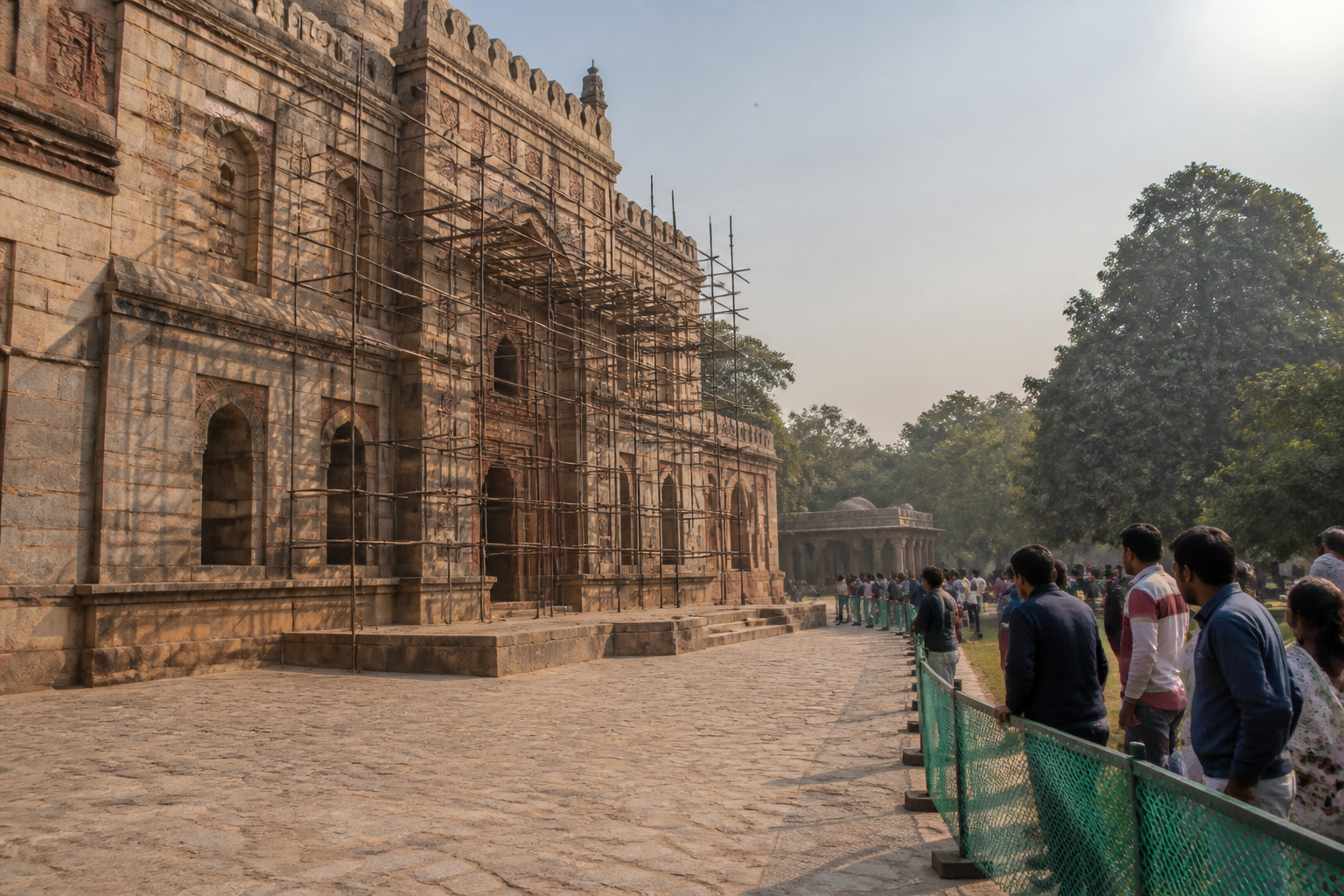
Restrictions at Hauz Khas Fort, Jantar Mantar, Agrasen ki Baoli and several other Delhi heritage sites are not isolated closures. An RTI response shows the Archaeological Survey of India’s Delhi Circle managing a wide spread of structural repairs, conservation works, accessibility upgrades and visitor-facility improvements across some of the capital’s most important public monuments. The pattern raises a larger urban question: how does a historic city keep its heritage accessible while protecting fragile structures from the pressures of use, age and visitors?
The response, accessed by PTI, covers 10 monuments and heritage complexes where access to parts of the sites has been restricted. Emergency structural repairs are underway at the group of monuments in Hauz Khas and at the Kotla Firoz Shah complex. Visitor facilities are being refurbished at Tughlaqabad Fort and the tomb of Ghiyasuddin Tughlaq, while accessibility improvements are being carried out at the Qutub Minar complex.
At Salimgarh Fort, the work includes structural repairs and renovation of the signal regiment building and a toilet block. Conservation work is also underway around the well area, including the parapet at the Lahore Gate of the Red Fort. The response does not specify when all the restrictions began, making it difficult to distinguish between newly imposed closures, long-standing access controls and temporary restrictions linked directly to active works.
That distinction matters because Delhi’s monuments are not a single category of public asset. They range from large destination complexes such as the Red Fort and Qutub Minar to smaller urban heritage sites embedded in neighbourhoods and commercial districts. Their conservation needs, visitor pressures and operating models differ substantially. A restriction at a delicate interior space does not carry the same meaning as a closure affecting a public route, a sanitation facility or an entire visitor experience.
Hauz Khas illustrates the layered nature of Delhi’s heritage. Its complex developed around a large medieval reservoir built during the reign of Alauddin Khalji and later acquired a madrasa, a tomb and other structures associated with Sultan Firoz Shah Tughlaq. Today, the site is also part of a dense and active urban area. The RTI response said a portion of the group of buildings at Hauz Khas I has been restricted while repair work is carried out.
Jantar Mantar presents a different conservation challenge. Built in 1724 by Maharaja Sawai Jai Singh II of Jaipur, it contains massive masonry instruments designed for astronomical observation. Visitor movement has been restricted at structures within the complex. The site’s significance depends not only on the survival of its masonry forms but also on the ability of visitors to understand and move through them safely in a functioning city centre.
Agrasen ki Baoli, another centrally located heritage site, has also seen restricted visitor movement. The available RTI material does not establish the precise nature, cost or completion schedule of the work at each site. It does, however, show that access management is being used across different kinds of monuments while conservation and public-facing improvements proceed.
The Red Fort provides the clearest example of the tension between access and preservation. The ASI’s Delhi Circle has restricted access to six structures: the Hammam, Moti Masjid, Diwan-i-Khas, Khas Mahal, Rang Mahal and Sheesh Mahal. Some of these restrictions have been in place for years. The Hammam and Moti Masjid have remained closed because their delicate marble and inlay work are vulnerable to damage from heavy footfall.
These closures demonstrate that visitor access is not simply a question of opening or closing a gate. Historic interiors can be damaged by repeated contact, crowd density and uncontrolled movement. At the same time, prolonged closure can reduce the public value of conservation by separating citizens from the spaces being preserved. The administrative challenge is therefore to match access arrangements with the physical vulnerability and carrying capacity of each structure.
The Qutub Minar complex shows how safety decisions can become long-term access policies. The first floor of the Hindu Remains Corridor, Jamali Kamali Tomb and the internal structure of Qutub Minar are out of bounds to visitors, according to the response. Entry into the Qutub Minar’s interior has been restricted since a stampede in 1981. The continuing closure links present-day visitor management to an earlier safety incident and illustrates how a single event can shape public access for decades.
Other sites combine conservation with basic public infrastructure. Repair work is underway at the mosque and adjoining cells at Safdarjung Tomb, while public amenities are being upgraded at Humayun’s Tomb. At Tughlaqabad Fort and the tomb of Ghiyasuddin Tughlaq, visitor facilities are being refurbished. These works indicate that heritage management involves more than restoring monuments. Toilets, circulation, accessibility and other facilities determine whether a site can function as a usable public destination.
The financial figures in the RTI response show a fluctuating but largely spent conservation budget for the Delhi Circle. The allocation was Rs 19.10 crore in 2021-22, when nearly the entire amount was spent. It rose to Rs 30.50 crore in 2022-23, with expenditure also reported at about Rs 30.50 crore. In 2023-24, Rs 36.61 crore was allocated and around Rs 36.57 crore was spent. The allocation fell to Rs 17.85 crore in 2024-25, with about Rs 17.85 crore spent. For 2025-26, the allocation was Rs 28.70 crore and expenditure was around Rs 28.67 crore.
Across the five financial years listed, the reported allocations total approximately Rs 152.76 crore, while expenditure totals about Rs 152.69 crore. The figures suggest a high rate of utilisation within the amounts allocated, but they do not by themselves show whether the funding is sufficient for the scale of the conservation backlog, how much is spent at each monument or how long individual projects take. They also do not establish whether restrictions reflect inadequate funding, technical complexity, procurement timelines, safety concerns or a combination of these factors.
That limitation is important for interpreting the data. Near-complete expenditure can indicate that available funds are being deployed, but it cannot be treated as proof that every priority has been addressed. The reported decline in allocation in 2024-25, followed by a higher allocation in 2025-26, also shows that annual budget figures can vary considerably. Without site-level project costs, completion dates and condition assessments, the financial series reveals the scale of public spending but not the full performance of the conservation system.
The institutional responsibility in the reported cases rests with the ASI’s Delhi Circle, which is managing conservation, repairs, access controls and visitor facilities across the listed monuments. This concentration of responsibility allows a single agency to coordinate work across nationally important sites, but it also means that the public experience of Delhi’s heritage depends heavily on the circle’s ability to prioritise works across sites with very different histories and urban settings.
For residents and visitors, the immediate consequence is uneven access. A person visiting the Red Fort may find several historically important interiors closed, while a visitor to Qutub Minar cannot enter the monument’s interior. At Hauz Khas, Jantar Mantar and Agrasen ki Baoli, movement is restricted in parts of the sites. These limitations may protect vulnerable structures, but the absence of clear information about when restrictions began and when they may be reviewed makes the visitor experience harder to plan.
The RTI response therefore reveals two parallel realities. Delhi is continuing to invest in the conservation and operation of its heritage assets, and the reported expenditure indicates that allocated funds are being used. Yet the same response shows that access restrictions are widespread and, in some cases, long-standing. The central urban challenge is not choosing between preservation and public access; it is developing site-specific systems that allow both goals to coexist without compromising safety or the integrity of historic structures.
What remains unclear from the available information is the completion timeline for the individual works, the criteria used to impose or lift restrictions, and whether the ASI publishes regular public updates for visitors. Those details will determine whether the current restrictions represent a temporary phase of planned maintenance or a more persistent limitation on access to Delhi’s shared heritage.
