


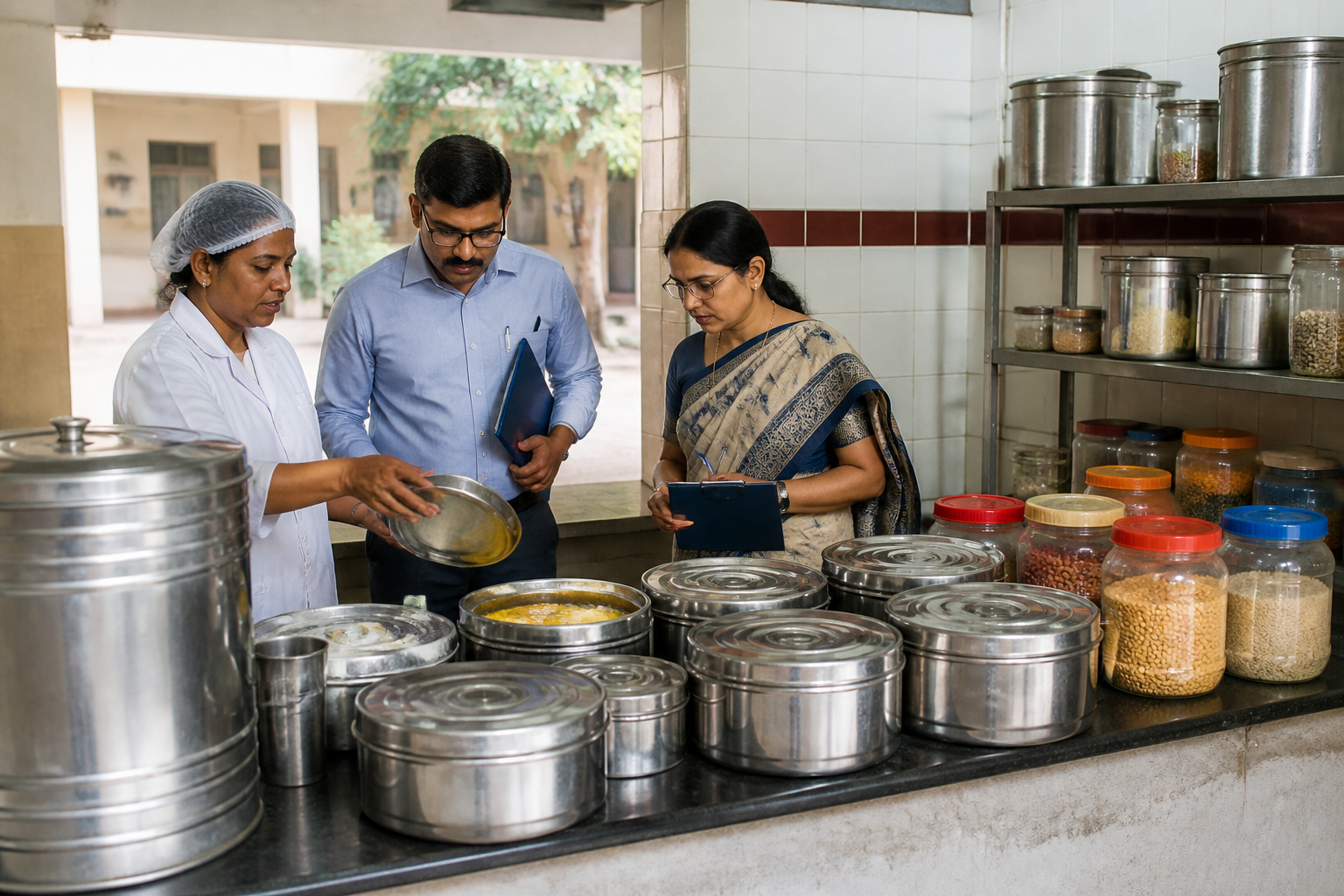
School meal safety has become a public concern after reported incidents in Bihar, Himachal Pradesh, Rajasthan and Delhi involved children falling ill, complaints about food quality and protests over recurring problems. The cases do not establish that every school meal is unsafe, or that the illnesses had a common cause. They do, however, expose how difficult it can be for parents to know whether the food served through an institution is safe before a child becomes sick.
The reported incidents vary significantly. In Bihar’s Nalanda district, at least 24 students reportedly fell ill after eating soybean rice prepared for a midday meal. Some children experienced vomiting and dizziness and were taken to Biharsharif Sadar Hospital. Locals alleged that salt and detergent powder had been stored in the same area and that detergent may have been used instead of salt. The report makes clear that this allegation had not been verified.
In Himachal Pradesh’s Kullu district, more than 30 students reportedly fell ill after being served kheer. Some were said to be semi-conscious and were taken to a health centre. Doctors reportedly considered food poisoning as one possibility, while also pointing to potentially contaminated water or poor-quality milk. Parents sought testing of the food, milk and water. The cause, according to the supplied report, remained subject to investigation.
In Rajasthan’s Kota district, at least 27 students reportedly experienced nausea, vomiting, stomach ache and dizziness after consuming a school meal. Some were later taken to hospitals. Authorities did not attribute the illness to the meal, noting that hot weather, humidity or contaminated water could also have been responsible. That distinction is important: illness following a meal does not, by itself, prove that the meal caused it.
Delhi presents a different but connected concern. Students at the Jammu and Kashmir Girls Hostel of Jamia Millia Islamia reportedly protested over recurring complaints about food served in the hostel mess. They alleged that meals contained flies, rotten food and broken glass. The university questioned the protest but eventually agreed to remove the mess contractor, according to the report. The episode shifts the focus from an acute illness outbreak to the handling of repeated complaints before they escalate into public protest.
Taken together, these cases point to a safety chain with several points of failure. Food must be stored in a way that prevents contact with cleaning chemicals and other contaminants. Water used for cooking and drinking must be safe. Milk, grains, vegetables and other ingredients must be fit for consumption. Cooking areas and utensils require regular cleaning, while food handlers need basic training in hygiene and safe preparation. Inspections and testing must take place before, and not only after, children fall ill.
The available information does not show whether these safeguards failed in every case. Nor does it establish whether the reported incidents were connected. The Nalanda allegation concerns possible storage and handling practices. The Kullu case includes possible concerns about water and milk. The Kota authorities had not confirmed that the meal was responsible. The Delhi hostel complaints relate to food quality and contractor performance. Treating them as identical events would go beyond the evidence.
But treating them as entirely unrelated would also miss the institutional question. A school meal is not an ordinary commercial purchase. Children generally cannot inspect the kitchen, verify the condition of ingredients or choose an alternative lunch when they have doubts. The institution decides what is prepared, how it is stored and when it is served. That places a higher responsibility on the system managing the meal, particularly when children from financially vulnerable households may depend on it as an important part of their daily diet.
This is why prevention matters more than a response limited to hospitalisation. Once a child becomes ill, authorities may collect food or water samples, arrange medical care and begin an investigation. Those steps are necessary, but they occur after the immediate safety barrier has failed. A functioning system should also identify unsafe storage, poor kitchen hygiene, inadequate water quality or recurring complaints during routine operations.
The report’s emphasis on inspections raises a question about how accountability is distributed. Food preparation may involve schools, hostels, contractors, cooks, suppliers and administrative authorities. When something goes wrong, responsibility can become fragmented across these layers. A contractor may be blamed for poor food quality, while the institution may be responsible for selecting or monitoring the contractor. A cook may be held responsible for a handling error even when the kitchen lacks suitable storage. The supplied material does not establish how responsibility was assigned in the reported cases, but the incidents show why a clear chain of oversight is essential.
Complaint mechanisms are another part of the same system. In the Delhi hostel case, students reportedly took to the streets after what they described as persistent food problems. That does not prove that every complaint was valid, but it indicates that the existing route for raising concerns was either not trusted or was perceived as ineffective. A complaint system that records, investigates and closes issues transparently can identify problems before they become crises. Without such a mechanism, students and parents may have little choice but to escalate their concerns publicly.
The numbers in the reported cases are significant because they represent separate groups of children rather than an abstract service failure: at least 24 students in Nalanda, more than 30 in Kullu and at least 27 in Kota. The figures should not be added together as a confirmed total because the incidents occurred in different places, under different circumstances and with different levels of medical and administrative confirmation. Their relevance lies in showing the range of possible risks that can affect institutional food delivery.
The midday meal programme itself is not identified in the report as the cause of these problems. Its stated purpose is to reduce hunger and support children’s welfare and education. Removing or weakening school meals would not address failures in storage, water quality, kitchen hygiene, monitoring or contractor supervision. The central issue is whether the programme’s nutritional promise is matched by a reliable food-safety system.
That system requires evidence at each stage. Where children fall ill, food, water and ingredient samples need to be collected quickly. Where contamination is suspected, the cause must be established rather than assumed. Where complaints recur, authorities need records showing what was reported, who inspected the facility and what corrective action followed. The supplied material does not provide those records for the incidents discussed, leaving important questions unanswered about inspection frequency, laboratory testing, procurement controls and enforcement.
This gap between an incident and a verified explanation is central to public trust. Parents need to know what a child ate, whether the food was tested and what authorities concluded. Students need a safe way to report problems without waiting for illness or protest. Institutions need enough control over kitchens, suppliers and contractors to correct failures before they affect larger groups.
The evidence currently confirms a series of reported illnesses and food-related complaints, but not a single nationwide cause or a uniform pattern of negligence. It also shows that the risks extend beyond cooking itself, including storage, water, ingredients, contractor oversight, inspections and grievance handling. The next important developments are the findings of investigations into the Bihar, Himachal Pradesh and Rajasthan incidents, the outcome of the Delhi hostel action and any documented measures to strengthen preventive checks. A school meal can meet its social purpose only when the system behind it makes safety a condition of service, rather than an issue addressed after children are taken to hospital.

