


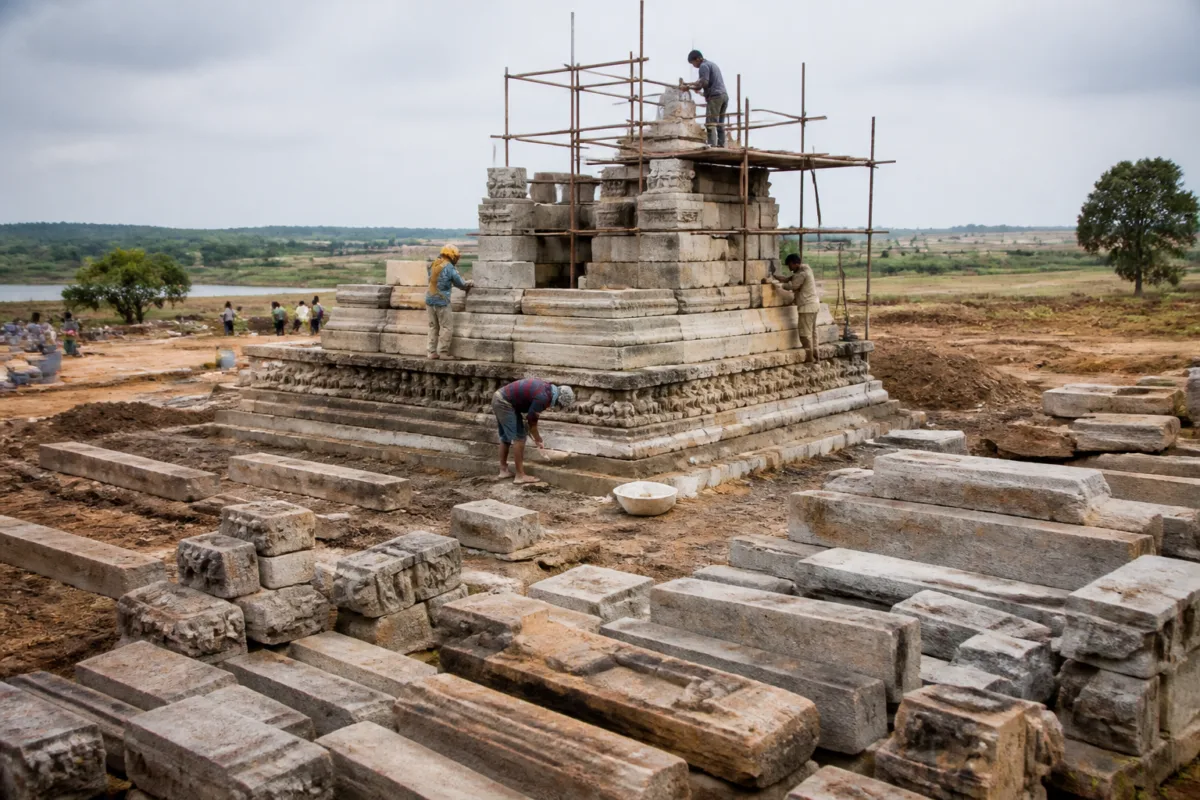
The reconstruction of two ancient Pulichintala temples in Vellatur, Suryapet district, has begun more than two decades after the Krishna River project placed them among the structures to be relocated. The work, taken up by the Archaeological Survey of India’s Hyderabad circle, is expected to be completed before March 2027. The delay is more than a heritage-management footnote: it shows how the cultural and physical consequences of large infrastructure projects can remain unresolved long after the main project has moved on.
The two structures are the Sri Chennakesawa Swamy Temple and the Sri Shiva Temple at Vellatur. Both date to between the 12th and 15th centuries, according to the report by Deccan Chronicle. They were identified for translocation when the Pulichintala project began in 2004-05. The project was associated with the Krishna River and affected villages and structures that the then undivided Andhra Pradesh government believed would be impacted.
The relocation exercise was not initially limited to the two Vellatur temples. A third structure, the Sri Shiva Temple at Gundlapally, was also identified for translocation. Reconstruction of that temple was completed in 2021-22, but work on the two Vellatur temples remained pending. The different timelines for the three temples underline how a common infrastructure-related relocation programme can produce uneven outcomes for sites facing broadly similar administrative obligations.
In 2004, the government asked the ASI to conduct preliminary explorations to identify antiquities and structures in villages expected to be affected by the project. That early survey created the basis for identifying the temples, but the Vellatur structures did not move directly from identification to reconstruction. The ASI’s Hyderabad superintending archaeologist, Dr Nikhil Das, told Deccan Chronicle that administrative challenges kept the work pending.
The immediate restart required the ASI to retrieve records, prepare fresh estimates and obtain a letter of credit from the ASI headquarters. The sequence is significant because it places the delay within the mechanics of public conservation work rather than presenting it simply as a construction pause. Documentation, estimates, financial authorisation and institutional approval all had to be brought together before physical work could proceed.
The site also presented a technical problem. Stone members of the temples had remained at the location for several years, and officials had to document and identify them before beginning reconstruction. Each component is being examined to determine its original position and relationship with other structural elements. For a stone temple, the work is therefore not merely the construction of a new building in an old style. It involves reassembling existing material while trying to retain the architectural character of the original structures.
The total sanctioned amount is Rs 1.72 crore. Around Rs 1 crore has been earmarked for resetting the temple structures, while the remaining amount is intended for landscaping and other amenities. The figures show that the project extends beyond putting the stone members back in place. The final intervention is expected to include the immediate setting around the temples, although the supplied report does not provide a detailed list of the planned amenities.
The foundation design was based on a geo-technical report submitted by experts from the National Institute of Technology, Warangal. That input connects the conservation exercise to the physical conditions of the new or reconstructed site. It also indicates that the project combines historical reconstruction with contemporary technical assessment. The report does not specify the findings of the geo-technical study, but it identifies the study as the basis for the foundation design.
Officials said lime concrete would be used and that construction would proceed layer by layer. Basic work had commenced, and sources cited in the report expected the basic structure to be completed within a month. The broader reconstruction programme is expected to be completed before March 2027. These milestones distinguish the immediate construction phase from the full project, which includes resetting the structures, landscaping and other amenities.
The most important conservation question is how to rebuild without reducing the temples to replicas. The ASI’s stated approach is to examine each stone component and place it in its original position with the other structural elements. That method is intended to retain the temples’ architectural character while conserving the original stonework. The available account does not establish whether every original component has been recovered or whether any elements will require replacement. It does, however, make clear that identifying and matching the surviving stone members is central to the work.
The project also exposes a division between responsibility and ownership. The temples are not under the ASI, and they will be handed over to the state government after the reconstruction is completed. The ASI is therefore carrying out the conservation work without becoming the long-term custodian of the sites. That arrangement makes the handover an important administrative milestone. It will determine which state authority assumes responsibility for the completed structures and their surrounding amenities, although the supplied report does not identify the specific department or agency.
This institutional arrangement is common to the logic of project-linked relocation: one agency identifies or reconstructs a structure, while another authority ultimately manages it. The Vellatur case shows why the period after construction matters as much as the rebuilding itself. A completed structure still requires maintenance, site management and an agreed public role. In this instance, those responsibilities will shift to the state government after the ASI completes the work.
The more than 20-year gap also changes the meaning of a rehabilitation commitment. When the temples were identified in 2004, the relocation was part of the response to a major river project and its impact on affected villages. By the time rebuilding began, the delay had become a separate institutional history involving old records, revised estimates, a new financial authorisation and stone members waiting at the site. The physical project may have created the original need for relocation, but the delay was sustained by administrative and technical processes.
The case does not establish that every heritage structure affected by infrastructure projects experiences a similar delay. It does show, however, that the completion of a major project does not automatically close all related obligations. Cultural structures can remain in an administrative queue even after the infrastructure that triggered their relocation has become part of the landscape. For residents and communities connected to such sites, the time between identification and reconstruction is not an abstract accounting period. It determines when a damaged or displaced place becomes usable again as a physical and cultural landmark.
The reported cost of Rs 1.72 crore is also best understood alongside the long period of delay. The amount covers the resetting of the structures, landscaping and other amenities, but the source does not provide the original estimate from 2004 or explain how costs changed over the intervening years. It therefore cannot establish the financial impact of the delay. It does establish that reopening the work required fresh estimates, suggesting that the project could not rely unchanged on its earlier administrative calculations.
The reconstruction further illustrates the difference between relocation and conservation. Relocation requires a structure to be moved or reassembled at another setting. Conservation requires decisions about material, sequence, structural stability and architectural integrity. In Vellatur, the ASI is using a geo-technical report for the foundation, lime concrete for the structure and a component-by-component process for the stonework. These details indicate that the work is being treated as a technical conservation project rather than a conventional replacement building.
The next phase will test whether the stated schedule can be maintained. Officials expect the basic structure to take shape within a month and the full work to finish before March 2027. The subsequent handover to the state government will be equally important because it will mark the transition from reconstruction to long-term administration. The evidence currently confirms that work has started, funding has been authorised and a conservation method has been defined. It does not yet establish how the completed temples will be managed or how the state will maintain the restored site.
The Vellatur temples therefore represent both a delayed heritage recovery and a continuing governance responsibility. Their reconstruction reconnects a 12th-to-15th-century architectural legacy with a modern infrastructure project that had placed the structures at risk. The immediate outcome is positive: work has begun after more than two decades. The larger lesson is less settled. Infrastructure planning can identify what must be moved, but preserving it depends on records, funding, technical knowledge, construction and an accountable institution willing to carry the obligation through to completion and beyond.

