


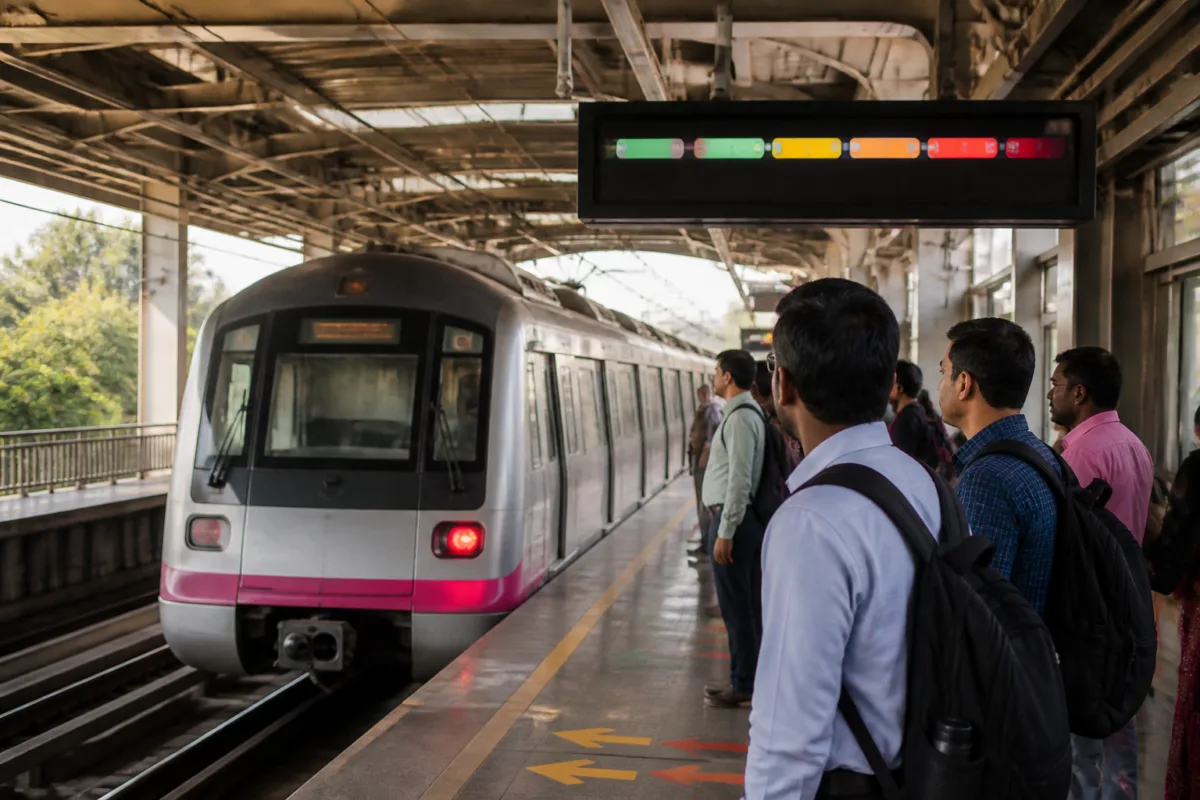
Delhi Metro has introduced real-time coach occupancy information on the Pink Line, allowing passengers to identify less crowded coaches before a train arrives and choose where to board. The facility, already available on the Magenta Line, is intended to distribute passengers more evenly across trains during busy periods.
The Delhi Metro Rail Corporation has installed the system at Pink Line stations, where passenger information display systems will show the estimated occupancy of individual coaches shortly before a train reaches the platform. The information is designed to help commuters move towards the section of the platform serving a less crowded coach instead of waiting for the train and searching for space after it arrives.
According to the report, the system uses load sensors installed in the coaches. These sensors measure the current weight of each coach and compare it with the coach’s empty weight. The resulting data is used to estimate the percentage of passengers in every coach. The occupancy information is then displayed on platform screens before the arrival of the train.
The feature was first introduced on the Magenta Line, where the passenger information display system has been providing real-time coach occupancy details since 2022. The information helps passengers decide which coach to board and is intended to improve the distribution of passengers across the train.
The Pink Line, also known as Line 7, presents a more complex data-management challenge because it operates as a circular corridor. The report said that linking the occupancy data across the line required integration of information from the coaches and station display systems. The facility has now been extended to Pink Line stations after the earlier implementation on the Magenta Line.
For passengers, the most immediate use of the system will be during the morning and evening peak periods, when some coaches can fill faster than others. By identifying the occupancy level in advance, commuters can position themselves closer to a coach with relatively more available space. This could reduce the need to walk along the platform after a train arrives and make boarding more predictable.
The system also provides the metro operator with a way to make existing train capacity more visible to passengers. Instead of relying only on where crowds happen to gather on the platform, commuters receive coach-level information before boarding. The reported objective is to prevent excessive concentration in particular coaches and improve the use of available space across the train.
The service does not add coaches or increase the frequency of trains on the Pink Line. Its immediate function is to provide passengers with operational information based on the estimated load inside each coach. The next phase of its use will depend on how the system performs across Pink Line stations and how commuters respond to the information during regular and peak-hour services.

