


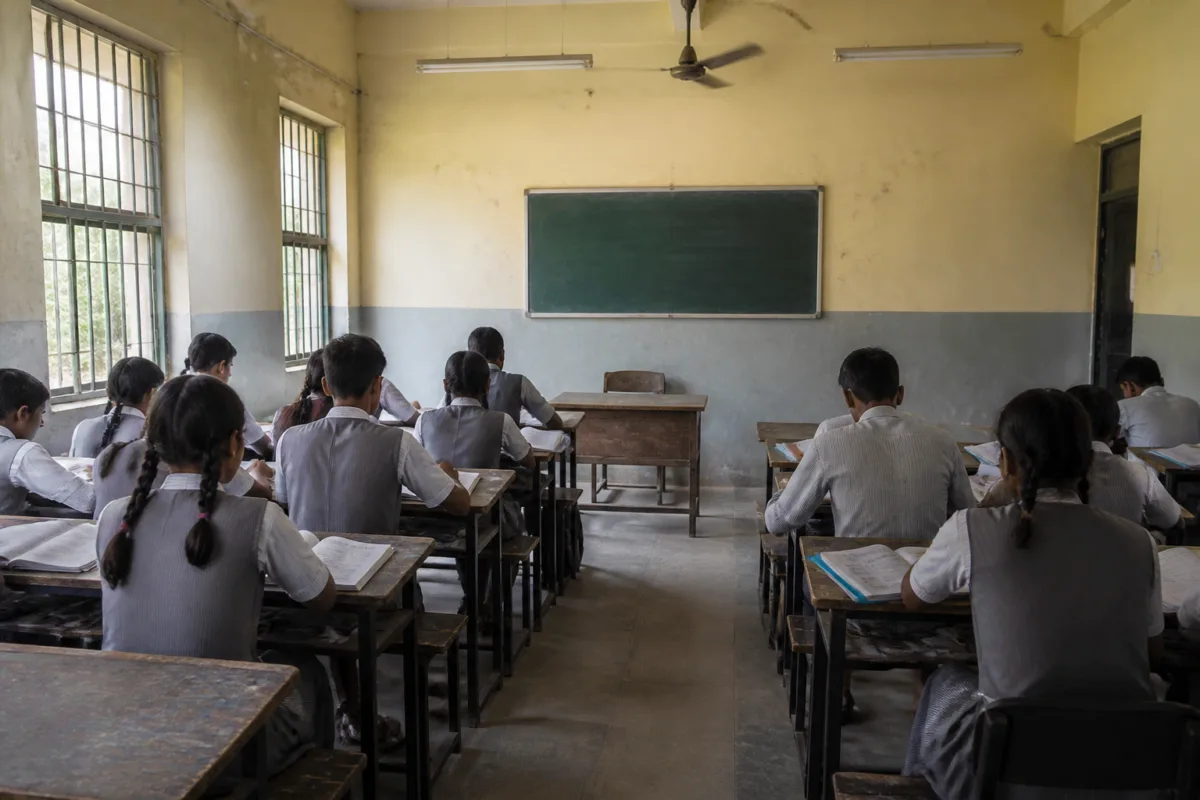
A reported shortage of a regular commerce teacher at Sarvodaya Kanya Vidyalaya on Loni Road has become more than an isolated school complaint. Class XII students in the northeast Delhi government school say they have gone without consistent subject teaching for nearly two years, while a temporary arrangement involving a teacher from another school has failed to provide reliable coverage. The episode exposes a basic administrative question: how does a school system protect senior-secondary learning when a subject-specific vacancy remains unresolved across two academic years?
The immediate concern is academic. Students said the school had no commerce teacher when they were in Class XI and that the situation continued into Class XII, the year in which they prepare for board examinations. A teacher from another school was recently assigned to take classes three days a week, on Monday, Tuesday and Wednesday. Students, however, alleged that these classes were frequently missed. The result, they said, was an interruption not of a few lessons but of the regular teaching sequence on which a specialised senior-secondary subject depends.
The available report does not establish the sanctioned strength of the school, the duration of the vacancy in official records, or the precise number of scheduled classes that were missed. It does establish the students’ account of prolonged disruption, the principal’s repeated requests for intervention and the education department’s acknowledgement that the matter would be probed and arrangements made. The department official did not specify whether the response would be the appointment of a regular commerce teacher or another temporary solution.
That distinction matters. A regular appointment and a shared-teacher arrangement may both be described as responses to a vacancy, but they do not provide the same level of continuity. The reported arrangement gives the school access to a teacher on selected days rather than ensuring that commerce instruction is embedded in the school’s weekly timetable. Students’ allegations about irregular attendance also point to an operational weakness: even a formally approved stopgap is ineffective if the system cannot ensure that the assigned classes take place.
## The evidence from one classroom
Students reported that 35 of the 61 commerce students failed their recent mid-term examinations. That figure is a significant warning sign, but it cannot by itself prove that the teacher shortage caused every failure. Examination outcomes can be shaped by several factors, and the supplied report does not provide a subject-wise comparison with earlier years, attendance data, internal assessment records or the performance of other streams in the same school. What the number does show is the scale of the concern within the affected cohort: more than half of the commerce students were reported to have failed the mid-term examinations.
The students’ concern is also tied to timing. They are now in Class XII and preparing for board examinations after experiencing an extended period without a regular teacher. The report does not state the board results that followed, nor does it confirm whether the department’s proposed intervention had begun by the time of publication. The uncertainty makes the department’s next action important. A promise to make arrangements is not the same as a documented plan for restoring subject continuity before the examinations.
The principal’s reported requests add an institutional dimension. The complaint was not presented as an issue that surfaced only after the mid-term results. Students said the principal had repeatedly approached the authorities, yet a regular teacher had not been appointed. If accurate, this indicates a gap between school-level escalation and department-level resolution. The central administrative problem is therefore not only recruitment. It is also how vacancies are tracked, prioritised, escalated and closed when the affected students are in a board-examination class.
The report also records that the school could not be reached for comment despite repeated attempts. That limits the available account of the vacancy, the school’s timetable, the requests made by the principal and the attendance of the visiting teacher. The students’ claims and the department’s response should therefore be read alongside this limitation. The supplied evidence is sufficient to identify a serious reported service gap, but not to establish every operational detail behind it.
## A pattern of temporary fixes
The Loni Road complaint comes barely two months after students at another Delhi government school in Khajuri Khas raised similar concerns about a prolonged absence of a subject teacher. In that case, students alleged that they had been without a regular chemistry teacher for up to three academic years, affecting more than 200 students in Classes XI and XII. The four sections were reported to have between 50 and 55 students each. After the complaints, the education department arranged for a chemistry teacher to visit the school three times a week.
The two cases involve different subjects and schools, but the reported response is similar: when a regular postgraduate teacher, or PGT, is unavailable, the system uses a teacher shared between institutions or a guest-teacher arrangement to fill part of the gap. Such measures can provide immediate relief. They can also become a substitute for resolving the vacancy if there is no publicly visible timeline for a permanent appointment or a stable alternative.
The issue is particularly acute in Classes XI and XII because the students are studying specialised subjects. The supplied report identifies commerce and chemistry, but it does not provide a complete list of subjects facing shortages across Delhi schools. It also does not establish how many PGT posts are vacant, how many guest teachers are engaged, or how many schools rely on shared staff. Those figures would be needed to determine the scale of the problem across the school system.
What the reported cases do show is a repeated dependence on arrangements that divide a teacher’s time between institutions. A teacher visiting one school three days a week may address part of a staffing shortage, but the model creates a question of responsibility and continuity. Which school receives priority when schedules conflict? Who monitors attendance? How are missed lessons recovered? Who supports students between visits? The report does not answer these questions, and the education department’s response in the commerce case did not specify the operating model it would adopt.
## The accountability gap
Education departments often need short-term mechanisms to prevent classes from stopping while recruitment or deployment is completed. The problem arises when the emergency mechanism has no clear end point. In the reported cases, the students’ complaints suggest that temporary arrangements have lasted alongside long-standing vacancies. This shifts the issue from a one-time staffing difficulty to a question of administrative follow-through.
The education department official’s statement that the matter would be probed and arrangements made is an acknowledgement of the complaint, but it leaves key questions open. Will the department appoint a regular commerce teacher? If not, what alternative will ensure that all scheduled classes are held? How will the department verify attendance and teaching hours? Will students receive remedial support before the board examinations? The report does not record answers to these questions.
Education activist and lawyer Ashok Agarwal raised a broader concern about promoting students without regular classroom instruction. His argument, as reported, is that promotion alone does not establish whether students have acquired the knowledge and skills expected at their level. That distinction is important in the context of the complaints. A student may move from Class XI to Class XII while the underlying teaching gap remains unresolved. The administrative completion of promotion does not necessarily represent educational continuity.
The reported shortages therefore expose two different measures of system performance. The first is whether students remain enrolled and progress to the next class. The second is whether they receive consistent, subject-specific instruction. The source material does not provide enough evidence to compare these measures across Delhi, but the complaints show why enrolment or promotion figures alone cannot describe the full experience of a senior-secondary student.
## What the numbers establish—and what they do not
The available figures are limited but important. At Sarvodaya Kanya Vidyalaya, students reported that 35 of 61 commerce students failed the recent mid-term examinations. At the Khajuri Khas school, more than 200 students in Classes XI and XII were reportedly affected by the absence of a regular chemistry teacher. Each of four sections there was reported to have between 50 and 55 students. The report also says that the commerce teacher shortage lasted nearly two years and that the chemistry shortage lasted up to three academic years.
These figures illustrate duration, cohort size and reported academic impact. They do not provide a city-wide vacancy rate, a comparison with private schools, historical board results, or evidence that the temporary arrangements were equally irregular in both schools. Nor do they show whether the vacancies resulted from recruitment delays, transfers, sanctioned-post gaps, leave, retirement or another administrative cause. Those distinctions matter because the remedy depends on the cause.
The evidence does, however, establish a common operational pattern in the reported cases: a regular teacher is absent for an extended period; students and school authorities raise concerns; the department responds with a teacher visiting from another school several times a week. The recurrence of this pattern is the strongest reason to treat the complaints as a governance issue rather than two unrelated classroom disputes.
## The larger urban governance question
For families in Delhi, a government school is not only a place of instruction. It is a public institution that determines whether students can access specialised education without depending on private coaching or household resources. The supplied report does not measure the financial burden on families or say whether affected students turned to private tuition. It does show why the absence of a regular teacher can have consequences beyond the timetable, particularly when students are approaching board examinations.
The larger question is whether the education system can detect and resolve subject-specific staffing gaps before they become learning gaps. A school may continue functioning while a specialised class is taught irregularly. From outside, there may be no visible closure or disruption. Inside the classroom, however, missed instruction accumulates over months and academic risk becomes apparent only through examination performance or student complaints.
The next stage of this case should therefore be judged by concrete administrative outcomes: whether the department completes its probe, identifies the staffing arrangement, ensures that commerce classes are held consistently and clarifies whether a regular teacher will be appointed. The Khajuri Khas case also warrants follow-up to establish whether the three-day chemistry arrangement has continued and whether the underlying vacancy was resolved. Until those details are available, the evidence confirms a reported and recurring staffing problem, but not its full scale across Delhi.
The significance of the Loni Road complaint lies in that unresolved gap between a school’s request and a department’s response. A temporary teacher can keep a timetable moving, but the reported experience of these students raises a more fundamental test for public education: whether the system can guarantee continuous, subject-specific teaching when it matters most.

