


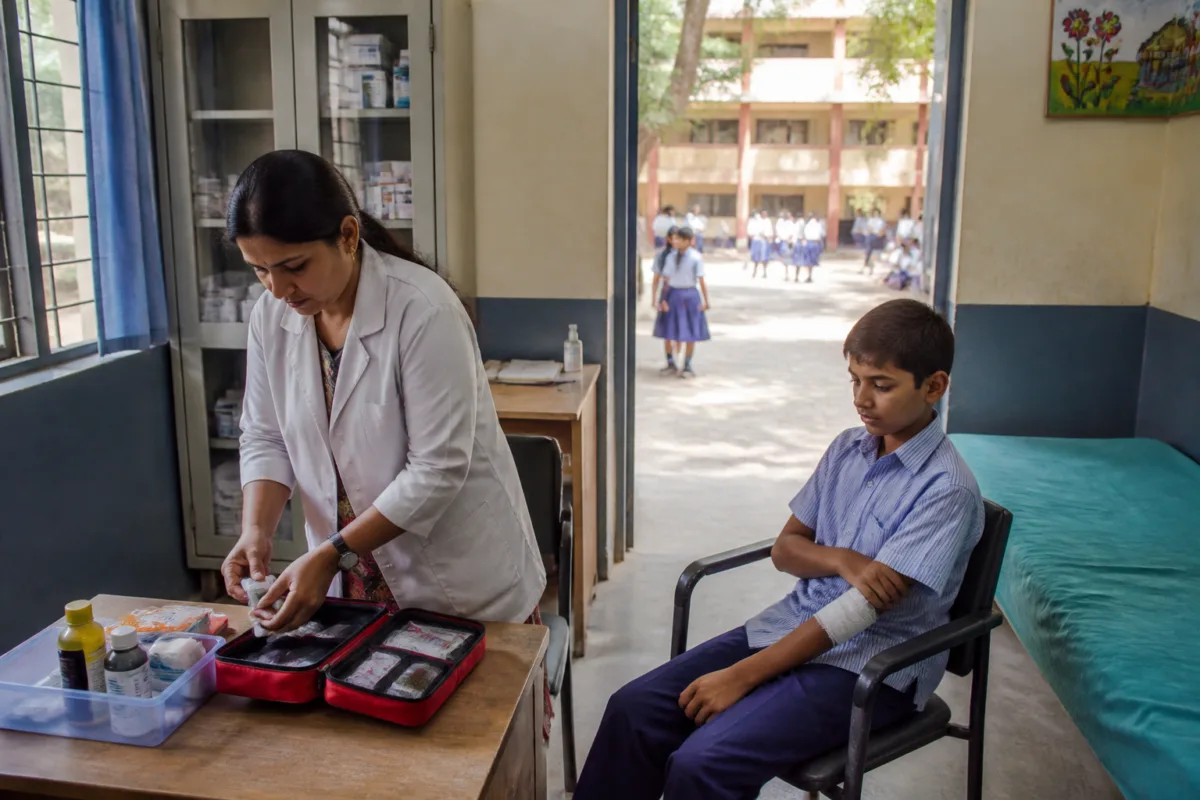
Delhi has proposed setting up first-aid medical facilities in all 1,086 government schools under the Directorate of Education, with a trained health worker at each school and an estimated annual cost of Rs 48.9 crore.
The proposed facilities will provide immediate first-response care during school hours, including wound dressing, administration of oral rehydration solution and temporary rest under trained supervision. They will not offer diagnostic services or administer prescription medicines on school premises, according to the proposal reported by the Times of India.
Each school is expected to have a trained health worker, such as an auxiliary nurse midwife or multipurpose health worker. Besides attending to minor injuries and sudden health complaints, the workers will provide adolescent health support. The facilities will also offer girls a safe and private space for menstrual health needs.
Delhi education minister Ashish Sood said every child in government schools should have access to a safe and caring environment. He said the presence of first-aid support inside school campuses would give parents and teachers greater assurance when students fell ill or were injured during school hours.
The proposal identifies gaps in the ability of many schools to respond to minor injuries, sudden illness, fatigue, dizziness and other health-related discomfort. Without a designated facility or trained person, students may face delays in receiving basic assistance, while teachers and parents may be left uncertain about how to respond.
The plan is intended to be implemented in phases. The first phase will cover schools that already have separate rooms that can be used for medical facilities. Schools without dedicated space will be covered later through alternative rooms or porta cabins, according to the proposal.
The proposed model separates basic medical assistance from clinical treatment. Health workers would provide first-response care and temporary support rather than diagnosis or prescription-based treatment. This distinction means that students requiring medical evaluation or more advanced care would still need to be referred outside the school, although the proposal does not specify a referral system or the institutions that would handle such cases.
The annual cost of Rs 48.9 crore will cover the proposed network across all 1,086 schools, but the source material does not provide a detailed financial breakup or specify the staffing agency, recruitment process or procurement mechanism. It also does not state the timeline for completing the rollout.
The government has described the initiative as a student-welfare measure aligned with the National Education Policy 2020. Its immediate implementation milestones will be the identification of schools with available rooms, arrangements for schools requiring alternative spaces and the deployment of trained health workers under the phased plan.

