


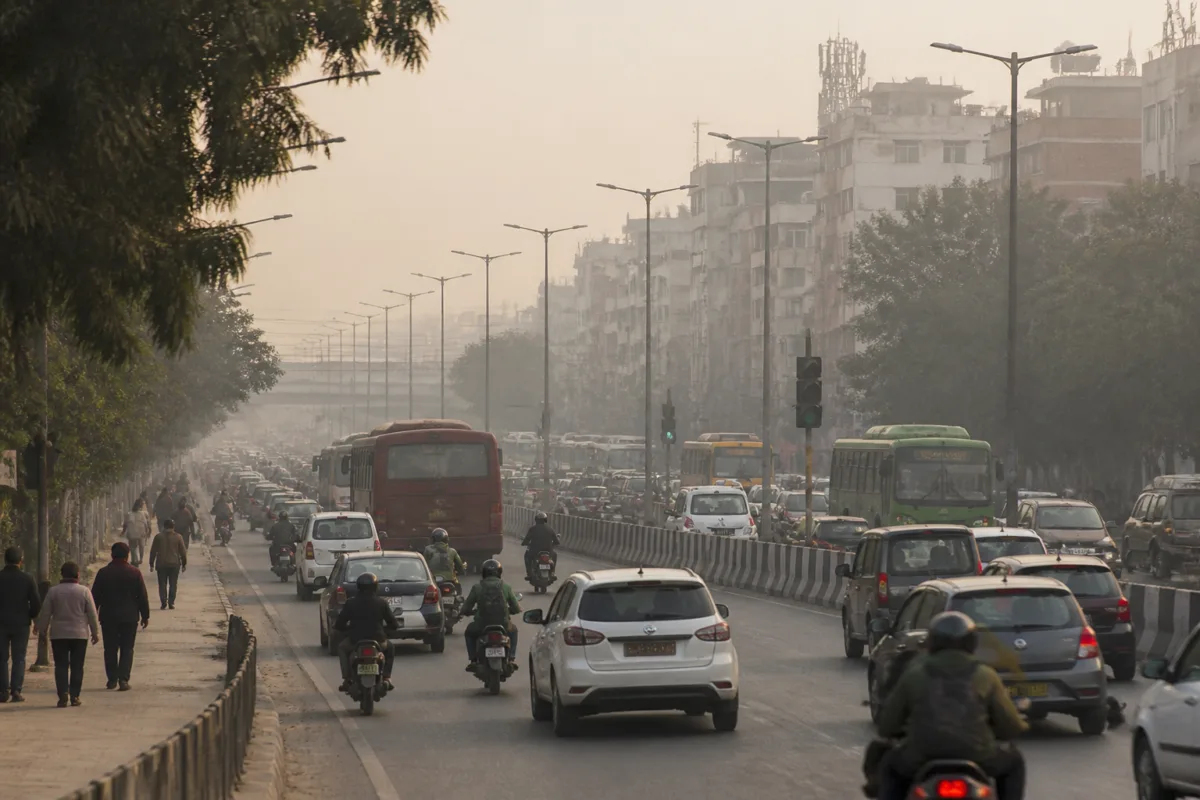
Delhi’s air quality improved for a fourth consecutive day on Sunday, but the city remained in the ‘poor’ category, with transport emissions continuing to account for the largest estimated share of PM2.5 pollution.
The city’s Air Quality Index (AQI) settled at 239, 26 points lower than the previous day, according to a report by Millennium Post. The AQI had declined from 280 on November 19 to 270 on November 20, 265 on Saturday and 239 on Sunday.
The improvement was uneven across the capital. Of 56 monitoring stations that recorded data, 36 reported ‘poor’ air quality, eight recorded ‘very poor’ conditions and 12 were in the ‘moderate’ category. Uttam Nagar recorded the highest AQI at 332, followed by IGNOU Maidan Garhi at 330.
Real-time source-apportionment estimates from the Air Quality Early Warning System identified vehicular emissions as the largest contributor to Delhi’s PM2.5 concentration on Sunday, at 38.6 per cent. The estimated share was higher than the 33.1 per cent recorded on Saturday.
Biomass burning, including stubble burning and the use of domestic solid biofuels such as wood and dung cakes, contributed 24.2 per cent of the estimated pollution load. Waste burning—including municipal waste, plastic, rubber and electronic waste—accounted for 14.9 per cent.
Secondary organic aerosols contributed 8.9 per cent and secondary inorganic aerosols 8 per cent. Road dust, soil and mineral particles accounted for 2.2 per cent, while mixed combustion contributed 1.6 per cent. Industrial sources and coal combustion made up 1.5 per cent and 0.2 per cent, respectively.
The latest decline coincided with favourable weather. Northwesterly winds reached speeds of up to 15 kmph, helping disperse pollutants instead of allowing them to accumulate near the surface, the report said.
The figures indicate why a lower citywide AQI does not represent uniform relief for residents. Local conditions continued to differ sharply between monitoring locations, with Uttam Nagar and IGNOU Maidan Garhi recording AQI levels in the ‘very poor’ range even as the overall city reading improved.
The source-apportionment estimates also place road transport at the centre of Delhi’s continuing pollution challenge. However, the reported improvement was linked to atmospheric dispersion, and the available data do not establish that emissions from vehicles or other sources had structurally declined.

