


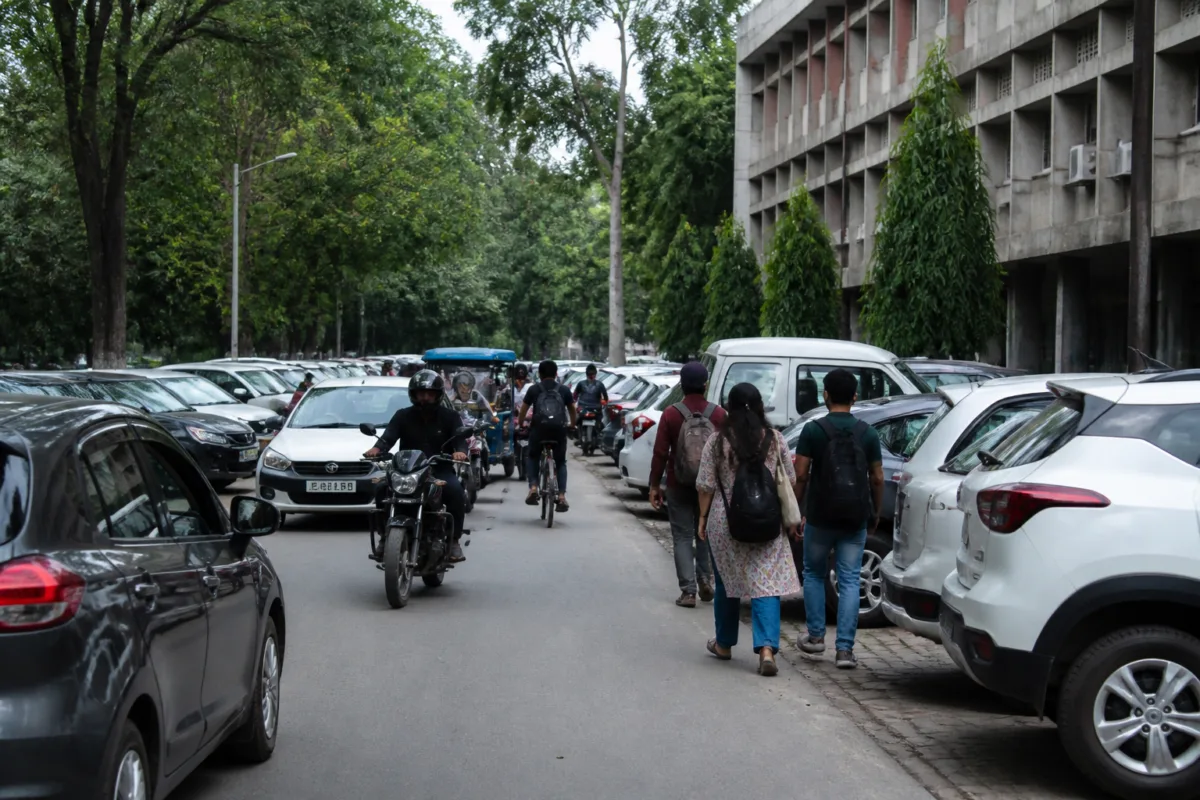
Panjab University’s efforts to manage traffic and reduce private-vehicle use have not resolved congestion and parking pressure across the campus, with Gate Nos. 1 and 2 and roads near Gandhi Bhawan, the Administrative Block and the Centre for Distance and Online Education emerging as recurring trouble spots, according to a report by The Tribune.
Cars and two-wheelers are reported to crowd several internal stretches during peak morning and afternoon periods. The increase in private vehicles has placed additional pressure on available parking, particularly around the hostels, where paid parking facilities are reportedly struggling to accommodate demand.
The problem extends beyond delays and inconvenience. The report highlights concerns about pedestrian safety and accessibility after an SUV reportedly struck the white cane of a visually impaired student on campus. The student, who requested anonymity, narrowly avoided injury and reported the incident to the university’s Centre for Equal Opportunity for Persons with Disabilities.
The incident underscores the risks created when vehicles and pedestrians compete for limited road space without consistently protected walking routes. For a large institutional campus, mobility planning must account not only for vehicle entry and parking capacity but also for the safety and independent movement of students with disabilities.
Panjab University had announced a monthly car-free day in September 2023 to encourage students and faculty members to walk, cycle or use shuttle services. The initiative, however, appears to have lost momentum. Its limited continuity points to a broader implementation challenge: discouraging private vehicles requires regular enforcement and practical alternatives, rather than a one-day intervention alone.
Vikram Singh of the university’s Security Office said a Traffic Committee constituted in 2025 had been working to regulate vehicle movement, especially by restricting the entry of outsiders. He said Gate Nos. 1 and 2 used a token system for entry, while Gate No. 3 was reserved for professors, staff and students.
The report said the effectiveness of the token system remained a concern because its implementation was not consistently evident during the ground visit. That gap between a stated control mechanism and its visible application is significant. Entry restrictions can reduce through-traffic, but they are unlikely to ease congestion if parking demand inside the campus continues to grow or if enforcement is inconsistent.
Registrar YP Verma said the university was exploring sustainable transport measures and seeking corporate social responsibility grants for e-rickshaws and electric vehicles on campus. He also said the university planned to issue identity cards to everyone on campus to make it easier to identify members of the university community.
These proposals could support better-managed internal mobility, but the report does not indicate that funding has been secured or that an implementation timeline has been announced. Similarly, identity cards may assist access management, but they would not by themselves address the shortage of parking, pedestrian protection or the continued dependence on private vehicles.
Panjab University Teachers’ Association president Parveen Goyal called for stricter enforcement of parking stickers to distinguish university vehicles from those belonging to outsiders. He also urged professors, staff members and administrative officials to reduce their dependence on private vehicles and set an example for students.
Faculty members have raised concerns about the growing use of expensive cars and SUVs among sections of the student community, describing them as status symbols. The report also records concerns about young students allegedly driving without valid licences. These claims are attributed to faculty members and are not independently quantified in the report.
The campus mobility problem therefore combines several pressures: rising private-vehicle use, limited parking, inconsistent entry controls, weak continuity in demand-management initiatives and inadequate attention to pedestrian accessibility. The reported conditions around the hostels and major internal roads suggest that expanding parking alone would not resolve the underlying issue.
A more effective campus mobility plan would need to connect access rules with reliable shuttle or electric-vehicle services, safer pedestrian routes, accessible design, parking-sticker enforcement and sustained monitoring. The university’s proposed e-rickshaws, identity cards and existing gate controls indicate that institutional mechanisms are being considered. The unresolved question is whether these measures will be implemented together and enforced consistently enough to reduce vehicle dependence while protecting people walking through the campus.

