


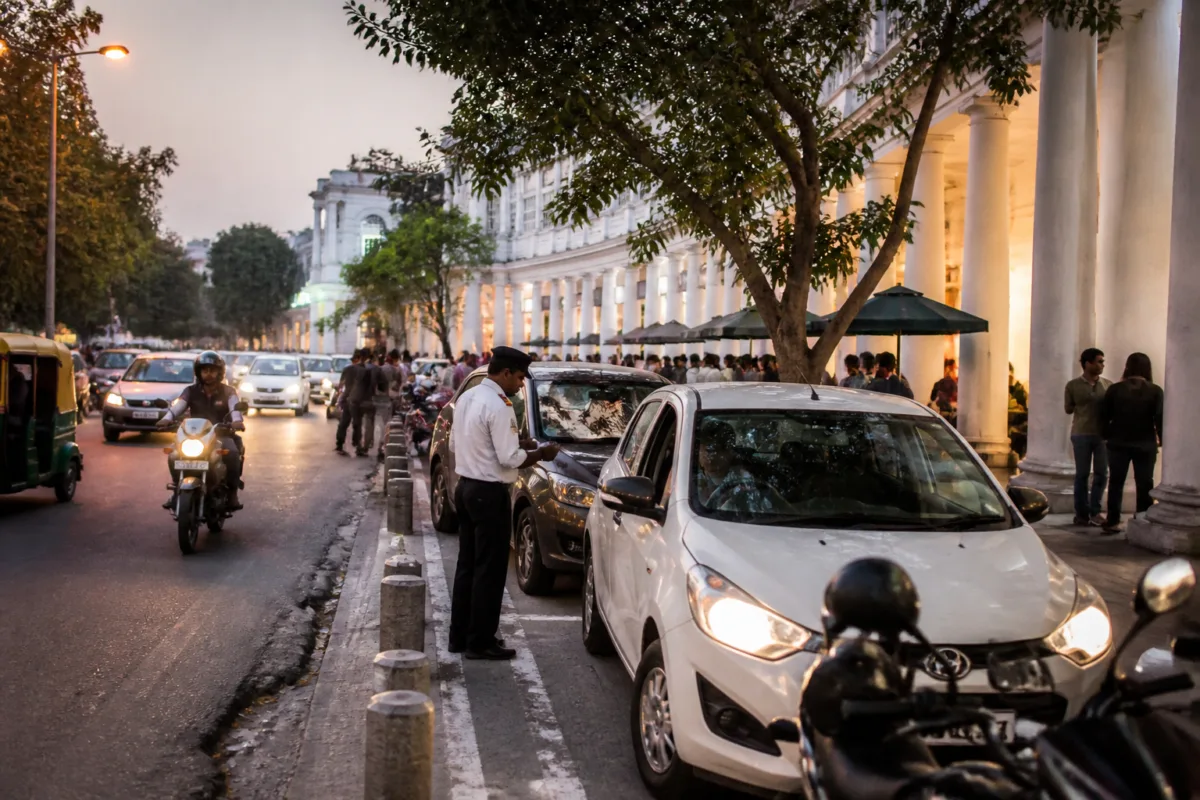
Delhi parking fees in Connaught Place’s H Block have risen to Rs 100 an hour at some locations, compared with Rs 40 outside the block, according to a report by Millennium Post. The price gap is influencing where visitors leave their vehicles in one of New Delhi’s busiest dining and commercial areas.
The report said cafes and restaurants including Social, Chili’s and Tan Coffee attract heavy footfall, turning limited curb space into a daily pressure point. A regular visitor, Shagun Sharma, who travels from near ITO, said he prefers parking outside H Block to avoid the higher charge.
The increase is linked to temporary anti-pollution measures rather than a permanent revision of the New Delhi Municipal Council’s baseline tariffs. Documents reviewed for the report trace standard rates to council resolutions and the 2022 Citizen Charter. These include Rs 20 an hour, subject to a Rs 100 daily maximum, for four-wheelers; Rs 10 an hour, subject to a Rs 50 daily maximum, for two-wheelers; and monthly passes of Rs 2,000 for cars and Rs 1,000 for two-wheelers. Separate monthly concessions are listed for shopkeepers.
A 2016 council resolution distinguishes between off-road, indoor and on-road parking. It lists rates ranging from Rs 20 an hour for off-road cars to Rs 50 an hour for on-road four-wheelers, with lower charges for two-wheelers and indoor parking.
Since November 2023, the report identified four rounds of temporary fee increases associated with Graded Response Action Plan restrictions. The first began on November 13, 2023, was extended to private concessionaires later that month and was subsequently rolled back in February 2024. Another round was reported in October 2024. A third, introduced in October 2025, affected 102 of 126 facilities and was rolled back in February 2026. The report noted a discrepancy in the stated bus charge during that period, with figures of Rs 200 and Rs 300 reported.
The latest measure was described as effective from November 1, 2026, to February 28, 2027, following a Delhi government notification issued under Section 5 of the Environment (Protection) Act, 1986. The stated purpose is to use higher parking costs as part of seasonal measures intended to discourage private-vehicle use during periods of poor air quality.
Implementation, however, appears uneven. A parking supervisor identified in the report as an NDMC government employee said central spaces had increased from Rs 50 to Rs 100, while side lanes had moved from Rs 20 to Rs 40. He also described collecting half rates from battery-operated vehicles.
The NDMC public notice cited by the report exempts electric vehicles and monthly passes from the enhancement. NDMC Vice-Chairman Kuljeet Singh Chahal said he had asked the parking committee director to review the Rs 100 charges and referred to discounts for electric vehicles.
The episode highlights the practical challenge of applying temporary environmental pricing to a fragmented urban parking system. For visitors, shopkeepers and concessionaires, the distinction between baseline tariffs, on-road charges, seasonal surcharges and exemptions needs to be visible at the kerb. Clearer signage and consistent enforcement would be necessary if parking prices are to influence travel choices without creating confusion at one of the capital’s most heavily used public spaces.

