


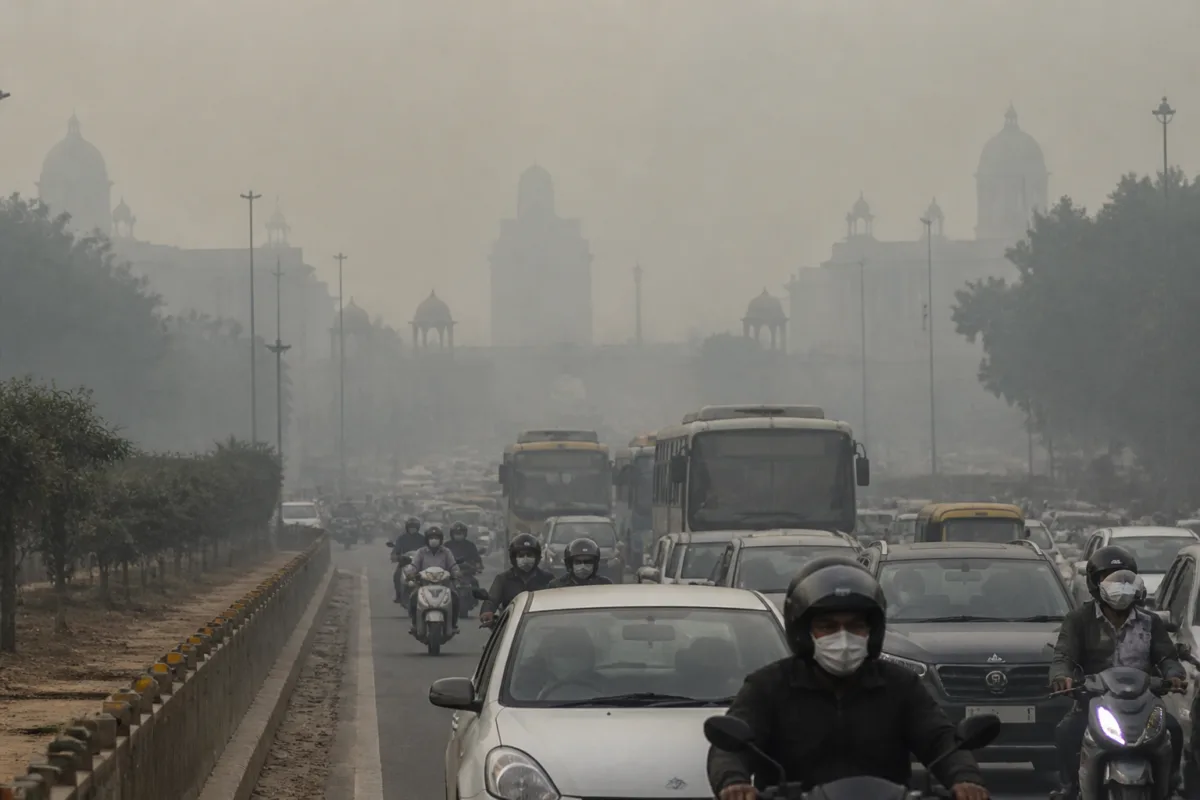
Delhi’s air quality deteriorated to the severe category on Friday, with the city recording an Air Quality Index of 403 around 8am and residents waking to smog, hazy skies and reduced visibility. The reading made it the capital’s most polluted day since January 19, when the AQI stood at 410, according to Central Pollution Control Board data cited in the report.
The city’s air quality improved marginally during the day but remained dangerous. The AQI fell to 398 by noon, placing it in the very poor category, and stood at 373 by 4pm. The readings are measured on a scale of 0 to 500. The improvement followed limited dispersion of pollutants that had accumulated over the previous 24 hours.
Several monitoring locations recorded substantially worse conditions than the citywide average. The IIT Delhi station recorded an AQI of 481 at noon, which improved to 451 by 4pm. Both readings remained in the severe category.
The deterioration was attributed to a combination of unfavourable meteorological conditions and emissions from local pollution sources. Experts cited a lower inversion layer, a change in wind direction towards north-westerly winds and stagnant atmospheric conditions that restricted the dispersal of pollutants, particularly during the morning.
Anumita Roychowdhury, executive director of the Centre for Science and Environment, said conditions improved marginally later in the day as some of the pollution accumulated during the previous 24 hours dispersed. She said year-round efforts were needed to control pollution sources because similar atmospheric conditions recur every year.
Indian Institute of Tropical Meteorology data showed that the contribution of pollution sources changed between Thursday and Friday. On Thursday, biomass burning accounted for 25.4% of Delhi’s pollution, followed by secondary organic aerosols at 25% and vehicular emissions at 17%. Firecracker emissions, which continued to linger after Diwali, contributed about 7% of the pollution load.
On Friday, vehicles became the largest identified contributor, accounting for 31.5% of the city’s pollution. Secondary organic aerosols contributed another 25%, while biomass burning, including emissions from stubble burning and coal combustion, accounted for around 20%. Municipal waste burning contributed more than 5%, and firecracker emissions accounted for 2.2%.
The latest spike comes while restrictions under Stage III of the Graded Response Action Plan are in force. Delhi’s winter pollution framework, which came into effect on November 1, has also barred private construction and the entry of non-Delhi-registered BS-IV or lower vehicles into the city, among other measures.
The Delhi Traffic Police held a coordination meeting with neighbouring states to strengthen enforcement of the Commission for Air Quality Management’s directions and GRAP vehicle restrictions. Discussions covered tighter checks at border entry points, preventing non-compliant vehicles from using alternative routes and installing digital display screens at diversion points to inform commuters about restrictions and alternate routes.
Officers were directed to intensify public awareness campaigns and enforcement of valid Pollution Under Control certificates. The police also said action would be taken against diesel vehicles that are 10 years or older and petrol vehicles that are 15 years or older, in accordance with applicable norms. IITM forecasts cited in the report indicate that Delhi’s air quality is likely to remain in the mid-to-upper range of the very poor category, with the AQI expected to stay between 301 and 400.

