


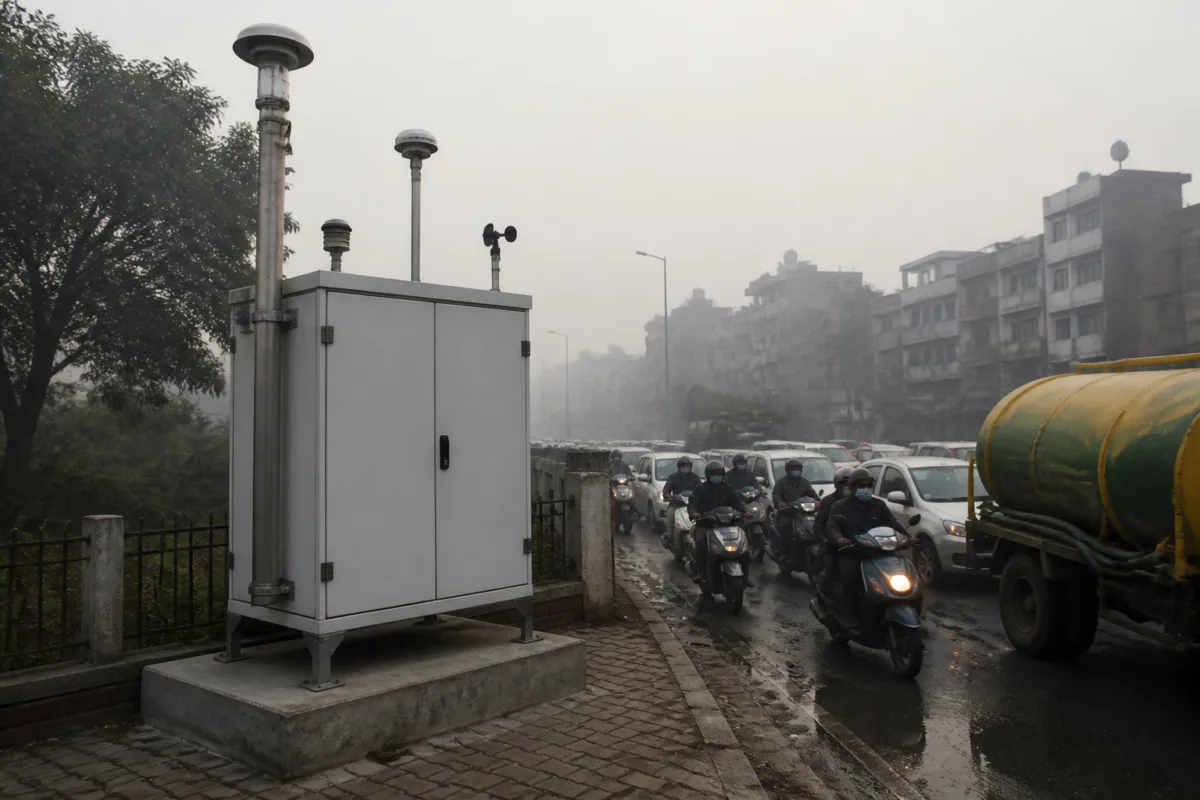
Delhi’s average air quality index (AQI) reached 350 on Tuesday, the city’s worst reading in 287 days, as the Aam Aadmi Party alleged that water was being sprayed over an air-quality monitoring station to influence pollution readings. The allegation has not been independently established in the report, but it comes as several parts of the capital recorded air in the ‘severe’ and ‘very poor’ categories.
According to the report, all 57 AQI monitoring stations in Delhi recorded polluted air. Ten stations reported ‘severe’ air quality, 35 recorded ‘very poor’ conditions and 12 were in the ‘poor’ category. Jahangirpuri recorded the city’s highest reading at 462, placing it in the ‘severe’ category.
Saurabh Bhardwaj, Delhi unit president of the AAP, alleged that water was being sprayed directly over the monitoring station at ITI Jahangirpuri. In a video shared by him, Bhardwaj claimed that the spraying was intended to reduce the pollution reading recorded by the equipment, rather than reduce pollution across the surrounding area.
Bhardwaj described the alleged practice as dangerous, arguing that residents could rely on an artificially lower AQI reading and take fewer precautions despite hazardous conditions. He also alleged that the Bharatiya Janata Party-led Delhi government had added 20 monitoring stations in green areas to reduce the mathematical average of the city’s AQI. The report did not include a response from the Delhi government or an independent assessment of either allegation.
The claims place scrutiny on how Delhi’s air-quality data is collected and interpreted. Monitoring stations are intended to provide local readings that help authorities and residents understand pollution conditions. A citywide average, however, combines readings from multiple locations and can differ substantially from conditions recorded in individual neighbourhoods, as illustrated by the gap between Delhi’s reported average of 350 and Jahangirpuri’s reading of 462.
The reported figures also show that the city’s pollution was not confined to one monitoring location. While 10 stations were in the ‘severe’ category, 35 stations recorded ‘very poor’ air quality, indicating widespread deterioration across the monitoring network on the day covered by the report.
The allegations now raise questions about whether the monitoring stations were operated according to established procedures and whether the placement or addition of stations has been independently assessed. The report does not provide technical findings, monitoring logs or an official clarification on the water-spraying allegation. Delhi’s authorities have yet to publicly respond to the claims in the supplied report.

