


A proposed 10-year framework called Vayu 2026 seeks to link urban air-pollution control with public health, climate change, transport, energy use and city planning. The policy paper, prepared after a national conference at India Habitat Centre, recommends stronger monitoring networks, scientific source assessment and artificial intelligence (AI)-based pollution forecasting for cities across India, including Delhi.
The framework is being developed under the theme “Vayu 2026: Urban Air Pollution, Climate and Public Health”. It was prepared with academic support from Delhi University’s Sri Venkateswara College and organised by the Earth Route Foundation, according to a report by Jagran. The draft is expected to be finalised after incorporating participants’ suggestions, shared with the Union Ministry of Earth Sciences and subsequently submitted to the central government.
The proposal treats air pollution as more than an environmental issue. It links deteriorating air quality to urban development, changing climatic conditions and health risks. The paper identifies vehicles, industrial activity, construction work and rising energy consumption as pressures affecting city air. It also notes that changing temperatures and heat stress can make the effects of pollution more complex.
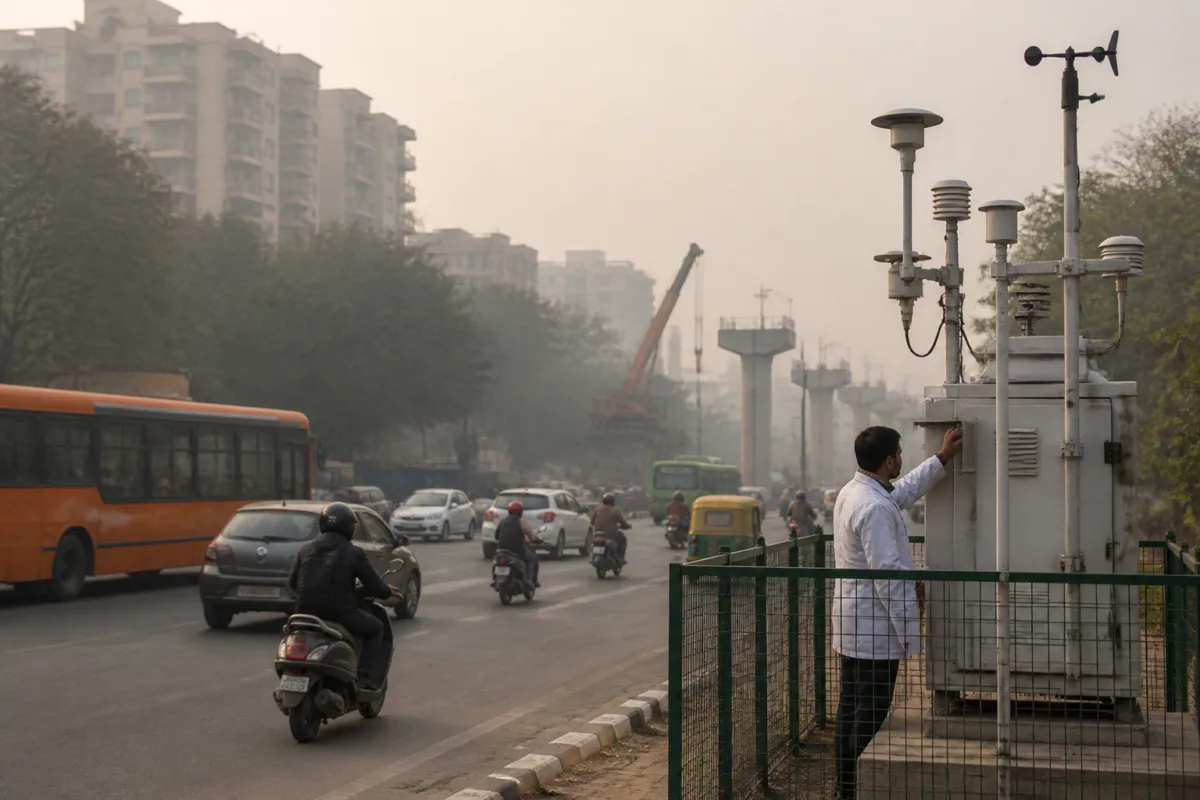
For urban authorities, one of the main recommendations is to expand air-quality monitoring beyond large metropolitan areas. The proposed network would include smaller cities, industrial zones and environmentally sensitive locations. The paper calls for monitoring not only particulate matter, including PM2.5 and PM10, but also black carbon, hydrocarbons and atmospheric aerosols.
The emphasis on source assessment is significant for city-level action. The policy paper recommends regular scientific studies to identify pollution sources by region and to match control measures to local conditions. Such an approach would move planning beyond a single citywide pollution response, although the report does not specify the agencies, funding arrangements or enforcement mechanisms that would be required to implement it.
Vayu 2026 also proposes using AI and machine learning as part of air-quality management. The suggested system would forecast pollution levels and issue timely warnings. The paper further recommends linking environmental and health databases so that pollution alerts and mitigation plans can be assessed alongside their effects on public health.
Its proposed implementation is divided into three phases. During the first two years, authorities would identify pollution hotspots, strengthen monitoring networks and prepare city-level air-quality and health action plans. Between the third and fifth years, the framework proposes developing AI-based forecasting systems and connecting environmental and health databases. Over the fifth to tenth years, it recommends creating an integrated national air-quality and climate information system and strengthening climate-adaptive urban infrastructure.
The recommendations could affect several areas of urban governance. Transport planning would need to account for the proposed focus on sustainable mobility, while construction and industrial regulation would remain important to controlling local emissions. Energy choices and infrastructure design would also become part of a broader air-quality strategy rather than being treated as separate policy areas.
However, the framework remains a draft proposal. The report does not establish whether the central government will adopt its recommendations, which institutions would lead implementation or how progress would be measured. Its immediate significance lies in bringing monitoring, forecasting, health data and climate-resilient infrastructure into a single policy conversation. The next test will be whether the proposed roadmap is finalised and translated into funded, accountable city-level action.

