


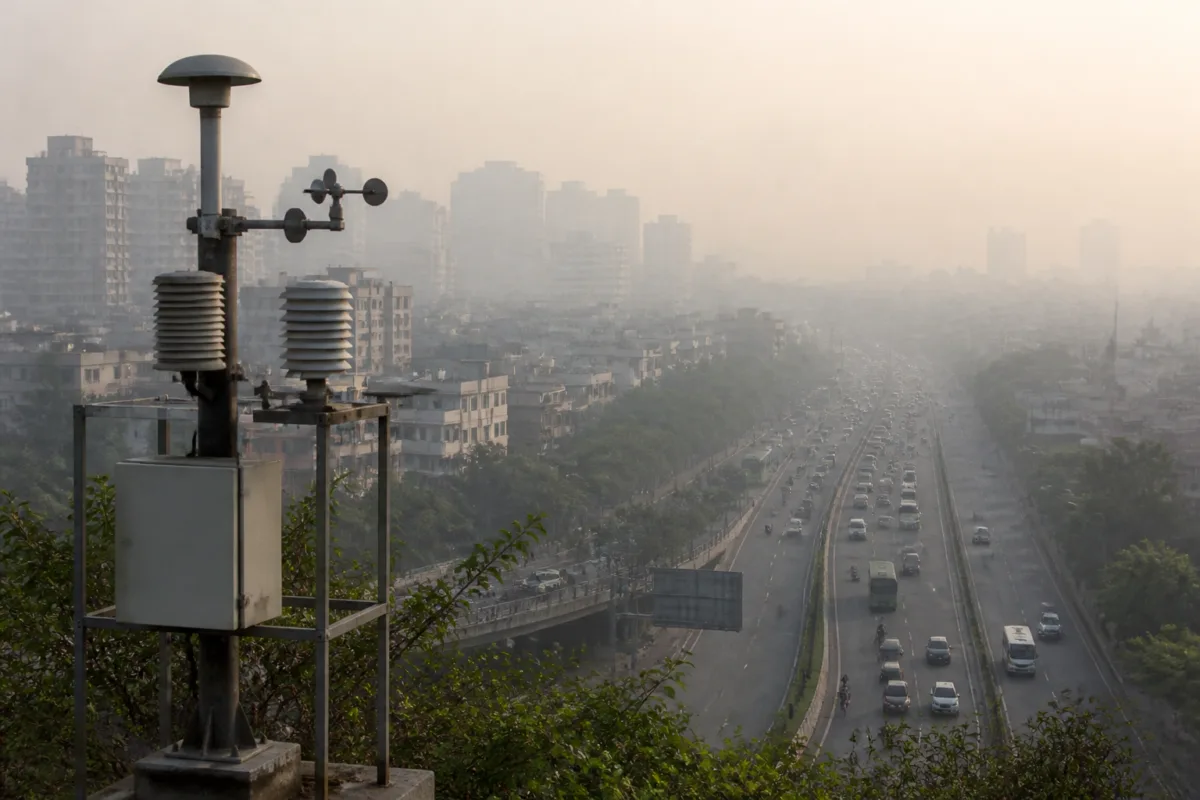
Delhi’s air quality was recorded in the poor category on Sunday morning, with the citywide Air Quality Index (AQI) reaching 222 at 9 am, according to the Sameer app. The reading placed the capital in the 201-300 poor band under the Central Pollution Control Board’s classification system.
Of Delhi’s 54 monitoring stations, 31 recorded poor air quality, while three stations reported readings in the very poor category. The distribution showed that pollution levels varied considerably across the city, with some localities recording substantially higher AQI values than the overall city average.
Jahangirpuri recorded Delhi’s highest AQI at 345, placing it in the very poor category. Punjabi Bagh followed with an AQI of 317, also within the very poor range. Under CPCB classifications, AQI readings between 301 and 400 are considered very poor, while readings between 201 and 300 are classified as poor.
The CPCB’s scale categorises AQI readings from zero to 50 as good, 51 to 100 as satisfactory and 101 to 200 as moderate. Readings between 401 and 500 are classified as severe. Sunday’s citywide reading therefore represented a deterioration beyond the moderate band, while several monitoring locations crossed into a more serious pollution category.
The air-quality readings came as Delhi recorded a minimum temperature of 18 degrees Celsius, 1.9 notches below the seasonal average, according to the India Meteorological Department. Relative humidity stood at 98 per cent at 8.30 am. The combination of pollution readings across multiple monitoring stations and high morning humidity formed the immediate environmental conditions reported for the capital.
The IMD forecast mainly clear skies for the day, with the maximum temperature expected to reach 29 degrees Celsius. The weather department’s forecast was the next stated update for Delhi’s atmospheric conditions, while the Sameer app and CPCB monitoring classifications provided the air-quality assessment for Sunday morning.
The station-level variation highlights how citywide AQI figures can conceal sharper pollution spikes in individual neighbourhoods. While Delhi’s overall reading was 222, Jahangirpuri and Punjabi Bagh recorded AQI levels above 300, placing them in the very poor category. The monitoring network’s 54 stations provides the basis for tracking these differences across the capital.

