


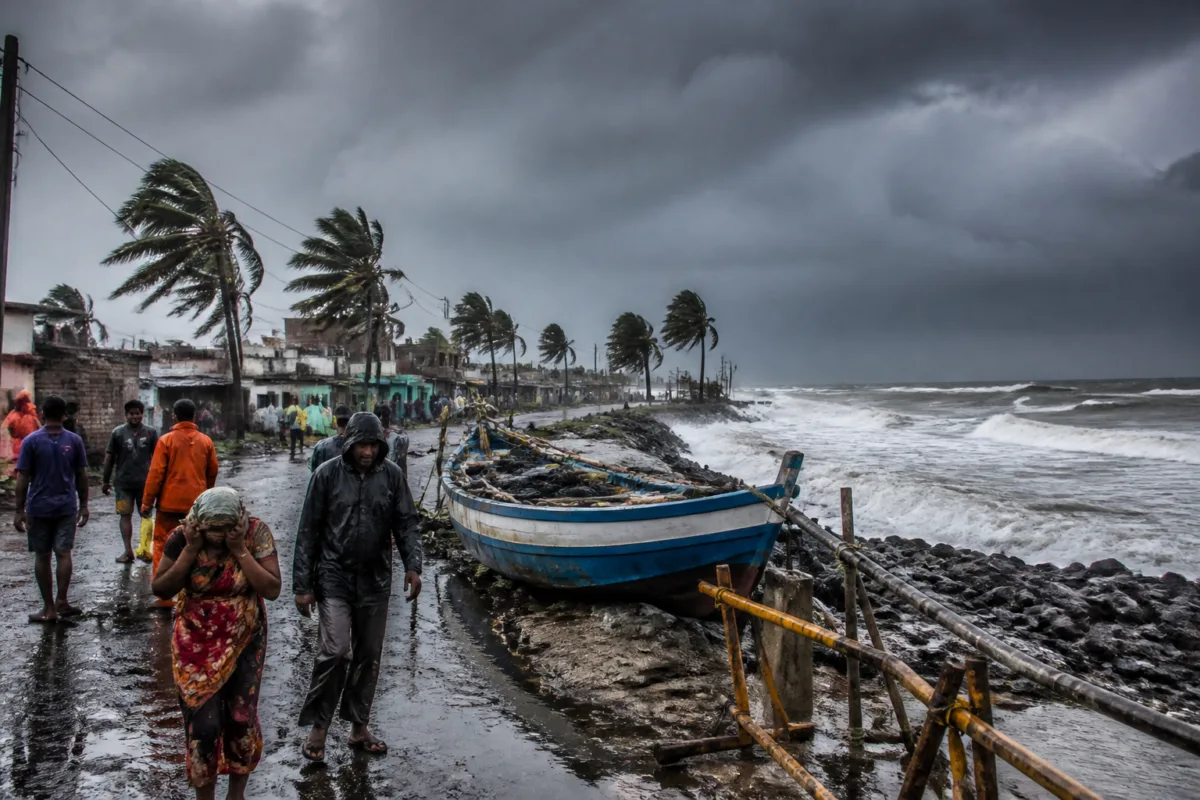
Cyclone Murasu is expected to strengthen over the Bay of Bengal and approach the Andhra Pradesh coast, while bringing heavy to very heavy rain and strong winds to southern Odisha, according to a report by The Samaja citing India Meteorological Department Director General Mrutyunjay Mohapatra. The forecast comes as parts of Ganjam, Gajapati and Kandhamal districts continue to deal with flooding and landslides linked to Cyclone Arnab.
The report said a low-pressure area formed over the southeast Bay of Bengal and adjoining areas near the Andaman and Nicobar Islands. It intensified into a depression on Saturday and was moving west-northwest. The system was expected to become a deep depression before developing into a cyclonic storm over the southeast and adjoining southwest and west-central Bay of Bengal.
According to the report, the system could intensify further before moving towards the west-central Bay of Bengal and the Andhra Pradesh coast. The report identified the likely landfall zone as between Nellore and Narasapur, with southern Odisha, northern Tamil Nadu and Puducherry also expected to experience impacts from the system.
The forecast cited in the report indicates that the heaviest rainfall in Odisha could occur on the 3rd and 4th, particularly across districts in the southern part of the state. Winds near the Odisha coast could reach 40 to 50 kmph, with gusts up to 60 kmph from the evening of the 2nd, rising to 50 to 60 kmph with gusts up to 70 kmph on the 3rd, according to the report.
The report also stated that the storm’s maximum wind speed could reach between 80 and 90 kmph, with gusts up to 100 kmph. In another section, however, it cited a possible maximum wind speed of 100 to 110 kmph and gusts up to 120 kmph near the Andhra Pradesh coast. It also gave differing landfall windows, referring to both the evening of the 2nd and the morning of the 3rd.
The system is developing while communities in southern Odisha are still dealing with the effects of earlier extreme rainfall. Floodwaters and landslides have affected residents in Ganjam, Gajapati and Kandhamal, increasing the potential for further disruption if heavy rain returns before recovery work is complete.
The report said sea conditions would remain rough over the central, southwest and north Bay of Bengal. Fishermen were advised not to venture into the sea during the period of adverse weather. The cyclone name Murasu, according to the report, was assigned by India and refers to an ancient drum-like musical instrument.
The landfall track, intensity and rainfall outlook require confirmation from the latest official IMD bulletins because the supplied report contains conflicting details on these parameters.

