


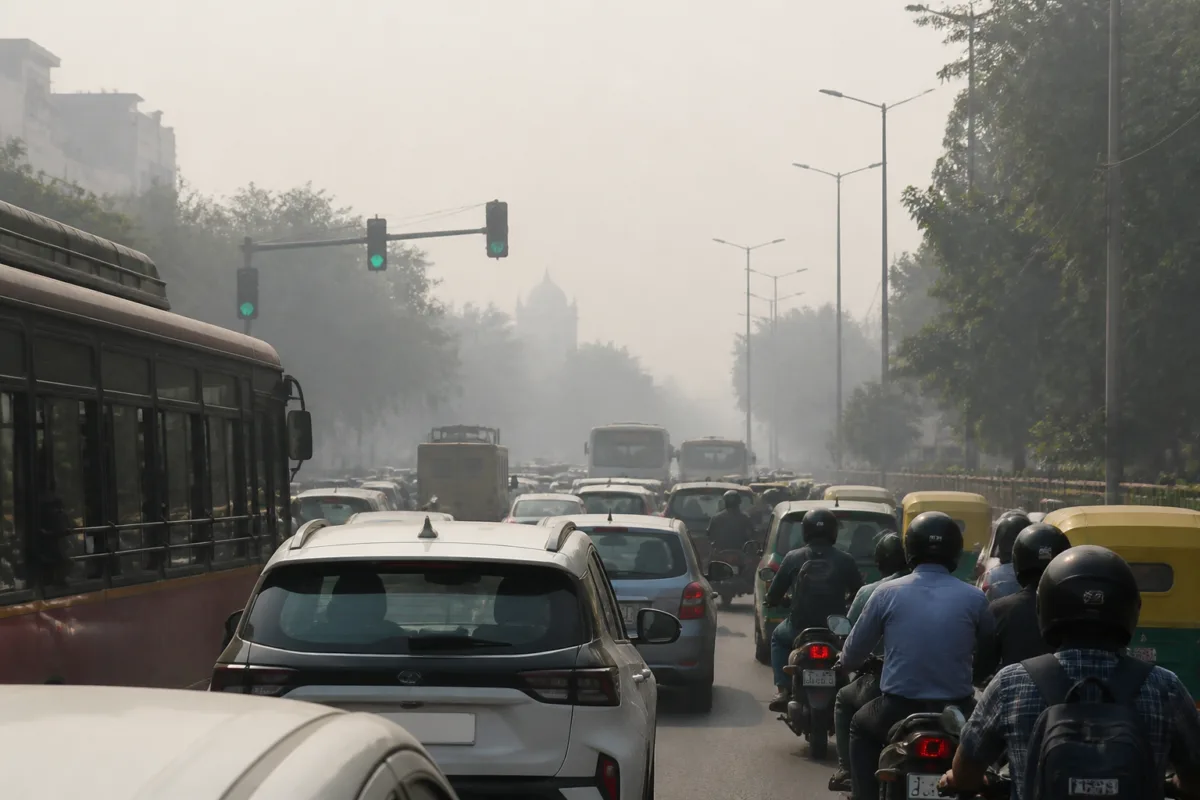
Delhi’s air quality remained in the ‘poor’ category on Friday, with an overall Air Quality Index (AQI) of 230 and official forecasts indicating that conditions are unlikely to improve over the next nine days. The reading reflects a citywide pollution problem with significant variation between monitoring locations.
Three of Delhi’s 56 monitoring stations recorded ‘very poor’ air quality. Pusa reported the highest AQI at 324, placing it in the ‘very poor’ category. Thirty-six stations recorded ‘poor’ air quality, while the remaining 17 reported ‘moderate’ conditions.
The distribution shows that the city’s overall AQI does not capture the same level of exposure across all neighbourhoods. Residents near stations reporting ‘very poor’ conditions faced substantially worse air quality than those in areas classified as moderate, even as the citywide average remained in the poor range.
According to the pollution contribution figures reported in the source, the transport sector accounted for 20.3 per cent of Delhi’s pollution. Residential sources contributed 5.2 per cent and industries accounted for 4.2 per cent. These figures identify transport as the largest among the listed local source categories in the latest assessment.
Pollution sources also extended beyond Delhi’s administrative boundaries. Gurugram accounted for the highest contribution from the National Capital Region at 8.8 per cent, followed by Jhajjar at 6.1 per cent and Gautam Buddha Nagar at 4.7 per cent. The figures underline the regional nature of air quality management in the capital, where emissions from neighbouring districts can affect conditions within Delhi.
The persistence forecast means that residents may continue to experience poor air quality despite day-to-day differences between monitoring stations. The report does not provide a separate timeline for improvement beyond stating that conditions are likely to remain unchanged for the next nine days.
Weather observations recorded at Safdarjung showed a maximum temperature of 32.2 degrees Celsius and a minimum of 19 degrees Celsius. The temperature readings were reported alongside the AQI data as part of the day’s conditions.
Delhi’s air quality will continue to be tracked through the city’s 56 monitoring stations, while the official forecast remains that pollution levels are likely to stay broadly unchanged over the coming nine days.

