


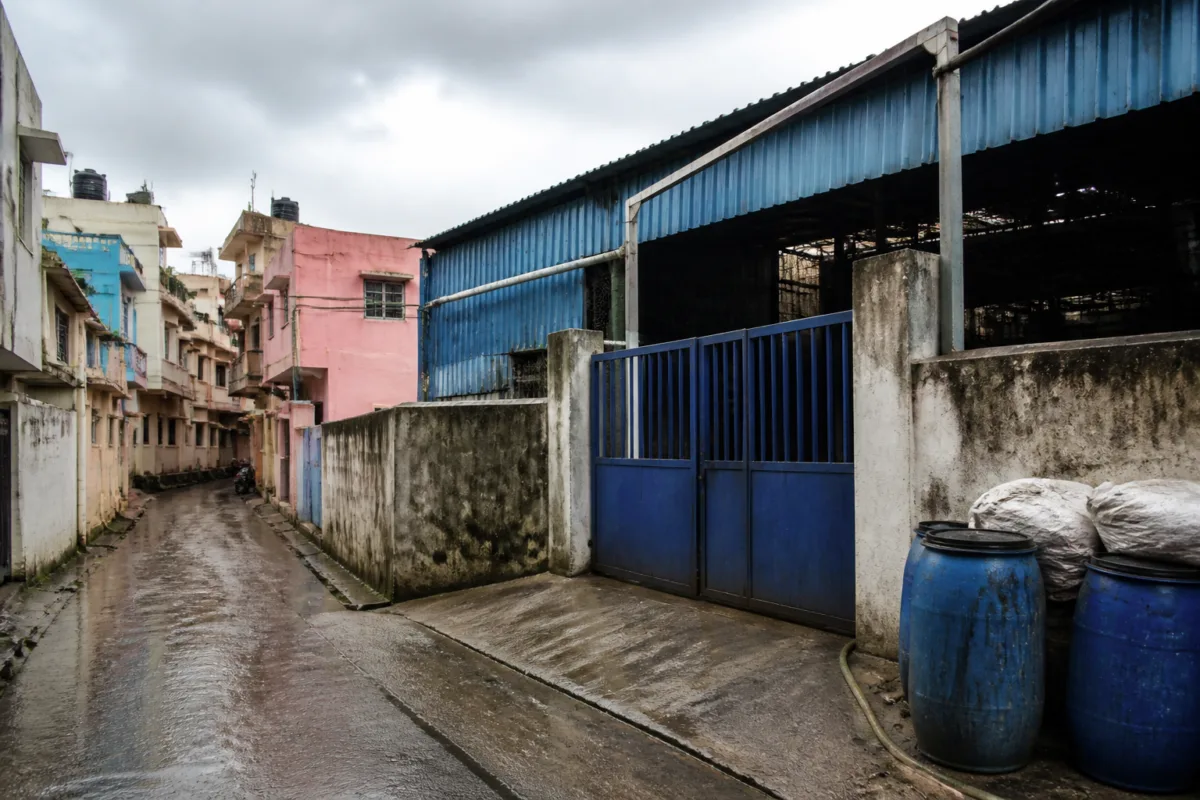
The death of a one-year-and-seven-month-old boy after he entered a copper factory near his home in Bengaluru’s Srirampura has brought a difficult urban safety question into focus: what happens when homes, workplaces and hazardous industrial processes exist within the same everyday neighbourhood environment?
According to a report by Deccan Herald, the child fell into a tub containing chemicals at a medium-scale copper factory in L N Puram, Srirampura, at around 11 am on November 2. Workers rescued him and took him to a nearby hospital before he was referred to a speciality hospital in Koramangala. He died at a city hospital on November 12 after failing to respond to treatment, police said.
The report says the child had wandered into the factory while playing. His parents were away at work and he was being looked after by his paternal grandmother, according to a police officer quoted by the newspaper. The incident was captured by a CCTV camera on the factory premises. Srirampura police have registered an unnatural death report and begun an investigation.
The immediate facts are specific, but the setting is familiar to many Indian cities: residential life and small industrial activity can operate in close proximity, sometimes along the same narrow streets and behind buildings that do not visibly separate workplaces from homes. The available report does not establish whether the factory breached any safety rule, whether the chemical tub was required to be covered or secured, or how the child gained entry. Those questions remain part of the police investigation.
That distinction matters. A fatal accident inside a workplace does not, by itself, establish negligence or a regulatory violation. At the same time, the circumstances make physical access and hazard control central questions. A child was able to enter a factory premises and reach a container holding chemicals. The report does not say whether the premises had a gate, warning signs, barriers, security arrangements or other controls, nor does it identify the chemical involved. Until investigators establish those facts, the incident should not be reduced to either a confirmed compliance failure or an unavoidable accident.
The case illustrates how urban safety is shaped not only by major infrastructure but also by the edges of ordinary properties. A city’s built environment includes factories, workshops, homes, lanes, schools and informal play spaces. Where these uses sit close together, safety depends on how boundaries are designed and maintained in daily practice. A formal land-use classification may define a property’s permitted use, but residents experience the area at street level, where the distance between a home and a workplace can be only a short walk.
The report identifies the premises as a copper factory and describes it as medium-scale. That information establishes the nature of the workplace but does not provide enough detail to determine its legal category, the approvals governing it or the agency responsible for inspecting it. Depending on the activity and substances handled, different parts of the regulatory system may be relevant. The supplied account does not name the factory, identify the licensing authority, or state whether any inspection had taken place before the incident.
This institutional uncertainty is one of the important issues raised by the case. Police have registered an unnatural death report, which begins the criminal and investigative record of what happened. But a full understanding of workplace safety may also require records from the authorities responsible for factories, labour conditions, fire safety, local permissions, hazardous substances or municipal planning. The report does not say whether those agencies have been asked to examine the premises. It is therefore not possible, on the available evidence, to say whether the incident reflects a wider enforcement failure or a specific lapse at one location.
The sequence of events also shows why accident reporting cannot end with the initial rescue. The child was taken first to a nearby hospital and then referred to a speciality hospital in Koramangala. He died ten days after the incident, after failing to respond to treatment. That interval means the investigation must account for both the conditions at the factory and the medical record of the injuries and treatment. The police have not publicly disclosed those details in the supplied report.
For residents, the proximity of industrial premises to homes creates risks that are not always visible until an incident occurs. A chemical container may be dangerous even when it is not part of a large industrial plant. A factory may be active during working hours, while children move through nearby lanes under the care of family members. The report does not establish that the premises were routinely accessible to the public, but it does document one instance in which a child entered the site. That fact alone makes access control a relevant line of inquiry.
The incident also exposes the limits of relying on CCTV as a safety measure. The camera recorded what happened, according to the report, and may help investigators reconstruct the sequence. But recording an accident after it occurs is different from preventing access to a hazardous area. Whether the premises had preventive safeguards is not stated. The distinction is important for urban governance because surveillance can support accountability, while physical separation, supervision and safe storage address the risk before an accident happens.
There is no evidence in the supplied report about earlier complaints, previous accidents or notices issued to the factory. There is also no information on whether the locality contains other workshops or factories with similar hazards. Without those records, the broader prevalence of the problem cannot be measured. The Srirampura incident should therefore be treated as a documented warning about mixed urban environments, not as proof that every small factory in the area operates unsafely.
The policy question is consequently narrower and more practical than a general debate over industrial activity in residential neighbourhoods. Authorities must establish what happened at this premises, what safety obligations applied, whether those obligations were met and whether corrective action is required. If the investigation finds an access or storage failure, the relevant response would need to address the physical condition that allowed the child to reach the chemical tub, rather than relying only on post-incident prosecution or compensation. The supplied report does not state what action authorities plan to take beyond the investigation.
For Bengaluru, the case also demonstrates why urban administration is divided across institutions. Police investigate the death, but workplace safety, land-use permissions, fire precautions and municipal enforcement may sit with different authorities. When these responsibilities are not coordinated, a premises can be visible to one department without its full safety profile being examined by another. Whether that occurred here is not established, but the case shows why a single incident may require more than one official record to explain.
The evidence currently confirms four central facts: the child entered a copper factory near his home; he fell into a tub containing chemicals; he was taken for treatment and died on November 12; and police registered an unnatural death report after the incident. It does not yet confirm the chemical involved, the factory’s permissions, the presence or absence of safety barriers, or whether any authority had previously identified a risk.
The next meaningful developments will come from the police investigation and any findings by the authorities responsible for the factory’s safety and operation. Those records will determine whether the death was linked to a specific breach, an unsafe physical arrangement, inadequate supervision or another cause. Until then, the Srirampura case remains a tragic reminder that urban safety is often decided at the boundary between a child’s neighbourhood and a workplace containing hazards that are not meant for public access.

