


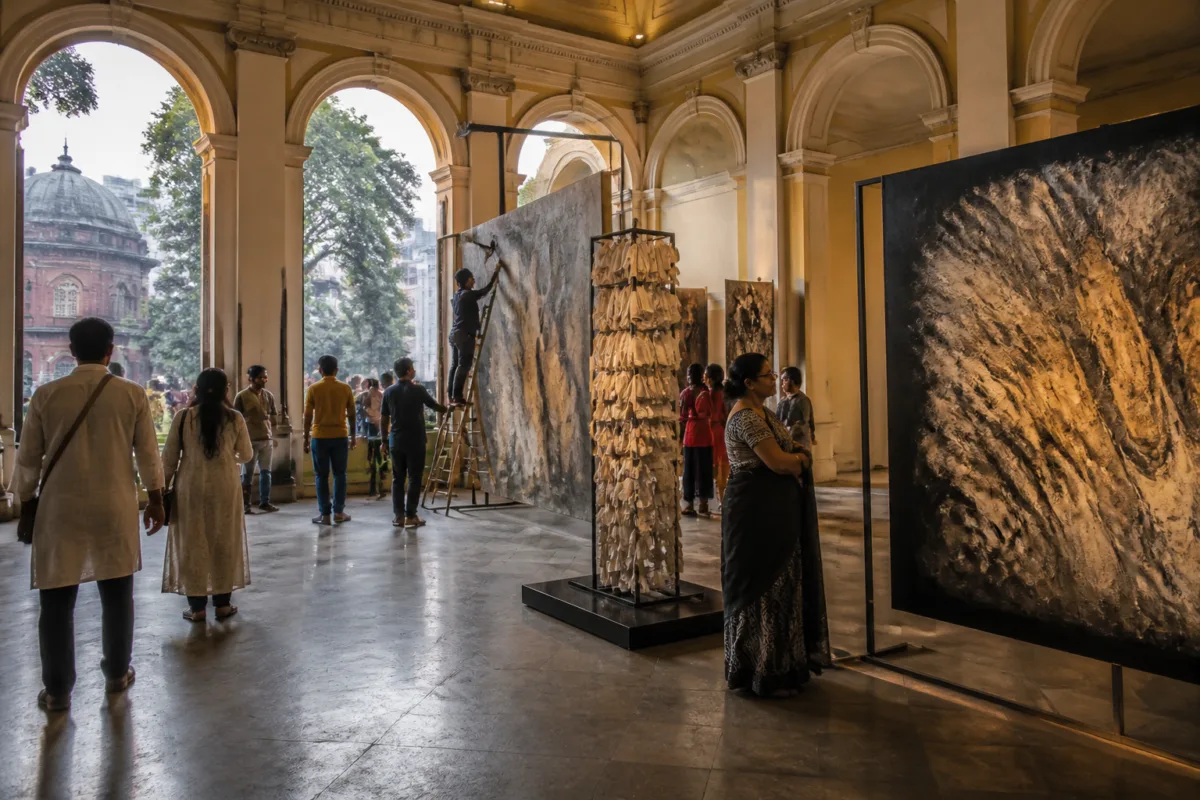
The second Bengal Biennale will open across Santiniketan and Calcutta on November 25 and November 28 respectively, bringing nearly 100 artists and 70 exhibitions to 18 venues. More than an expanded art programme, its structure points to a different way of using a city’s cultural infrastructure: not as a collection of isolated galleries, but as a network of public, institutional and heritage spaces where ecological conflict, political resistance and artistic practice can meet.
The theme, “Banalata”, translates literally as wild creeper. Its associations reach into Bengali poetry, visual art and memories of landscape. But the organisers say the word is intended to do more than evoke nostalgia. The programme will examine “nodes of resistance and renewal” in a world shaped by ecological and political strain. That ambition places the Biennale within a larger urban question: how can cultural institutions respond to conflicts over land, natural wealth, democracy and climate without reducing them to slogans or conventional exhibitions?
The Biennale’s first edition, held in 2024 under the theme “Anka Banka: Through Cross-Currents”, was curated by Siddharth Siva Kumar. The second edition has a different institutional arrangement. It is being jointly curated by Ritika Biswas and Chander Haat, a collective of seven artists based in Sarsuna beyond Behala. The organisers describe this combination as both situated in Bengal and open to international perspectives.
That curatorial shift matters because the event is not being concentrated in one purpose-built exhibition complex. Eleven venues in Calcutta and seven in Santiniketan will host the programme. The network includes the Indian Museum, Victoria Memorial Hall, Lalit Kala Akademi, Kala Bhavana, Visva-Bharati’s Sculpture Park, the Somnath Hore Studio and other institutional or artist-linked spaces. The Biennale therefore depends on the ability of existing cultural infrastructure to carry a large, dispersed public programme.
A distributed format changes the way audiences encounter art. Instead of moving through a single exhibition building, visitors will move between museums, academic spaces, studios and other locations. The city becomes part of the exhibition’s framework, while the venues acquire an additional role as places of connection between art, history and public life. The supplied account does not establish visitor projections, transport arrangements or access plans, but the scale and geographical spread make the relationship between the programme and the two urban settlements central to its operation.
At the heart of the Santiniketan programme will be an exhibition at Kala Bhavana, drawing on its acclaimed collection. The exhibition will be curated by Soumik Nandi Majumdar, Banatanwi Das Mahapatra and Santosh K Sakhinala. It will include artists from the Far East, including Xu Beihong, as well as works collected by Rabindranath Tagore during travels to Japan and China. This places the Biennale’s contemporary concerns alongside an older institutional history of cultural exchange.
The programme also brings together artists from different generations and practices. Amar Kanwar will present work on the movement in Odisha against corporate takeover of land. Atul Dodiya will show at the Indian Museum, marking his first exhibition there in almost 30 years, according to Malavika Banerjee. Young artists including Amol Patil, Aban Raza and Jahanvi Khemka are also part of the programme. Ayoung Kim of South Korea will show digital-media works at TRI Art & Culture in Calcutta, while Dutch artist Jonas Staal will present work on art, democracy and propaganda at Visva-Bharati’s Sculpture Park.
The inclusion of these works gives the Biennale a clear institutional and political geography. Land conflict in Odisha, questions around democracy and propaganda, ecological change and the history of collections are not being presented as separate subjects. Ritika Biswas said the organisers wanted to explore how ecological and climate issues are entangled with the resistance of indigenous communities to government appropriation of natural wealth. The description is significant because it frames the exhibition as a site where cultural production intersects with questions of land administration and resource control.
The organisers also say the event will avoid a didactic format. Biswas described plans to create “nodes of active rest” and libraries at sites, while saying that the issues would not be arranged through simple binaries. The phrase suggests an attempt to make the venues more than display areas. However, the supplied report does not specify the design, duration, staffing or public operating arrangements for these libraries and rest areas. Their significance will depend on how they are implemented across the different locations.
The Biennale’s institutional landscape is equally important. Its sponsors include DAG, Kiran Nadar Museum of Art, Emami Foundation, Paharpur Cooling Towers, Tata Steel and Karan Chand Thapar. The mix includes cultural organisations, foundations and private companies. Such support can expand the capacity of a large art event, but it also makes the relationship between cultural programming and institutional funding visible. The article does not provide the value of sponsorships, the event’s total budget or the terms attached to the support, so the financial model cannot be assessed from the available information.
The choice of venues also connects the programme to the preservation and reuse of cultural assets. The Sculpture Park at Visva-Bharati is described as being revived, while Debnath Bose will show work at Somnath Hore’s Studio in Santiniketan. In Calcutta, the Victoria Memorial Hall will host a photography exhibition, and Lalit Kala Akademi on AJC Road will display works by the recently deceased artists Arpita Singh and Jogen Chowdhury, among others. These locations carry their own institutional histories, and their use gives the Biennale a built-in conversation between contemporary practice and inherited cultural spaces.
That conversation extends to the artists whose work will be displayed. Alongside Singh and Chowdhury, the programme includes Chittaprosad, Rabin Mondal, Bikash Bhattacharjee and Nirode Mazumdar. Their presence means that the Biennale is not solely an international contemporary-art event. It is also assembling a history of Bengal’s modern and contemporary artistic production, while placing it next to new work, digital media and international practices.
For Kolkata, this creates a cultural infrastructure question rather than simply an events question. Large programmes often reveal whether a city’s institutions can operate collectively, share audiences and make multiple destinations legible to visitors. In this case, the programme spans major museums, memorial institutions, academic spaces and smaller or artist-associated sites. The supplied material confirms the number of venues and exhibitions, but it does not state how ticketing, wayfinding, transport, crowd management or coordination among institutions will work.
The same question applies to Santiniketan, where the Biennale will use Kala Bhavana, the Sculpture Park and Somnath Hore’s Studio. Santiniketan’s cultural identity is closely tied to its educational and artistic institutions. The event’s presence there is therefore not merely a matter of adding another exhibition to a calendar. It places pressure on the relationship between heritage, institutional access and contemporary cultural use, even though the report does not detail the operational arrangements.
The second Bengal Biennale consequently sits at the intersection of three systems. The first is the art system, represented by curators, artists, collections and exhibitions. The second is the institutional system of museums, universities, memorial buildings, studios and cultural foundations. The third is the wider urban system, in which people move between venues and encounter debates on land, ecology, democracy and public life. The event’s stated ambition is to connect these systems without turning the exhibition into a series of fixed oppositions.
What the available evidence confirms is the breadth of that ambition. The Biennale will involve 18 venues, 70 exhibitions and almost 100 artists, with participation from institutions and sponsors across public, private and cultural sectors. It will address ecological and political questions through works linked to land resistance, climate concerns, democracy and propaganda. What remains unclear is how this distributed model will be financed, accessed and coordinated, and how the organisers will measure public participation beyond the number of exhibitions and artists.
The opening dates provide the immediate milestone: November 25 in Santiniketan and November 28 in Calcutta. The programme’s longer significance will depend on whether the network of venues can function as a connected civic and cultural platform, and whether the promised libraries, spaces for rest and revived institutions become durable parts of the experience rather than temporary additions to an exhibition schedule.

