


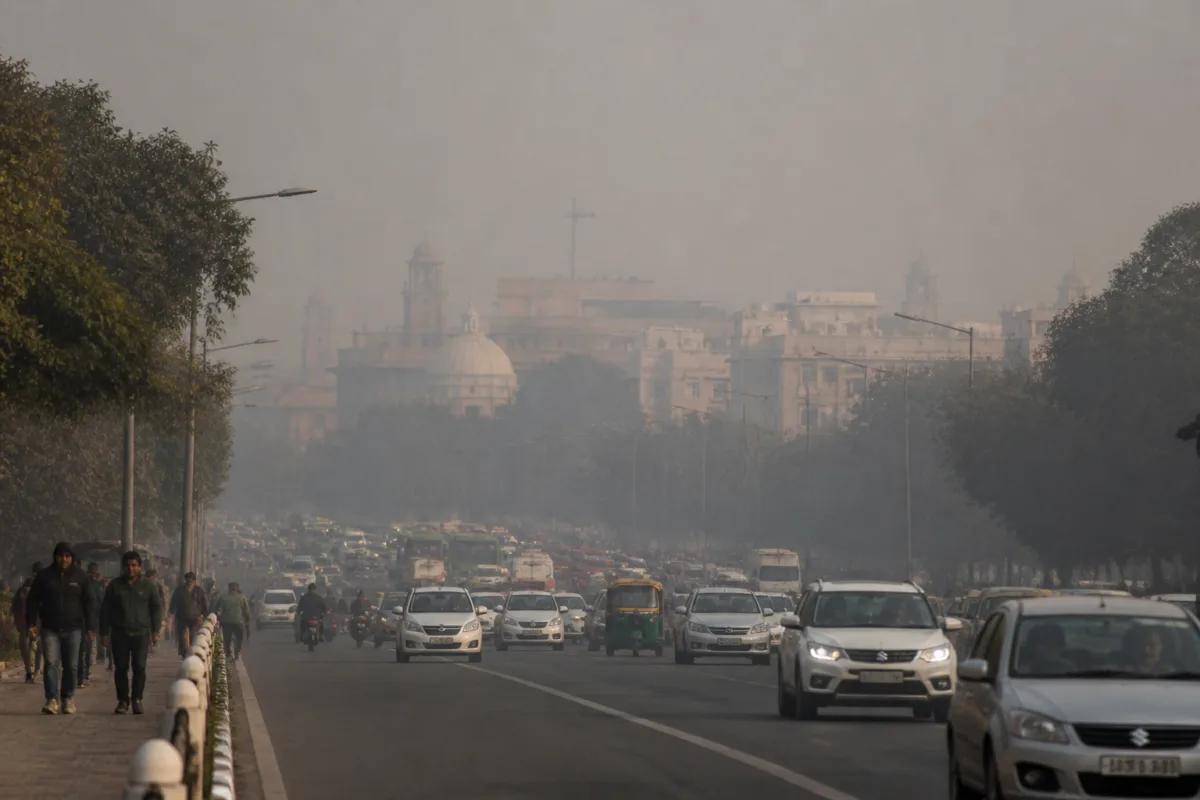
Delhi’s air quality deteriorated further on Thursday, with the city’s Air Quality Index (AQI) rising to 280, and is forecast to remain in the ‘very poor’ category from Friday, according to a report by Jagran citing the Air Quality Early Warning System.
The AQI had been recorded at 232 on Wednesday and 204 on Tuesday. The report attributed the latest rise primarily to biomass burning, whose contribution to Delhi’s PM2.5 concentration increased to 33.3% from 24% on Wednesday and 18% on Tuesday.
The forecast indicates that Delhi’s air could remain in the ‘very poor’ category through 22 November. The report said unfavourable meteorological conditions are expected to restrict the dispersion of pollutants, allowing them to accumulate close to the ground.
Of 56 monitoring stations reporting on Thursday, 37 recorded ‘poor’ air quality and 16 recorded ‘very poor’ conditions. Only three stations reported ‘moderate’ air quality. The highest AQI was recorded at Jawaharlal Nehru University at 376, followed by Siri Fort at 363.
The source-apportionment analysis cited in the report estimated that biomass burning accounted for 33.3% of PM2.5 pollution. This category includes household solid fuels such as wood and cow-dung cakes. Waste burning contributed 19.7%, while vehicle emissions accounted for 18%.
Other reported contributors included secondary organic aerosols at 14.1%, secondary inorganic aerosols at 9.5%, coal burning at 1.8%, industrial activity and firecrackers at 1.5% each, and road dust and soil at 0.7%.
Dispersion conditions were also expected to weaken. The mixing depth was forecast to fall from about 1,100 metres on Thursday to 1,000 metres on Friday. The ventilation index was expected to drop from 5,000 square metres per second to 1,000, before rising to 2,800 on Saturday and 3,100 on Sunday. The report considers dispersion unfavourable when the ventilation index is below 6,000 square metres per second and average wind speed is below 10 kmph.

