


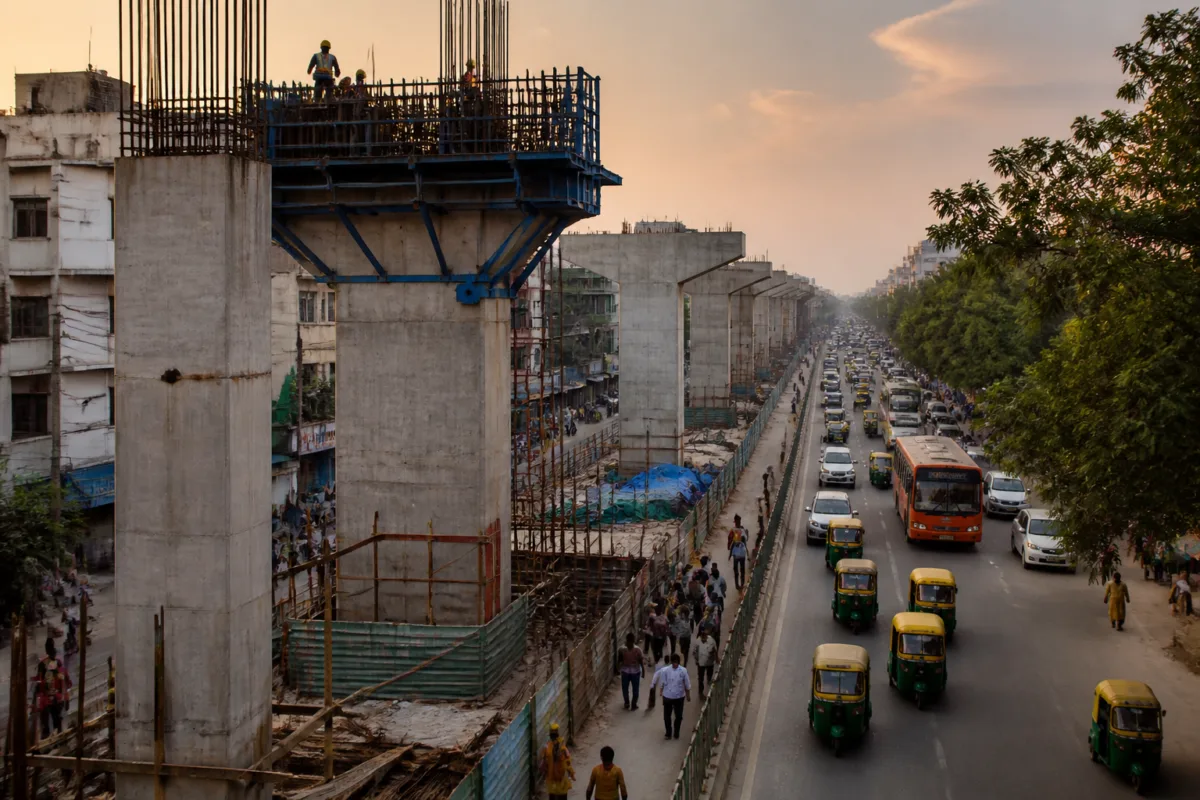
The Delhi Golden Line extension from Lajpat Nagar to Saket G Block is set to bring eight elevated metro stations to parts of south Delhi, reducing the dependence of residents on buses, autos and private vehicles to reach the existing network.
The 8.385-kilometre corridor will serve areas including Greater Kailash, Chirag Delhi, Pushp Vihar and Saket. According to the Delhi Metro Rail Corporation (DMRC), construction of seven of the eight stations has been awarded for Rs 137.92 crore, with a target of completing the work in 22 months. The Lajpat Nagar station will be awarded separately.
Construction on the corridor began in December last year, and station construction is now expected to begin. The entire project is targeted for completion by June 2029, according to the report.
The new stations are intended to improve access to local markets, educational institutions, government offices and Saket’s commercial areas. For residents in neighbourhoods that are not within convenient walking distance of an existing station, the extension could shorten the first and last legs of a metro journey. The report, however, does not provide projected daily ridership, station catchment estimates or details of feeder-bus and pedestrian-access plans.
The corridor is also planned as an interchange link within the wider metro network. Lajpat Nagar is expected to provide interchange access between the Pink, Violet and Golden lines. At Chirag Delhi, passengers will have an interchange option with the Magenta Line. Saket G Block is planned to connect with the Aerocity–Tughlakabad corridor.
These links are intended to improve access from south Delhi to Indira Gandhi International Airport, Noida and other parts of the capital. Their eventual usefulness will depend on the completion and operational integration of the connecting corridors, as well as the quality of pedestrian approaches, feeder services and interchange design at the stations.
The Lajpat Nagar–Saket G Block section is also planned to be the first part of the Golden Line to operate three-coach metro trains. The report does not specify the proposed service frequency, passenger-capacity rationale or whether the train configuration will change as demand develops.
For the surrounding neighbourhoods, the project’s immediate significance lies in bringing stations closer to residential and activity centres. Its broader value will depend on timely construction, safe access across busy roads, seamless transfers and coordination with the other corridors on which the promised airport and Noida connectivity relies.

