


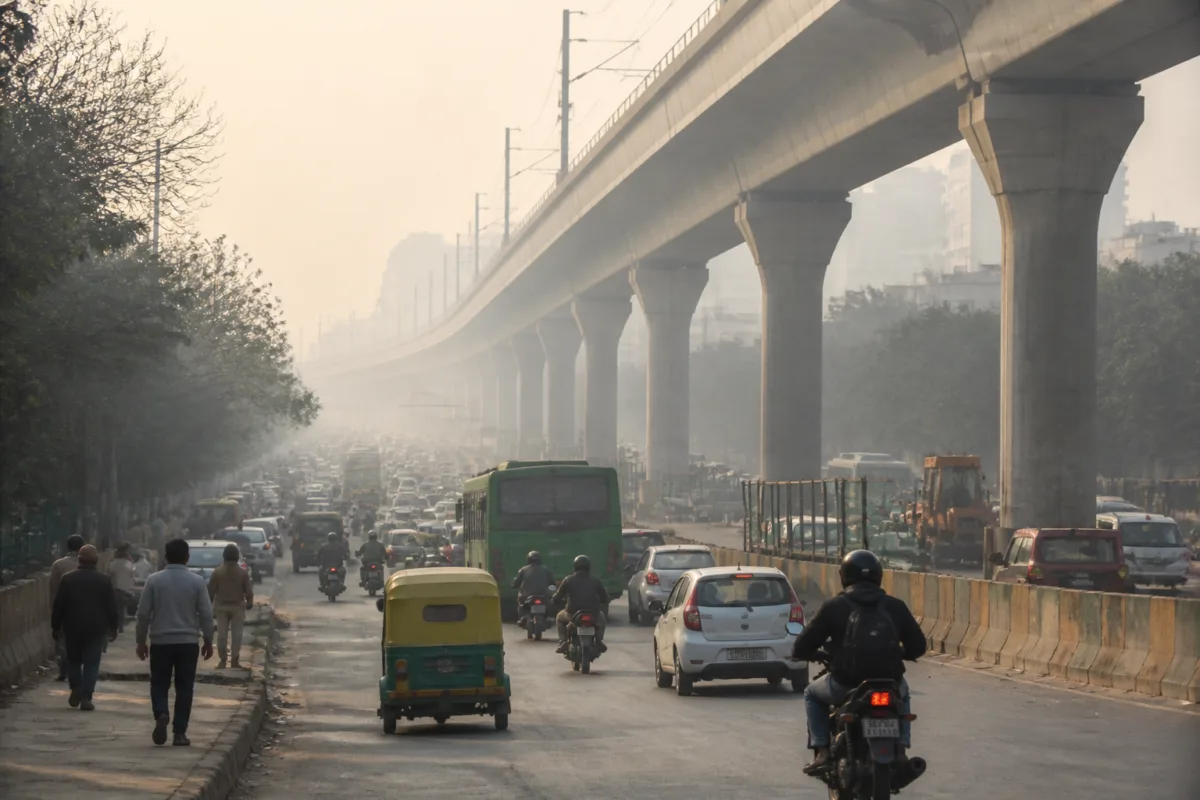
Delhi air pollution could move back into the ‘very poor’ category over the next two days as falling temperatures reduce the atmosphere’s mixing height and wind speeds are expected to remain below 15 kilometres per hour, according to the air quality forecast cited in a Live Hindustan report.
The city recorded an average Air Quality Index (AQI) of 232 on Wednesday, placing it in the ‘poor’ category, according to the Central Pollution Control Board. Five local areas recorded AQI readings above 300 at 4 pm, which falls in the ‘very poor’ category.
The change follows four days during which Delhi’s AQI remained below 300, helped by faster winds. The report said colder air arriving from the hills had also pushed down temperatures. Safdarjung recorded a minimum of 11°C on Wednesday, the lowest of the season so far, while Palam recorded 11.5°C, Lodhi Road 11.8°C, the Ridge station 12.3°C and Ayanagar 11.1°C.
The forecast highlights how weather conditions can quickly alter the city’s pollution burden. Lower temperatures and reduced wind movement can limit the dispersion of pollutants, allowing emissions from transport, construction, roads and other urban activity to remain concentrated closer to the ground. The report, however, does not quantify the contribution of each source to the expected deterioration.
Delhi Chief Minister Rekha Gupta, after inspecting the Delhi Pollution Control Committee’s control room, said November had been relatively better than usual over the past decade. The report attributed to her a claim that the average AQI during the first half of November was 170. She also directed officials to strengthen monitoring and action at pollution hotspots, construction sites, roads, industrial units and among vehicles.
The chief minister said departmental and officer-level accountability would be fixed for pollution control, with particular attention to areas where inspections had been limited. These directions place implementation and enforcement alongside weather forecasting as central parts of the city’s response.
Environment Minister Manjinder Singh Sirsa said November had typically seen four to six days in the past decade when Delhi’s AQI crossed 400. He also said October was the best month in a decade and that the number of clean-air days had reached 220. The report did not provide the underlying monitoring series for these comparisons.
The Delhi government has set a target of reducing pollution by up to 15% each year, according to the report. Measures cited include adding 1,703 electric buses to the fleet by October, with another 692 planned by December, and installing 6,000 electric-vehicle charging points between January and October. A subsidy of up to ₹1 lakh in the first year was also cited for buyers of electric light vehicles.
The government also reported improvements at 43 of 62 identified congestion points, with a claimed 54% reduction in congestion at those locations. It is targeting signal-free movement on 18 corridors, eight of which it said had been completed, and is preparing a multi-lane free-flow system at 154 entry points.
These transport measures could support longer-term emissions reduction, but the immediate outlook remains dependent on atmospheric conditions and on whether enforcement reaches the construction, road, industrial and vehicle-related sources identified by the government. For residents, the next two days are likely to bring a return of very poor air in parts of the capital even as authorities continue to report progress on structural measures.

