


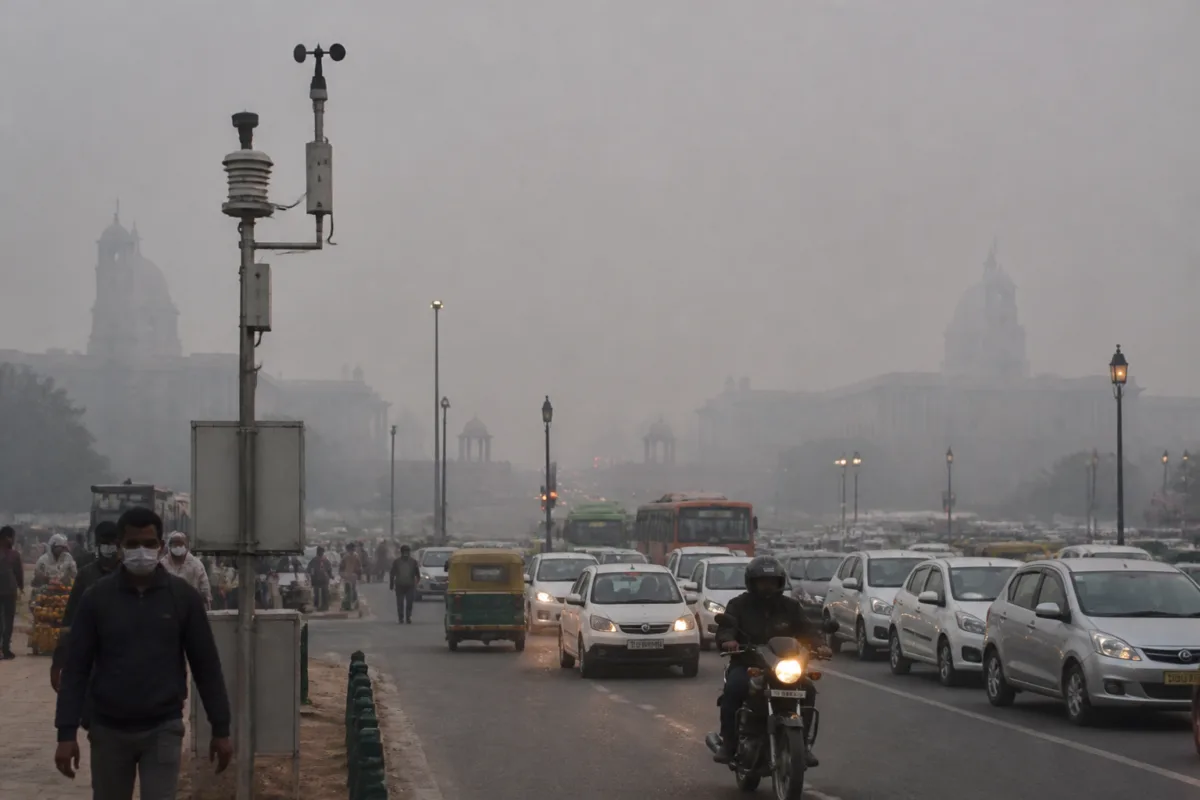
Delhi air quality deteriorated to its worst level in 287 days on Tuesday, with the citywide Air Quality Index settling at 350 and 10 of its 57 monitoring stations recording severe pollution. Jahangirpuri reported the highest AQI at 462, placing it in the severe category.
The Central Pollution Control Board classifies an AQI of 301 to 400 as very poor and 401 to 500 as severe. Of Delhi’s monitoring stations, 35 recorded very poor air quality and 12 reported poor conditions. The last time the capital recorded a higher citywide AQI was on January 20, when the index stood at 378.
PM2.5 was the dominant pollutant. These particles, measuring 2.5 micrometres or less, can penetrate deep into the lungs and enter the bloodstream, creating significant health risks, according to the report.
The Air Quality Early Warning System for Delhi has forecast that air quality is likely to remain in the very poor category from November 4 to 6. Its six-day outlook indicates that conditions could remain in the very poor to severe range.
Delhi was placed under Stage II of the Graded Response Action Plan on Monday after the city’s AQI fell to 324, marking the first very poor air-quality day of the season. Stage II measures are intended to respond to worsening pollution through restrictions and enforcement across key urban sources, although the supplied report does not detail the specific actions implemented under the current order.
The Decision Support System attributed 15.3 per cent of Delhi’s pollution to stubble burning and 15.8 per cent to transport emissions. Other local sources included residential sources at 3.9 per cent, industries in Delhi and the periphery at 3 per cent, construction activities at 2.2 per cent, energy production at 1.2 per cent, waste burning at 1.4 per cent, road dust at 1.2 per cent and other sectors at 1 per cent.
The data also identified contributions from neighbouring National Capital Region districts, including Jhajjar at 8.8 per cent, Gurugram at 4.1 per cent, Sonipat at 2.6 per cent, Rohtak at 2.5 per cent and Mewat at 2 per cent. These figures show that Delhi’s air-quality response operates across an interconnected regional airshed rather than within the city’s administrative boundary alone.
Satellite observations recorded 219 farm-fire incidents across six states on November 2. Punjab accounted for 98 incidents, Rajasthan 67, Madhya Pradesh 48, Uttar Pradesh four and Haryana two. No residue-burning events were detected in Delhi or Uttarakhand, according to data from the CREAMS Lab at the Indian Council of Agricultural Research–Indian Agricultural Research Institute.
Between September 15 and November 2, 3,535 farm-fire incidents were recorded across the six states. Punjab accounted for 1,612 incidents, followed by Rajasthan with 738, Madhya Pradesh with 614, Uttar Pradesh with 349, Uttarakhand with 176, Haryana with 44 and Delhi with two. The stubble-burning period runs from September 15 to November 30. Delhi recorded its first incident of the season on September 19 and the second on October 24.
The early-warning system’s six-day forecast and the Stage II GRAP measures will determine the immediate response as Delhi’s air quality remains in the very poor to severe range.

