


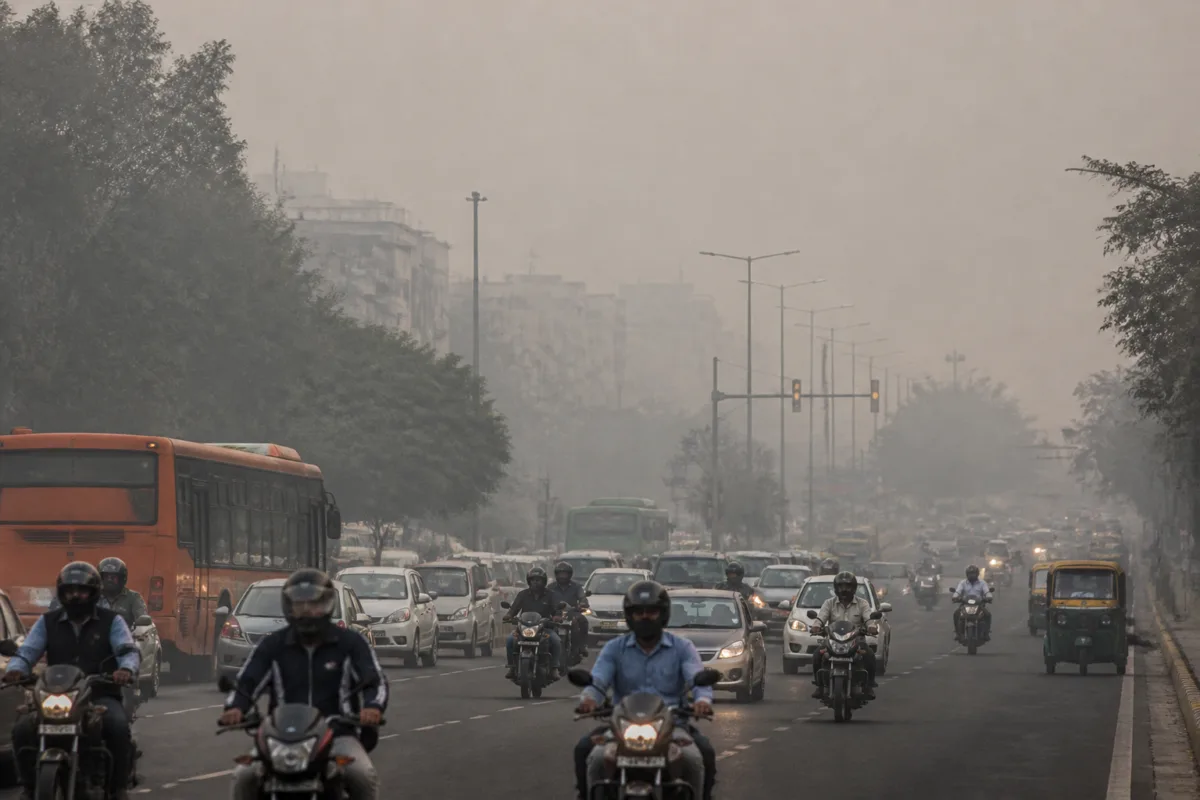
Delhi air pollution rose sharply as Dussehra fireworks, weakening atmospheric dispersion, transport emissions and farm fires combined to increase the city’s pollution burden. The capital’s AQI climbed from 179 to 244, its highest level in 100 days, while nearby Noida recorded an AQI of 281 and Gurugram 220.
The significance of the latest deterioration lies not in any single emission source. It shows how Delhi’s winter pollution season is produced by the interaction of local emissions, regional smoke and weather conditions that trap pollutants close to the ground. The city’s air becomes more vulnerable in October because the post-monsoon transition begins to reduce the atmosphere’s ability to disperse what is emitted at street level.
The rise was accompanied by severe particulate matter readings at several monitoring stations during the intervening night of October 20 and 21. PM10 reached 488 micrograms per cubic metre at Anand Vihar, with levels remaining above 450 micrograms per cubic metre through Tuesday night. At Okhla Phase 2, PM10 peaked at 469 micrograms per cubic metre at 10 pm on Tuesday, while Mandir Marg recorded 410 micrograms per cubic metre at 2 am on Wednesday.
PM2.5 levels also rose sharply. Punjabi Bagh recorded a peak of 305 micrograms per cubic metre at 11 pm on Tuesday, while Okhla Phase 2 reached 269 micrograms per cubic metre at 10 pm. The permissible standards cited in the report are 60 micrograms per cubic metre for PM2.5 and 100 micrograms per cubic metre for PM10. These station-level readings show how pollution can become particularly intense in localised urban environments even when the citywide AQI provides a single headline number.
The immediate trigger was the Dussehra period, when fireworks added a concentrated burst of particulate emissions. A 2024 study by IIT Delhi researchers found that fireworks accounted for more than 85% of the measured elemental mass in PM2.5 during Diwali celebrations between 2019 and 2021, after accounting for differences in atmospheric dispersion. Although the study relates to Diwali, it provides evidence of how festival-related fireworks can rapidly alter particulate composition and concentration in Delhi.
Fireworks alone, however, do not explain the deterioration. As winter approaches, the atmospheric boundary layer — the lowest part of the atmosphere through which pollutants mix — becomes shallower. Night-time temperature inversions can further prevent polluted air from rising and dispersing. The India Meteorological Department has stated that average wind speeds below 10 kmph are unfavourable for pollutant dispersion.
The available evidence points to a tightening atmospheric lid over the city. A 2026 study published in the journal Atmospheric Environment, involving researchers affiliated with the Physical Research Laboratory, the Space Applications Centre and the National Centre for Medium Range Weather Forecasting, found that Delhi’s boundary layer remained below one kilometre from November to January between October 2023 and February 2024. The study also associated lower boundary-layer heights with higher PM2.5 concentrations.
This meteorological shift matters because the same quantity of emissions can produce different air-quality outcomes depending on wind and atmospheric mixing. When winds are weak and the boundary layer is shallow, pollutants from traffic, industries, power generation, construction and other perennial sources remain concentrated near where people live and travel. Weather does not create these emissions, but it determines how long they remain in the urban air.
Transport remains the largest identified contributor in the latest source-apportionment estimate. The Indian Institute of Tropical Meteorology’s Decision Support System estimated that transport emissions accounted for 21% of Delhi’s PM2.5 pollution on Wednesday. Stubble burning contributed around 4% that day, but its contribution was forecast to rise to 15% by Friday.
The figures underline why Delhi’s pollution cannot be reduced to a single seasonal explanation. Farm fires can add to the city’s burden when their location, scale and timing coincide with winds moving from the northwest. But the transport estimate indicates that a substantial share of the pollution is generated within the urban region itself. Regional smoke can worsen conditions, while local emissions provide a continuing baseline.
Satellite monitoring data also shows that the regional residue-burning season was underway. The Indian Agricultural Research Institute reported 85 detected fire events across seven states and regions on October 21. Between September 15 and October 21, satellites detected 1,350 events across the northern belt: 454 in Punjab, 393 in Madhya Pradesh, 229 in Rajasthan, 190 in Uttar Pradesh, 72 in Uttarakhand, 11 in Haryana and one in Delhi.
The distribution of these fires does not by itself establish how much smoke reached Delhi. That depends on wind direction, wind speed, atmospheric mixing and the location and timing of individual fires. Sunil Dahiya, lead pollution analyst at Envirocatalysts, said winds were coming from the northwest at speeds below 4-5 kmph, allowing smoke from farm fires to reach Delhi. He also said a rise in smoke coincided with the hours of fireworks.
Dahiya described the current episode as the result of fireworks and regional sources combining with emissions from transport, power, industries and other perennial sectors within Delhi. His assessment places the latest AQI rise within a broader seasonal pattern rather than treating it as an isolated festival-related spike.
The institutional picture is correspondingly fragmented. Air-quality monitoring is supported by agencies including the India Meteorological Department, the Indian Institute of Tropical Meteorology and the Indian Agricultural Research Institute, while the sources of pollution span city transport, industry, power, construction and agricultural activity across several states. The result is a governance problem in which Delhi’s air is shaped by decisions and conditions beyond the jurisdiction of any single city authority.
The data also highlights a mismatch between how pollution is experienced and how it is communicated. A citywide AQI of 244 captures the overall deterioration, but readings at Anand Vihar, Okhla Phase 2, Mandir Marg and Punjabi Bagh show that exposure varies considerably by location and time. Night-time peaks are particularly important because they occur when weak winds and atmospheric inversions can intensify pollution close to the ground.
The emerging pattern is therefore not simply that Delhi has entered a bad-air season. It is that the city’s emissions become more damaging when the seasonal atmosphere loses its dispersive capacity. Festival fireworks can create short, sharp increases, farm fires can add regional smoke, and transport and other urban sources continue to operate. Together, these factors make the transition into winter a recurring stress test for Delhi-NCR’s air-quality governance.
The evidence supplied so far confirms the latest AQI deterioration and identifies several contributing factors, but it does not establish a permanent share for each source across the entire season. The next developments to monitor are the change in wind speeds, atmospheric boundary-layer height, the estimated contribution from farm fires and the persistence of transport and other local emissions as winter approaches.

