


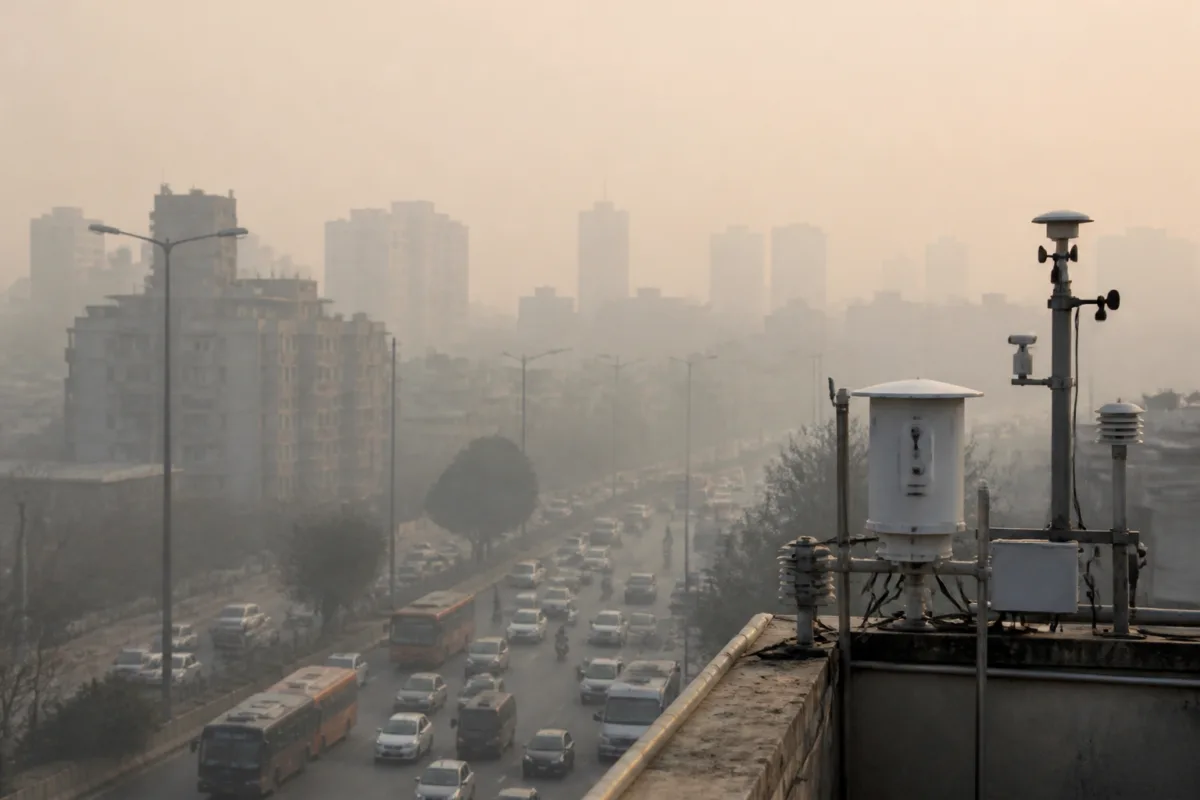
Delhi air pollution is not being driven only by visible sources such as vehicle exhaust, road dust and open burning. Preliminary analysis from a new atmospheric chemistry laboratory set up by the Indian Institute of Tropical Meteorology in New Rajendra Nagar indicates that gases already present in the air are reacting to form fine secondary aerosols, adding a less visible but significant layer to the city’s PM2.5 problem.
The finding changes the way Delhi’s pollution burden has to be understood. Direct emissions remain important, but they are not the complete explanation for the fine particles measured in the city. Some particles are emitted directly by vehicles, industries and fuel combustion. Others are created later in the atmosphere when gases undergo chemical reactions. These secondary aerosols can remain suspended for extended periods and enter the body through breathing, according to the report.
The distinction matters because the two categories of pollution require related but different control strategies. Road cleaning, dust suppression and action against visible smoke can reduce direct particulate emissions. However, controlling secondary aerosols also requires attention to the gases that act as their chemical building blocks. The preliminary analysis cited by Jagran identified volatile organic compounds, sulphur dioxide, nitrogen oxides and ammonia among the relevant substances involved in these processes.
PM2.5 refers to particles measuring 2.5 micrometres or less. The category can include dust, smoke, soot and other fine solid particles or liquid droplets. Because of their small size, these particles can travel deep into the respiratory system. The report says the IITM laboratory’s initial work is intended to examine the composition of pollutants, their sources and their potential health effects.
The initial source-apportionment figures show why the chemical dimension cannot be treated as a minor supplement to conventional pollution-control planning. Vehicles accounted for 25 per cent of Delhi’s PM2.5 pollution in the analysis. Secondary organic aerosols contributed 18.4 per cent, while secondary inorganic aerosols accounted for 16.5 per cent. Road dust contributed 10.9 per cent and waste burning 5 per cent.
Together, the two secondary aerosol categories represented 34.9 per cent in the preliminary assessment—more than the reported contribution from vehicles alone. That does not mean the figures apply uniformly across Delhi or throughout the year. The report expressly notes that the estimates are based on an initial analysis for a particular day and that pollution-source shares can change from one day to another. Even with that qualification, the numbers indicate that a substantial part of the city’s fine-particle burden may be generated through atmospheric chemistry rather than released as particles at the point of origin.
The reported contribution of secondary organic aerosols is linked to volatile organic compounds released by vehicles and industries. Secondary inorganic particles such as sulphates and nitrates can form through reactions involving sulphur dioxide, nitrogen oxides and ammonia. This means that a city may experience a large particulate load even when the original emissions are gases that are not as visually obvious as smoke or dust.
That creates an administrative challenge. Pollution management is often organised around identifiable activities: vehicle emissions, construction dust, road dust, waste burning and industrial releases. A chemically formed particle, by contrast, may not be traceable to a single location by looking at the final concentration alone. The source may be a combination of emissions from transport, industry, fuel use and other activities, followed by atmospheric reactions. The laboratory’s role is therefore not simply to measure pollution levels but to help establish what the particles contain and where their precursors may have come from.
The IITM’s Atmospheric Chemistry and Aerosol Toxicity Analysis Lab, or AATAL, has reportedly been established at a cost of about Rs 80 crore and contains 25 advanced instruments. Its stated purpose is to analyse pollutant composition, sources and possible health impacts. The laboratory’s location in New Rajendra Nagar gives Delhi a dedicated facility for studying the chemical processes that affect the city’s air, although the report describes the findings currently available as preliminary.
This distinction between preliminary analysis and a settled annual pollution profile is important. The reported percentages should not be treated as fixed shares for every season, neighbourhood or weather condition. The source material does not provide a full-year dataset, a comparison across monitoring sites or a complete breakdown of the days on which the analysis was conducted. What it does establish is that secondary aerosols have emerged as a measurable component in the initial assessment and that further monitoring is necessary to understand how their contribution changes.
Delhi’s existing response already includes several measures aimed at direct emissions. The report says the government is acting on vehicle emissions through pollution-under-control checks and is using mechanised road cleaning and water sprinkling to address dust. It also refers to measures targeting construction dust, waste and biomass burning, along with efforts to promote public transport. The Graded Response Action Plan provides additional restrictions when pollution levels rise.
These measures address important sources, but the new laboratory findings point to a wider emissions framework. The challenge is not to replace action on dust, vehicles or burning, but to connect those actions with controls on precursor gases. A reduction in PM2.5 may depend not only on whether particles are directly emitted from a vehicle or road surface, but also on whether the gases released by transport, industry and fuel combustion later combine in the atmosphere.
That has implications for how pollution-control institutions coordinate their work. Vehicle testing, industrial regulation, construction oversight, waste-management enforcement and air-quality monitoring are often handled through separate administrative channels. Chemical source analysis can connect these areas by showing how emissions from different sectors contribute to the same final pollutant. The evidence supplied in the report does not establish which agency should lead such coordination, but it shows why measuring only visible sources may provide an incomplete account of urban air pollution.
It also places greater importance on the quality and continuity of monitoring. A single day’s source-apportionment estimate cannot describe Delhi’s full pollution cycle. Different days may produce different contributions from vehicles, dust, burning and chemically formed particles. Sustained measurements are needed to determine whether the reported shares are persistent, seasonal or linked to particular pollution episodes. The report does not provide that longer time series, making the laboratory’s continuing work central to interpreting the initial findings.
The broader urban question is whether Delhi’s pollution policies are designed around what residents can see or around the full chemical system that produces exposure. Dust on roads and smoke from burning are visible and politically legible. Secondary aerosols are harder to observe because their formation takes place after emissions enter the atmosphere. Yet the initial figures cited by Jagran suggest that these less visible pollutants may account for a major share of PM2.5 on at least the day studied.
The evidence currently confirms three points. Delhi’s fine-particle pollution includes both directly emitted particles and secondary aerosols formed through chemical reactions. The preliminary IITM analysis attributes 18.4 per cent of PM2.5 to secondary organic aerosols and 16.5 per cent to secondary inorganic aerosols in the reported assessment. And the city’s pollution-control response will need increasingly detailed information about pollutant composition and precursor gases. The remaining question is how these contributions vary across seasons, locations and pollution episodes. Further analysis from the new laboratory will determine whether the initial snapshot becomes a broader basis for Delhi’s air-quality policy.

